




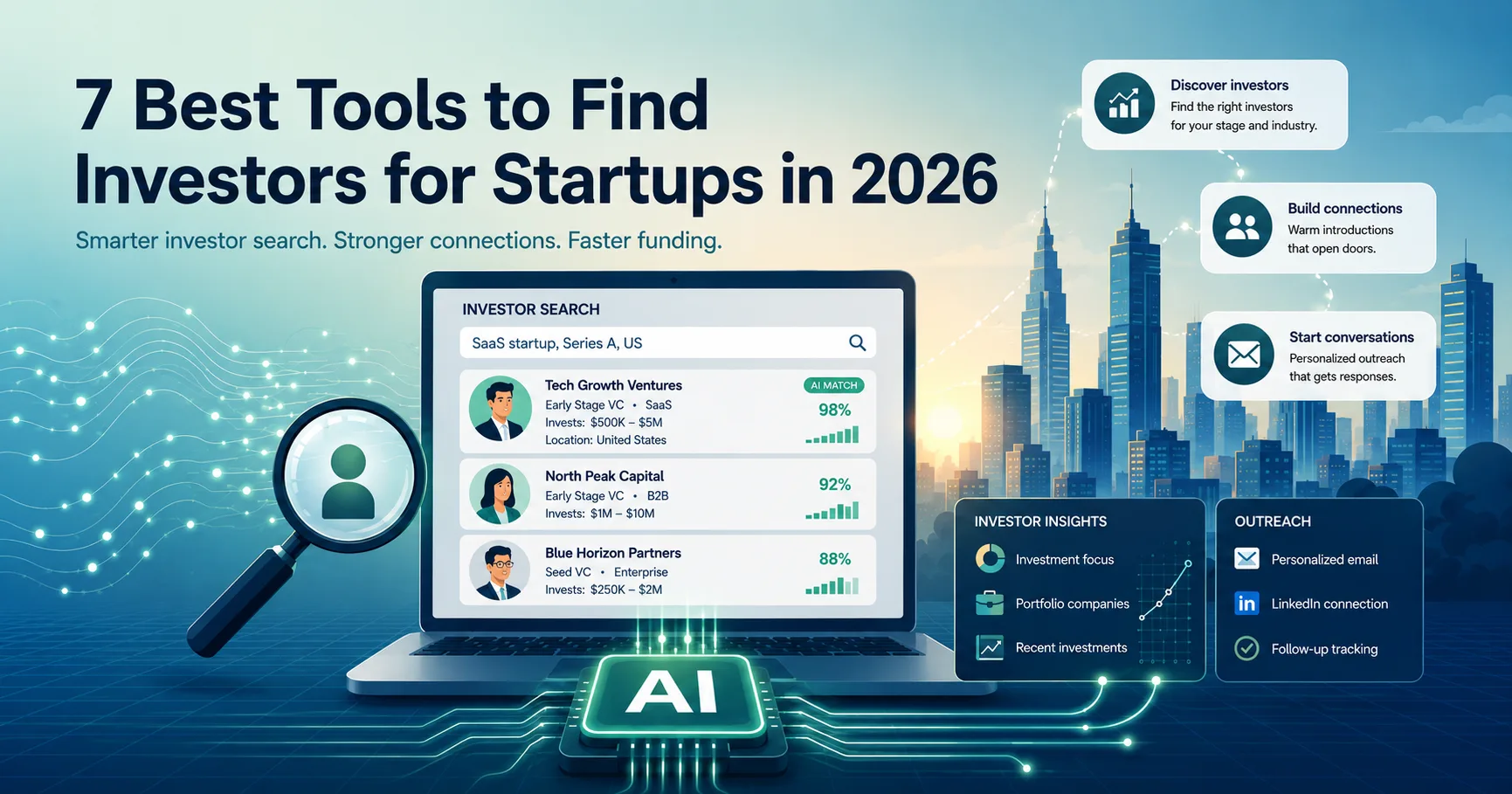
Investoren zu finden ist ein Problem der Zielgruppenansprache, nicht der Datenbankgröße. Die sieben folgenden Tools lassen sich in verschiedene Typen einteilen: ein KI-Agent für die Personensuche, den du in einfacher Sprache briefst (Lessie), Matching- und Outreach-Plattformen, die Gründer mit Investoren zusammenbringen (OpenVC, VCMatch, RoundFunded), breite Datenbanken, die du filterst (Crunchbase, PitchBook), und ein Investoren-CRM zur Verfolgung einer laufenden Finanzierungsrunde (Foundersuite). Stimme Phase, Sektor, Geografie und Checkgröße ab, bevor du eine E-Mail schreibst. Dieser Leitfaden vergleicht sie nach Suchmethode, Passgenauigkeit, Kontakten, Kontaktaufnahme und Preis – nach der Aufgabe, die du erledigen musst, nicht nach einer Rangliste.
Die 7 Tools im Vergleich (2026) – auf einen Blick
Nach Typ geordnet, nicht nach Rang. Ja / Limitiert / Nein spiegeln die öffentlich angegebene Fähigkeit wider, nicht einen Leistungstest. Die Preise sind hier zur Übersicht vereinfacht – die vollständigen Bedingungen findest du bei jedem Tool.
| Tool | Typ | Natürl. Sprache | Kontakte | Outreach | Startpreis |
|---|---|---|---|---|---|
| Lessie | KI-Personensuche | Ja | Ja | Ja | Kostenlos; ab 99 $/Monat |
| OpenVC | Matching | Nein | Limitiert | Limitiert | Kostenlos; Premium 99 $/Monat |
| VCMatch | KI-Matching | Limitiert | Limitiert | Limitiert | Kostenlos; 399 $ / 4 Mon. |
| RoundFunded | Datenbank + Outreach | Nein | Ja | Ja | Ab 99 $/Monat |
| Crunchbase | Finanzierungs-DB | Nein | Limitiert | Nein | 49 $/Monat (jährl. Abrechnung) |
| PitchBook | Institutionelle DB | Nein | Ja | Nein | Individuell |
| Foundersuite | Investoren-CRM | Nein | Limitiert | Ja | Kostenlos; ab 745 $/Jahr |
So wählst du ein Tool für die Investorensuche
Es gibt nicht das eine „beste“ Tool – es gibt das, das zu deiner aktuellen Aufgabe passt. Beginne bei deiner Situation:
- Fundraising ohne Budget (Bootstrapping): Beginne mit dem dauerhaft kostenlosen Kern von OpenVC oder dem kostenlosen Tarif von Lessie.
- Eine auf Passgenauigkeit geprüfte Shortlist plus Outreach an einem Ort: Lessie.
- Du hast ein Deck und willst auf deine These abgestimmte Investoren: VCMatch.
- Du führst eine aktive Runde und brauchst Finden + Kontaktieren + Verfolgen: RoundFunded (integrierter Outreach) oder Foundersuite als CRM für eine bereits erstellte Liste.
- Umfassende Unternehmens- und Finanzierungsrecherche: Crunchbase.
- Daten auf institutionellem Niveau wie für Fonds: PitchBook.
Prüfe dann jede engere Auswahl anhand dieser Punkte:
- Filtert es nach aktuell aktiven Investoren? Viele Verzeichnisse listen Fonds auf, die seit Jahren keinen Check mehr ausgestellt haben. „Aktiv“ ist wichtiger als „groß“.
- Kann es Phase, Sektor, Geografie und Checkgröße kombinieren? Eine Firma, die nur Foundational Models unterstützt, ist die falsche Wahl für ein Pre-Seed-Startup im Bereich Applied AI.
- Liefert es den Partner, nicht nur die Firma – und erklärt es die Übereinstimmung? Ein klares Signal für die Passgenauigkeit (These, kürzlicher Deal, Phase) plus Kontakte auf Partnerebene ist besser als eine rohe Liste.
- Unterstützt es die Kontaktaufnahme und das Follow-up, und wie aktuell sind Daten und Preise? Die Entdeckung ist nur ein Teil des Workflows – und bestätige den Preis, bevor du dich festlegst.
Offenlegung & Methodik
Lessie ist unser eigenes Produkt; wir führen es neben Alternativen auf und weisen darauf hin, wo andere eine Aufgabe besser erledigen. Die Tools sind nach Typ geordnet, nicht nach Leistung, und die Preise sind auf dem Stand von August 2026 – überprüfe sie auf der jeweiligen Anbieterseite, da sich die Preise im Venture-Bereich oft ändern.
Zur Leistungsfähigkeit: Ein unabhängiges, quelloffenes akademisches Benchmark – PeopleSearchBench (arXiv:2603.27476) – stufte Lessie als Nr. 1 unter den KI-Personensuchmaschinen ein (im Vergleich zu Exa, Claude Code und Juicebox). Dieser Nachweis bezieht sich auf die allgemeine Fähigkeit zur Personensuche, nicht auf diese spezifischen Investorendatenbanken. Quellen: arXiv:2603.27476, lessie.ai/de/benchmark.
Die 7 Tools im Detail
Lessie
Beschreibe den gewünschten Investor in einfacher SpracheVolle Transparenz: Lessie ist unser eigenes Tool. Anstatt Filter-Syntax zu lernen, beschreibst du den Investor in einfacher Sprache – „Seed-Investoren, die KI-Infrastruktur in den USA unterstützen, Checkgröße 250.000–1 Mio. $“ – und Lessie durchsucht strukturierte Datenbanken und das offene Web. Die KI-Prüfung bewertet jeden Kandidaten anhand deiner Kriterien und zeigt die unterstützenden Belege (These, kürzliche Deals, Phase), sodass du eine geprüfte Shortlist anstelle von reinen Datenzeilen erhältst. Von dort aus kannst du Kontakte freischalten und personalisierte Kontaktaufnahmen und Follow-ups im selben Workflow durchführen.
Wichtige Funktionen
- Briefings in einfacher Sprache – keine Filter-Syntax zu lernen
- Durchsucht strukturierte Datenbanken und das offene Web gemeinsam
- KI-Prüfung bewertet jeden Kandidaten anhand deiner Kriterien mit Belegen (These, kürzliche Deals, Phase)
- Verifizierte E-Mail-/Telefonkontakte freischalten
- Personalisierte Kontaktaufnahme und Follow-up im selben Workflow
Vorteile: Beschreibe einen Investor in einfachem Deutsch; eine geprüfte Shortlist mit Belegen statt roher Datenzeilen; Entdeckung → Kontakte → Kontaktaufnahme an einem Ort; kostenlos starten.
Nachteile: Nicht die größte rohe Datenbank zum Durchsuchen; für reine Recherchen auf Firmenebene ist eine günstigere Datenbank ausreichend. Aktuelle Preise findest du auf lessie.ai/de/pricing.
OpenVC
Ein kostenloses Verzeichnis, um eine Finanzierungsrunde zu startenEine wirklich kostenlose Möglichkeit, eine Finanzierungsrunde zu beginnen: Durchsuche über 16.000 Investoren (VCs, Angels, Family Offices, Accelerators), reiche dein Deck ein und verfolge das Engagement, ohne zu bezahlen – der kostenlose Plan ist dauerhaft, keine Testversion. Premium (99 $/Monat oder 299 $/Jahr) schaltet mehr Kontaktaufnahmen und einen Intro-Finder frei.
Wichtige Funktionen
- Dauerhaft kostenloser Kern: unbegrenzte Investorensuche, Deck-Sharing, CRM und Teammitglieder
- ~1 Investoren-Kontaktaufnahme/Tag im kostenlosen Plan; bis zu 5/Tag bei Premium
- Premium fügt 10 Investorenfilter und einen Intro-Finder hinzu, der dein Netzwerk scannt
- Premium enthält auch eine Fundraising-Masterclass und Vergünstigungen für Startup-Tools
Vorteile: Ein echter kostenloser Kern (dauerhaft, keine Testversion); günstiger Weg, eine Finanzierungsrunde zu starten; der Jahresplan für 299 $ ist günstiger als der monatliche.
Nachteile: Das Volumen der Kontaktaufnahmen ist begrenzt; kein automatisierter Versand oder Follow-up – du sendest und verfolgst Antworten manuell.
VCMatch
Lade ein Deck hoch, erhalte auf die These abgestimmte InvestorenLade dein Pitch-Deck hoch und VCMatch matcht dich mit Investoren anhand ihrer erklärten These, ihres Portfolios, ihrer Phase, ihres Sektors, ihrer Geografie und ihrer Checkgröße. Du erhältst für jeden Treffer einen Fit-Score mit Begründung und den Namen des zu kontaktierenden Partners.
Wichtige Funktionen
- Pitch-Deck-Upload steuert das Matching (keine Filter zu erstellen)
- Fit-Score und verständliche Begründung pro Investor
- Nennt den spezifischen Partner, nicht nur die Firma
- Gegründet 2024
Vorteile: Deck-basiertes Matching bedeutet, keine Filter-Syntax lernen zu müssen; Fit-Score + Begründung; auf Partnerebene.
Nachteile: Deck-basiert statt exakter Kriteriensuche; keine Kontaktaufnahme im großen Stil; voller Zugriff kostet 399 $ für einen 4-Monats-Pass, nicht monatlich.
RoundFunded
Finde, kontaktiere und verfolge eine Live-Runde in einem ToolKombiniert eine Datenbank mit über 60.000 aktiven Investoren mit KI-gestützter Kontaktaufnahme aus deinem eigenen Gmail, einer Pipeline und einem teilbaren Datenraum – finden, kontaktieren und verfolgen an einem Ort. Es legt den Schwerpunkt auf aktive Investoren (die kürzlich investiert haben) anstelle von veralteten Verzeichniseinträgen.
Wichtige Funktionen
- Datenbank mit über 60.000 aktiven Investoren (kürzliche Investoren werden priorisiert)
- KI-erstellte Kontaktaufnahmen, die von deinem eigenen Gmail gesendet werden
- Pipeline und teilbarer Datenraum zur Verfolgung der Runde
Vorteile: Finden, kontaktieren und verfolgen in einem Tool; Fokus auf aktive Investoren; Kontaktaufnahme aus deinem eigenen Posteingang.
Nachteile: Kein kostenloser Tarif (99 $/Monat, 3-Tage-Testversion); gefilterte Listen anstelle einer KI-geprüften Bewertung der Passgenauigkeit pro Kandidat.
Crunchbase
Umfassende Unternehmens- und FinanzierungsrechercheDer Standard für umfassende Unternehmens- und Investorenrecherche – starke Finanzierungsdaten und Filter, die abbilden, wer wen finanziert, mit etwa 2.000 Zeilen-Exporten/Monat im Pro-Tarif und CRM-Integrationen im Business-Tarif.
Wichtige Funktionen
- Umfassende Unternehmens- und Finanzierungsdatenbank mit tiefen Filtern
- ~2.000 Zeilen-Exporte/Monat im Pro-Tarif
- Business-Tarif fügt CRM-Integrationen hinzu
Vorteile: Umfassende Recherche; starke Finanzierungsdaten; niedriger Einstiegspreis.
Nachteile: Unternehmenszentriert, daher sind direkte persönliche Investorenkontakte begrenzt; der Preis von 49 $/Monat wird jährlich abgerechnet und ist ein Einführungspreis für das erste Jahr (monatlich kostet es 99 $).
PitchBook
VC/PE- und Deal-Daten auf institutionellem NiveauDie Datenbank der Enterprise-Klasse für institutionelle Investoren- und Deal-Daten – die tiefste Abdeckung in dieser Kategorie, mit Preisen für Institutionen.
Wichtige Funktionen
- VC/PE- und Deal-Daten auf institutionellem Niveau mit der tiefsten Abdeckung
- Preise nach Nutzer, Institutionstyp und Zusatzmodulen
Vorteile: Die tiefste institutionelle Abdeckung; die Referenzdatenbank für Fonds und Analysten.
Nachteile: Individuelle, angebotsbasierte Preise ohne kostengünstigen Einzelplan; überdimensioniert für einen Gründer, der nur eine Finanzierungsrunde durchführen will.
Foundersuite
Organisiere und verfolge eine aktive FinanzierungsrundeEin Investoren-CRM, das auf einer Datenbank mit 227.000 Investoren basiert – eher dafür gebaut, deinen Fundraising-Funnel zu organisieren und zu verfolgen, als um brandneue Investoren zu entdecken.
Wichtige Funktionen
- Investoren-CRM auf einer Datenbank mit 227.000 Investoren
- Massen-E-Mails plus Pipeline-Tracking für eine Live-Runde
- Bezahlte Tarife: Silver 745 $/Jahr, Gold 1.069 $/Jahr, Platinum 1.609 $/Jahr
Vorteile: Speziell entwickelt, um eine Live-Runde zu organisieren und zu verfolgen; große Investorendatenbank in den bezahlten Tarifen.
Nachteile: Eher zur Verwaltung einer Liste als zur Entdeckung neuer Investoren gedacht; wenn dein Engpass darin besteht, die richtigen Investoren zu finden, ist es weniger ideal.
Tools, die oft fälschlicherweise mit der Investorensuche verwechselt werden
AngelList wird oft als eine Möglichkeit genannt, „Investoren zu finden“, aber seit der Aufspaltung 2022 ist es eine Infrastruktur für Fonds/SPVs – SPVs, Rolling Funds und Fondsverwaltung (SPV-Einrichtung wird mit ca. 8.000 $ + ca. 2.000 $ Regulierungskosten bei einem Mindest-Raise von ca. 80.000 $ angegeben). Es ist für Investoren gedacht, die Syndikate leiten, nicht für Gründer, die Investoren entdecken und kontaktieren. Wellfound (der ausgegliederte Personalvermittlungsmarktplatz) ist ein anderes Produkt. Nützlich, aber kein Entdeckungstool für Gründer – deshalb ist es nicht unter den sieben oben genannten.
Wie du eine gezielte Investorenliste erstellst
Die Tools unterscheiden sich am stärksten darin, wie du von „wen ich will“ zu einer kontaktierbaren Shortlist kommst. Ein praktischer Ansatz: Formuliere das Ziel so, wie du es aussprechen würdest – zum Beispiel „aktive Seed-Investoren, die Applied AI in Europa unterstützen, mit typischen Checks unter 2 Mio. $, mit mindestens einer Investition in den letzten 12 Monaten“ – und lass dann einen KI-Agenten für die Personensuche eine geprüfte Liste daraus erstellen. Lessie durchsucht strukturierte Datenbanken und das offene Web, bewertet mit seiner KI-Prüfung jeden Treffer anhand dieser Kriterien mit Belegen und liefert Kontakte, die du exportieren und kontaktieren kannst. So wird das Investoren finden deutlich effizienter.
FAQ
Was ist das beste Tool, um 2026 Investoren zu finden?
Gibt es ein kostenloses Tool, um Investoren zu finden?
Crunchbase vs. PitchBook vs. Lessie – welches ist das beste Tool, um Investoren zu finden?
Wie finde ich Seed-Investoren für ein KI-Startup?
Was ist der günstigste Weg, um Investoren zu finden?
Wie erhalte ich die Kontaktdaten oder E-Mail-Adressen von Investoren?
Quellen & Aktualisierungsrichtlinie
Zuletzt überprüft im August 2026. Die Preise für Lessie, OpenVC, VCMatch, RoundFunded, Crunchbase und Foundersuite stammen von der offiziellen Preisseite des jeweiligen Anbieters (Crunchbase Pro für 49 $/Monat wird jährlich abgerechnet und ist ein Einführungspreis für das erste Jahr; monatlich kostet es 99 $/Monat). PitchBook veröffentlicht nur individuelle, angebotsbasierte Preise. Die Gebühren für AngelList SPVs sind von Drittanbietern/angebotsbasiert. PeopleSearchBench: arXiv:2603.27476 und lessie.ai/de/benchmark. Die Preise und Aktivitäten im Venture-Bereich ändern sich häufig – überprüfe sie vor einer Entscheidung auf der Seite des jeweiligen Anbieters.