




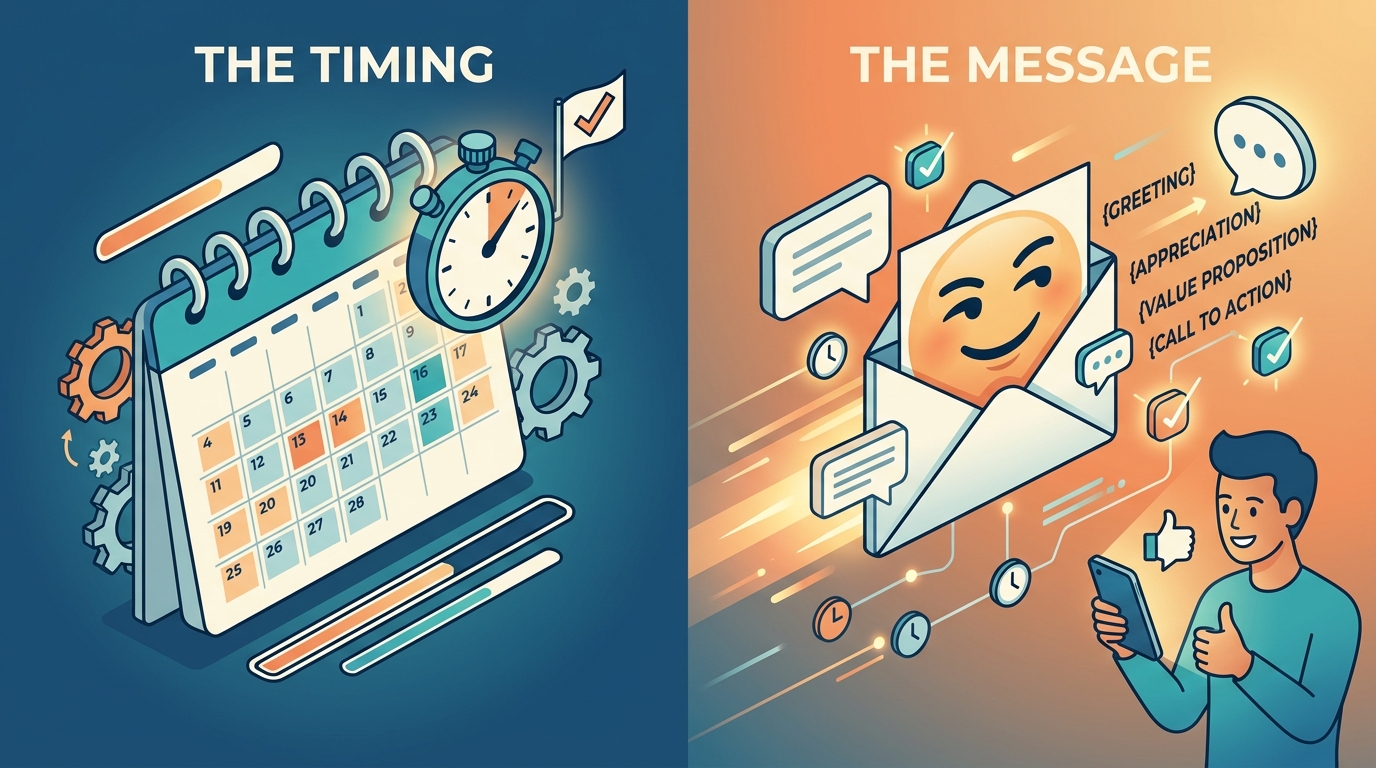
Send a follow-up email to a recruiter when you haven't heard back within the timeframe they gave you — or, if none was given, about 5–7 business days after applying or interviewing. Keep it short (under 120 words): reference the specific role, restate your fit in one line, and ask one clear question. This guide has copy-paste templates for every stage — after applying, after an interview, and when you've gone silent — plus the timing and mistakes to avoid.
The silence after applying or interviewing is the worst part of a job search. A good follow-up email to a recruiter breaks that silence without making you look desperate — it nudges your application back to the top of a busy inbox and signals genuine interest. The difference between a reply and the void is usually timing, brevity, and a clear ask.
Below are the rules for when to send, exactly what to write, and ready-to-use templates for each stage of the process. Before you send, make sure the application behind the follow-up is strong — a sharp resume summary is what the recruiter re-reads when your email lands.
When Should You Follow Up With a Recruiter?
Timing is the whole game. Answer first: follow up when the recruiter's stated timeline has passed, or after about a week of silence if no timeline was given. Too soon reads as anxious; too late and you're forgotten.
- After applying: wait 5–7 business days before a first nudge.
- After an interview: send a thank-you within 24 hours, then a status follow-up if the date they promised a decision has passed.
- After a referral or recruiter outreach: reply within 24–48 hours while interest is hot.
- General rule: one follow-up per stage, spaced about a week apart. Never daily.
How to Write a Follow-Up Email to a Recruiter
Every effective follow-up does four things in under 120 words. Answer first: be specific, be brief, add a little value, and make it easy to reply.
- Reference the specific role and date. Recruiters juggle dozens of reqs — remind them which one and when you applied or spoke.
- Restate your fit in one line. A single sentence on the most relevant strength, not a re-pitch of your whole resume.
- Ask one clear question. "Is there an update on timeline?" beats a vague "just checking in."
- Keep the tone warm and low-pressure. You're interested, not owed a response.
Follow-Up Email Templates
Copy these, swap the brackets, and keep them short. Each is written to be skimmable on a phone in five seconds.
Subject: Following up — [Role] application
Hi [Recruiter name], I applied for the [Role] position on [date] and wanted to reiterate my interest. With [X years] in [relevant skill/area], I think I could help [Company] with [specific goal/challenge]. Is there any update on the timeline for this role? Happy to share anything else that would be useful. Thanks for your time — [Your name]
Subject: Thank you — [Role] interview
Hi [Recruiter name], thank you for the conversation about the [Role] on [date]. It reinforced my excitement about [specific thing discussed]. I'm confident my experience with [relevant skill] maps well to what the team needs. Please let me know if there's anything else I can provide — I'd love to keep the process moving. Best, [Your name]
Subject: Quick check-in — [Role]
Hi [Recruiter name], I know things get busy — just wanted to check whether there's an update on the [Role] position we discussed on [date]. I'm still very interested and happy to work around your timeline. Thanks so much, [Your name]
Follow-Up Email Mistakes to Avoid
A bad follow-up does more damage than none. Answer first: avoid being pushy, generic, or error-prone.
- Following up too often. Daily "just checking in" emails are the fastest way to get filtered out.
- Being generic. A copy-paste with no role name or date signals you're mass-applying.
- Writing a wall of text. If it doesn't fit on a phone screen, it won't get read.
- Typos and wrong names. Re-read before sending; the wrong company name ends it instantly. (See alternatives to stiff sign-offs in our guide to email sign-offs.)
Make the Application Behind Your Follow-Up Stronger
A follow-up only works if what it points back to is compelling. Before you nudge, make sure your application stands on its own: a tailored resume summary that matches the role and a clean resume scored by our free ATS resume checker. And if a role doesn't work out, a gracious reply still matters — see how to respond to a rejection email after an interview.
On the hiring side of the table? Lessie is an AI recruiting tool that sources qualified candidates from 100+ data sources with verified contacts — so you reach out first instead of waiting on follow-ups. Free to start.