




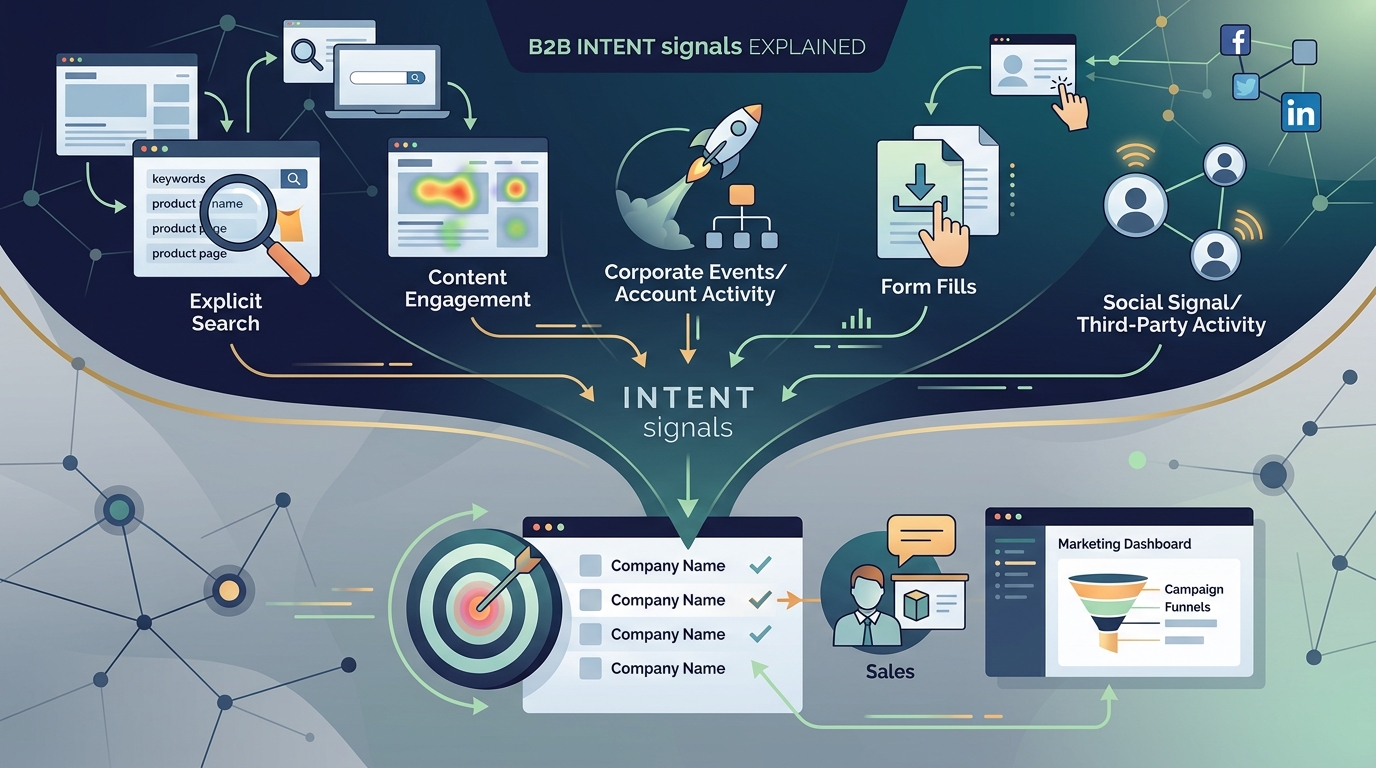
TL;DR: Intent signals are behavioral data points that reveal when a B2B account is researching a problem your product solves. They come in five flavors — first-party site behavior, anonymous visitor data, third-party topic surge, technographic changes, and hiring signals. Treat them as a real-time priority queue, not a marketing list. The teams that act inside 48 hours win the meeting; everyone else gets the rejection email.
Most B2B teams already sit on a goldmine of intent signals and ignore them. A prospect who visits your pricing page three times in a week is telling you something specific. So is a company that just posted a job opening for the exact role your tool replaces. So is an account whose researchers spiked their content consumption around “contract automation” on a third-party network last week. The problem is rarely signal scarcity — it's signal triage.
This guide breaks down what buying intent signals actually are, the five types every revenue team should know, where to source them, how to score them, and a practical workflow to turn them into booked meetings. We'll also touch how B2B lead generation changes when intent becomes the trigger instead of static account lists.
What Are B2B Intent Signals?
A B2B intent signal is any observable behavior that increases the probability an account is actively evaluating a solution. Unlike firmographic or demographic data, which tells you who someone is, intent tells you what they're doing right now. That timing layer is where pipeline gets created.
Static fit data goes stale slowly — a 500-employee SaaS company is still a 500-employee SaaS company next quarter. Intent data goes stale fast. A pricing page visit is hot for days, not months. A G2 category review surge fades in two weeks. Teams that treat intent like ICP data — batch-uploading lists once a month — extract almost none of its value.
The other distinction worth making: declared intent versus implied intent. A demo request is declared — the prospect named the product and asked for a meeting. An IP address from a target account hitting your comparison page is implied — you have to infer intent from behavior. Most pipeline sits in the implied bucket because declared intent is already saturated by every other vendor in the SERP.
Good intent programs combine both: declared signals route directly to sales; implied signals get enriched, scored, and prioritized. The five types below cover both ends of the spectrum.
One more clarification before the taxonomy: intent signals and account-based marketing (ABM) are related but not the same. ABM is the targeting strategy — a fixed list of accounts you commit resources to. Intent is the timing layer that tells you which accounts on your ABM list are warm right now, and which non-list accounts just entered your category. Most modern ABM programs use intent as the prioritization signal inside a finite account universe.
The 5 Types of Intent Signals
Intent signals split into five practical categories. Each one answers a slightly different question, and each has different latency and source costs. A mature program uses all five with weighted scoring.
Type 1: First-Party Signals. Behavior on properties you own — website visits, content downloads, demo requests, pricing page time-on-page, free trial signups, webinar attendance. This is the highest-quality intent data you'll ever access because you control the source and the identification. A pricing page revisit with a known logged-in user is gold. The catch: first-party data is also the smallest dataset — you only see the prospects who already came to you. Most active buyers in your category never hit your site in their first 60 days of research.
Type 2: Anonymous Website Visitors. The gray zone of first-party intent. Visitor de-anonymization tools (Clearbit Reveal, RB2B, Leadfeeder, etc.) match the IP addresses of unknown site visitors to company records. You learn that someone at Acme Corp read your comparison page three times this week, even if nobody filled out a form. Hit rates run 30–70% depending on traffic source and firewall coverage. Useful for account-level triggers; rarely useful for person-level outreach without enrichment.
Type 3: Third-Party Topic Intent. Networks like Bombora and G2 Buyer Intent aggregate content consumption across thousands of publisher sites. When researchers at a target account spike their reading on topics like “sales enablement” or “data lakehouse,” the network reports a surge. This catches buyers who've never been to your site. The downside: third-party signals are noisy, frequently mis-mapped to the wrong account, and only available in aggregated weekly batches at most vendors.
Type 4: Technographic Signals. A change in a company's tech stack is often a buying signal in disguise. They installed Marketo last month — they likely need a complementary enrichment tool. They removed Salesforce — they're consolidating to a competing CRM. Tools like BuiltWith and HG Insights crawl the public web and detect tech adoption events. The signal is delayed (typically 2–6 weeks behind reality) but durable: a tech stack change is a 6–12-month buying cycle, not a 48-hour one.
Type 5: Hiring Signals. New job postings tell you what a company is about to need. A “Head of RevOps” role posting means the company is about to buy or consolidate their revenue tech stack. A surge of “AI engineer” roles signals an infrastructure spend coming. Hiring data is publicly available, real-time, and one of the most underused intent sources. The catch: hiring intent has a 30–90-day lag between the posting and the buying decision — you need a long-cycle nurture, not a same-day call.
Each type has a different sweet spot in the funnel. First-party and de-anonymized visitor signals are bottom-of-funnel — the buyer is already in your category. Third-party topic intent and hiring signals are middle-of-funnel — the buyer is researching but hasn't self-identified. Technographic signals are top-of-funnel triggers that surface accounts before they've started actively looking. Layering all five gives you a complete picture; relying on one creates blind spots.
Top Sources of B2B Intent Data
Sourcing intent data is a fragmentation problem more than a technology problem. No single vendor covers all five signal types well, so most mature stacks combine 2–3 sources. Below are the vendors worth knowing in 2026.
| Vendor | Primary signal types | Best for | Pricing posture |
|---|---|---|---|
| Bombora | Third-party topic intent (surge data) | Enterprise marketing teams running ABM at scale | Enterprise contract, opaque |
| G2 Buyer Intent | Category-level review and comparison page activity | SaaS vendors competing in defined G2 categories | Add-on to G2 listing |
| 6sense | Aggregated multi-source (third-party + first-party de-anonymization) | Large RevOps teams with dedicated ABM motion | Six-figure enterprise |
| ZoomInfo Intent | Third-party topic + technographic, bundled with contact data | Teams already on ZoomInfo platform | Enterprise contract, opaque |
| BuiltWith / HG Insights | Technographic only | Adding tech stack triggers to existing workflow | Per-domain or annual |
| Clearbit Reveal / RB2B | Anonymous visitor de-anonymization | Inbound-heavy teams identifying account visitors | Self-serve |
Enterprise platforms like 6sense and ZoomInfo bundle intent into a broader ABM operating model — useful if you already have the headcount to consume that scale, expensive if you don't. For most teams under $50M ARR, the right move is to start with one focused source (hiring or technographic) plus first-party de-anonymization, and add third-party surge data only once you have a working workflow to ingest it.
A pragmatic stacking pattern most lean teams converge on: visitor de-anonymization (RB2B or Clearbit Reveal) covers your existing inbound; a hiring + tech-stack source (LinkedIn job feeds plus BuiltWith) covers outbound triggers; you skip third-party topic intent entirely until revenue justifies the contract. This stack typically costs $500–2,000/month total and covers roughly 80% of the signal value the enterprise platforms deliver at 10–20x the price.
Larger teams running formal ABM will eventually need third-party topic intent — Bombora's breadth is hard to replicate — but the sequencing matters. Adding Bombora before you've built the execution muscle to act on signals just creates a more expensive dashboard nobody opens. Earn the right to enterprise data by proving you can convert the free and self-serve sources first.
How to Score and Prioritize Intent Signals
Raw intent data is noisy. A scoring framework turns it into a queue your reps can actually work. Most failures in intent programs aren't sourcing failures — they're prioritization failures. Without a score, reps cherry-pick the easy accounts and ignore higher-value signals that take more effort to interpret.
Three dimensions matter when scoring a signal:
- Recency — A pricing page visit today is worth 10x the same visit two months ago. Decay scores weekly for site behavior, monthly for technographic.
- Velocity — Is the signal accelerating? A single G2 page view is weak. Five views in seven days across multiple stakeholders is strong. Velocity beats volume.
- Source quality — First-party (your own site) > de-anonymized visitor > hiring post > technographic > third-party topic surge. Lower-quality sources need corroboration before triggering outreach.
A working scoring rubric most teams use:
| Signal | Base points | Recency multiplier |
|---|---|---|
| Demo request (declared) | 100 | 1.0x (always hot) |
| Pricing page revisit (logged-in) | 50 | 1.0x within 7 days, 0.5x at 14 days |
| Anonymous visit to comparison page | 30 | 1.0x within 7 days, 0.3x at 14 days |
| Hiring post for buyer persona | 25 | 1.0x within 30 days, 0.5x at 60 days |
| Tech stack change (relevant tool) | 20 | 1.0x within 60 days |
| Third-party topic surge | 10 | 1.0x within 14 days |
Accounts scoring 50+ go to the SDR queue with a 48-hour SLA. Accounts at 25–49 enter a nurture sequence. Below 25 stays in marketing automation. The exact thresholds depend on your funnel size — the principle is that every signal gets a number and a destination, not a Slack message that lives until someone has time.
Compound signals beat single signals. An account with a pricing page visit is worth attention. An account with a pricing page visit and a tech stack changeand a Head of RevOps hire posted last week is a buying committee assembling in public. Most scoring rubrics under-weight stacked signals; a multiplier (1.5x for two concurrent signal types, 2x for three) corrects this and pushes the genuinely hot accounts to the top of the queue.
Equally important: negative scoring. An account that visited your site once eight months ago and never returned should decay to near zero, not sit in the queue at 30 points forever. Bake decay rules into the score, not into a separate cleanup job. Reps lose trust in scoring systems that surface stale accounts — once they stop trusting the queue, the whole program degrades.
From Signal to Outreach: A Practical Workflow
Signal sourcing without an execution workflow is data hoarding. The five-step loop below is what separates teams that book meetings off intent from teams that just have an impressive dashboard.
- Detect — Pipe every signal source into a single intent feed (a CRM object or a warehouse table). Stop checking five different vendor dashboards. If your reps need to log into Bombora to see surge data, they won't.
- Enrich — A signal at the company level is useless without a person. The account had a tech stack change — who's the buyer? Enrich with verified contacts (name, title, email, phone) before the signal ages out. Most teams lose 48 hours of intent freshness in the enrichment step alone.
- Personalize — The whole point of acting on intent is relevance. Generic “I noticed your company is growing” kills the advantage. Reference the specific signal: “I saw you just posted three Marketing Ops roles in two weeks— most teams hit a routing problem around then.”
- Send — Multi-channel sequenced outreach within 48 hours for hot signals. Email first because attribution is cleaner; LinkedIn second for backup coverage; cold call only for top-decile accounts where the signal justifies the cost.
- Measure — Track reply rate, meeting rate, and pipeline rate by signal type. Within 60 days you'll see which signal types convert and which were noise. Most teams find one or two signal types drive 70% of the pipeline lift —double down on those, drop the rest.
The whole loop should run in hours, not days. If detection-to-send takes more than 48 hours for a hot signal, your competitor with a faster loop wins the meeting. The signal was just early notification — the execution is the moat. See our companion guide on intent-based marketing for a deeper look at the strategic side of this workflow.
A common failure mode worth flagging: too many signals, no priority. Teams spin up intent programs, plug in three data sources, and within a month their reps are drowning in a queue of 800 “interesting” accounts. The intent program becomes noise instead of signal. The fix is brutal triage: only the top 10–15% of scored accounts per week ever reach a rep. Everything else stays in the marketing nurture or ages out. Discipline at the top of the funnel keeps the bottom of the funnel productive.
Another pattern: route by signal type, not by score alone. A demo request goes to AE same-day; a hiring signal goes to SDR with a multi-touch sequence; a third-party topic surge goes to marketing for a content-led nurture. Same scoring rubric, different execution motion. Sending a hiring-signal account to an AE for a same-day call wastes the AE's time — the buyer isn't ready for that conversation yet.
Where Lessie Fits: The Activation Layer
Intent platforms like Bombora, 6sense, and ZoomInfo are the data layer — they tell you which accounts are warming up. They're not where Lessie plays. Lessie sits one step downstream, in the activation layer: once a signal fires, someone still has to find the right person at that account and reach them before the window closes. That's the step most teams lose 48 hours in.
Concretely: take an account flagged by your intent tool, drop it into Lessie's B2B lead generation workflow, and get verified contacts for the relevant decision-makers in one query. Lessie isn't the intent source — it's how you turn the source into outreach the same day.
The broader pattern: pick one or two high-quality signal types, score them ruthlessly, act inside 48 hours, and measure conversion by signal type within 60 days. Intent isn't a magic data source — it's a triage system. The teams that treat it like one win the deals everyone else sees too late.
Once a signal fires, you still need a fast way to reach the right person. Lessie pulls verified contacts for flagged accounts so the 48-hour window stays open.