




Finding the right people is a foundational task across research, hiring, investing, and business development. Despite the rapid growth of professional networks, AI-powered tools, and search platforms, people search remains inefficient and difficult to scale. The problem is not a lack of information, but a lack of systems designed to support discovery as a process.
In practice, most people search workflows are fragmented. Teams move between search engines to look up individual profiles, professional networks to browse connections, spreadsheets to track progress, and separate tools to manage outreach. Each system solves a narrow task, but none of them work together as a whole. As a result, people search becomes manual, slow, and fragile—especially when the question itself is still evolving.
At its core, people search is not a simple retrieval problem. It is an exploratory one. Solving it requires more than better ranking or larger databases. It requires an agentic search engine.
Why People Search Cannot Be Solved by Traditional Search Engines
Traditional search engines are built around static queries and static results. They assume that users know exactly what they are looking for and that relevance can be determined at the moment a query is issued. This model works well for documents and web pages, but it breaks down when applied to people.
People search rarely starts with a fully formed question. More often, it begins with a vague intent—an interest in a domain, a type of background, or a set of adjacent problems. As exploration unfolds, users learn more about the space, refine their criteria, and change their priorities. Relevance shifts over time.
Because traditional search engines treat each query in isolation, they cannot adapt to this kind of evolution. They retrieve results, but they do not understand goals, preserve context, or guide users through uncertainty. Without agency, they are fundamentally mismatched to the way people discovery actually works.
What Is an Agentic Search Engine?
An agentic search engine treats search as an ongoing, goal-driven process rather than a single interaction. Instead of responding passively to queries, it actively supports exploration by maintaining context, interpreting intent, and adapting as new information emerges.
In people search, this distinction matters deeply. Discovering relevant individuals is closer to research than to lookup. It involves forming hypotheses, recognizing patterns, and comparing candidates across multiple dimensions. An agentic search engine is designed to support this mode of thinking, allowing users to move fluidly from vague questions to structured understanding.
Agency, in this sense, is not about automation for its own sake. It is about building systems that can reason alongside users as they navigate complexity.
From Individuals to Networks in People Discovery
People discovery often begins with a single known individual—a researcher, founder, or influencer whose work serves as an entry point into a broader space. But the goal is rarely to understand that person in isolation. The real objective is to uncover the surrounding network: others working on related problems, adjacent domains, or complementary approaches.
An agentic search engine recognizes this shift. It treats individuals as gateways rather than endpoints, enabling users to expand outward and map the structure of a field. This network-oriented view is essential for understanding relevance in complex ecosystems and for moving from curiosity to connection.
Introducing Lessie: An Agentic Search Engine for People Discovery
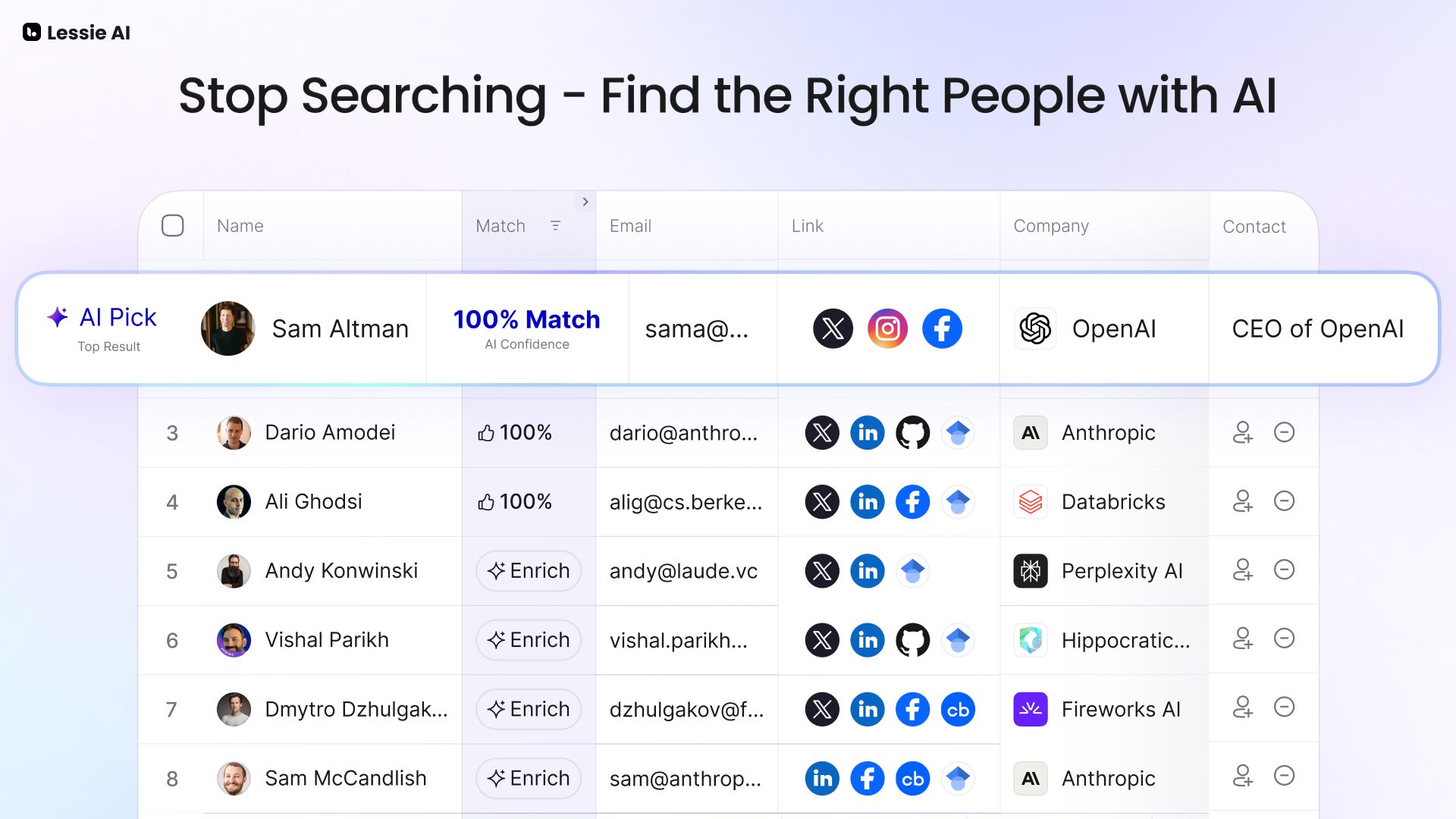
Lessie is an agentic search engine built specifically for people search and discovery. It is designed to support the way people actually explore, learn, and make decisions when finding relevant individuals.
Rather than forcing users to rely on rigid filters or perfectly formed queries, Lessie allows them to express intent in natural language and refine their understanding as they go. The system supports exploration, helps structure emerging insights, and bridges the gap between discovery and action.
Lessie does not treat people search as a static task. It treats it as an evolving workflow—one that benefits from agency, context, and continuity.
As technology ecosystems grow more complex, identifying the right people becomes both more difficult and more important. Teams need ways to map emerging fields, surface expertise, and build meaningful professional relationships without relying on brittle, manual processes.
We built Lessie because people search demands systems that can operate under ambiguity. Effective discovery should feel exploratory rather than transactional. It should help users evaluate relevance, not just consume information, and it should naturally lead from insight to action. An agentic search engine makes this possible by treating people search as a system rather than a series of disconnected steps.
Exploring with An Agentic Search Engine——Lessie AI
Exploring with an agentic search engine begins with intent. Instead of trying to frame a perfect query, users start by describing what they are trying to understand—whether that is a research space, a hiring goal, or a network they want to explore.
From there, discovery unfolds iteratively. As relevant people and patterns emerge, intent becomes clearer. Focus may narrow or expand, but context is preserved throughout. Rather than resetting search at every step, the system adapts as understanding evolves.
An agentic search engine is most useful when viewed through networks rather than individual results. The goal is not to find a single “answer,” but to understand how people relate, where expertise clusters, and which connections matter most.
The video below walks through this process in practice, showing how an open-ended question turns into a structured network and, eventually, meaningful outreach. Start with curiosity. Let structure emerge. Move from questions to networks, and from networks to real conversations.