




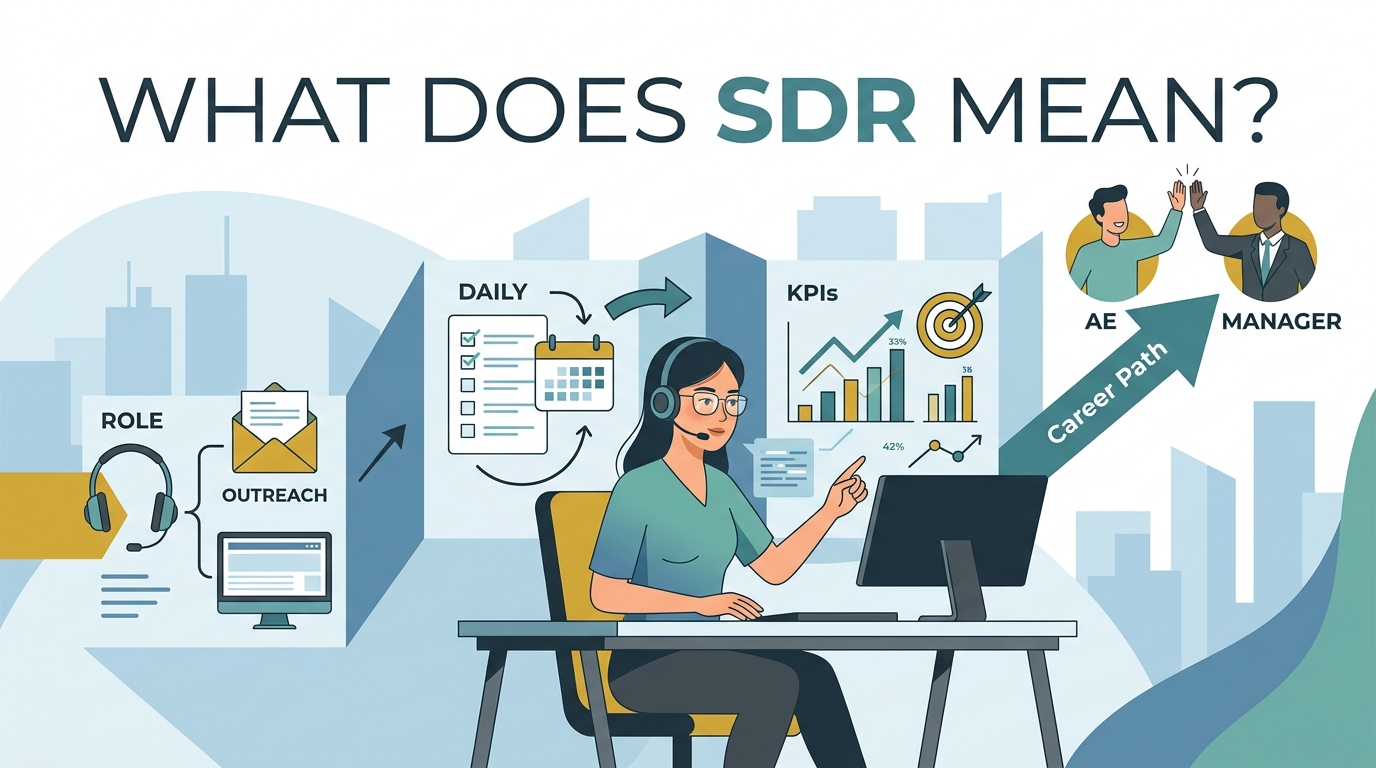
TL;DR: The sdr meaning sales teams use is Sales Development Representative—an early-career outbound seller whose job is qualifying leads and booking meetings for Account Executives, not closing deals. SDRs run cold email, cold calls, and LinkedIn touches against a target list, hit weekly activity and meeting quotas, and typically promote into AE roles within 12–24 months. US base salaries sit around $50K–$60K with $20K–$30K variable on top.
If you have heard the title thrown around in pipeline meetings or seen it on a job board and wondered what does SDR mean in sales, you are not alone. Sales Development is one of the fastest-growing functions in B2B, but the role definition still varies wildly between startups, mid-market companies, and enterprise teams. This guide walks through the precise SDR sales meaning, how the role differs from BDRs and AEs, what a typical day looks like, the KPIs leaders actually track, the tools SDRs use in 2026, and the realistic career path from a first SDR seat to senior sales leadership.
SDR Meaning: Sales Development Representative Explained
An SDR, or Sales Development Representative, is a B2B salesperson responsible for the top of the funnel: generating qualified pipeline through outbound prospecting. They identify target accounts, research contacts, run outbound sequences (email, phone, LinkedIn), and hand off interested prospects to closers. They do not negotiate contracts, run product demos end-to-end, or own revenue numbers directly—that is the AE's job.
The phrase "Sales Development" was popularized by Aaron Ross in Predictable Revenue based on the model he built at Salesforce. The core idea: splitting prospecting from closing lets each role specialize and scale. Today almost every venture-backed B2B SaaS company runs some version of this model, which is why "SDR" shows up in thousands of LinkedIn job posts at any given time.
A clean working definition: an SDR is the person who turns a name on a list into a calendar invite for an Account Executive. Everything else—list building, multi-touch sequences, objection handling on cold calls, CRM hygiene—is in service of that single outcome. Teams that blur this boundary (asking SDRs to also run demos, manage renewals, or close SMB deals) usually see both prospecting and closing volumes drop.
SDR vs BDR vs AE: How the Roles Differ
A quick answer up front: SDRs and BDRs are nearly identical in most companies—both prospect to book meetings—and AEs close those meetings into revenue. The split between SDR and BDR usually depends on the source of leads, not the activity itself.
| Role | Primary Goal | Lead Source | Owns Revenue? |
|---|---|---|---|
| SDR (Sales Development Rep) | Qualify and book meetings | Inbound leads (form fills, demo requests) | No—meetings booked / SQLs |
| BDR (Business Development Rep) | Qualify and book meetings | Outbound to cold accounts | No—meetings booked / SQLs |
| AE (Account Executive) | Close deals end-to-end | Meetings from SDR/BDR + own pipeline | Yes—quota in $ARR |
Companies use these labels inconsistently. Some call all reps SDRs regardless of lead source; others split SDR (inbound) and BDR (outbound); a few use BDR for senior outbound specialists and SDR for entry-level. When evaluating a job, look at the actual day-to-day activities, the quota structure, and the promotion path—not the title on the offer letter.
The relationship between SDR and AE is symbiotic: SDRs need AEs who actually run the handed-off meetings well (so the SDR's qualification work pays off), and AEs need SDRs who book meetings with real buyers (not anyone willing to take a call). High-functioning teams meet weekly to calibrate what a "qualified" meeting actually looks like, which protects pipeline quality on both sides.
A Day in the Life of an SDR
A working SDR day is structured around energy and prospect availability. Most reps front-load cold calls when decision-makers are at their desks and reserve email and LinkedIn work for lower-energy windows. The shape below is typical for a US-based outbound SDR carrying a weekly quota of meetings booked.
8:30–9:30 AM—Prep and prospecting. Open CRM, review yesterday's sequence replies, clear notifications, and pull a fresh list of accounts to work for the day. Many teams pre-build target account lists in their prospecting tool the night before so reps can hit the phones immediately the next morning.
9:30–11:30 AM—Cold call block 1. The first call block of the day. Goal is 30–50 dials, 5–10 connects, ideally 1–2 booked meetings. SDRs work from a script for the first ten seconds and improvise the rest based on the prospect's reaction.
11:30 AM–1:00 PM—Email and LinkedIn sequences. Send personalized emails to high-priority accounts, respond to inbound replies, and run LinkedIn connection requests and InMails on identified buyers. Templates do most of the heavy lifting; the SDR adds 1–2 lines of personalization per touch.
1:00–3:00 PM—Cold call block 2. Second call block targeting the West Coast or post-lunch East Coast prospects. Often higher connect rates than the morning. SDRs aim for another 30+ dials here.
3:00–5:00 PM—Follow-ups, research, list building. Confirm booked meetings, send calendar invites, write follow-up notes in CRM, and research tomorrow's target accounts. Some SDRs use this window for skill development—reviewing call recordings or shadowing AE demos.
Expect 60–100 outbound activities per day in a high-performing seat. That cadence is only sustainable when list quality is high; bad data turns cold call blocks into directory-validation work, which is the single fastest way to burn out an SDR.
Top SDR KPIs and How They Are Measured
SDR performance is measured on two layers: activities (inputs reps control directly) and outcomes (the results those activities produce). Strong managers track both, because activity without outcome signals a targeting or messaging problem, while outcome without activity is usually unrepeatable luck.
Activity metrics (daily / weekly).
- Dials—Total outbound calls placed. Benchmark: 40–80 per day depending on dialer technology.
- Connects—Calls where the SDR actually reaches a human (not a gatekeeper). Connect rate typically 5–15%.
- Emails sent—Personalized 1:1 emails plus automated sequence steps. Benchmark: 40–80 per day.
- LinkedIn touches—Connection requests, InMails, comments on prospect posts. 10–30 per day is normal.
Outcome metrics (weekly / monthly).
- Meetings booked—The primary scoreboard. Quotas typically run 8–15 booked meetings per month.
- Meetings held—Booked meetings that the prospect actually shows up to. Show rates of 60–75% are healthy.
- SQLs (Sales Qualified Leads)—Meetings that AE accepts as genuinely qualified. This is the metric tied to most SDR commission plans.
- Pipeline created ($)—The dollar value of opportunities generated from SDR-sourced meetings. The leading indicator of SDR-AE handoff quality.
Reply rate and meeting conversion rate are useful diagnostic metrics, not scorecards. A 1% reply rate with great list quality can outperform a 5% reply rate against the wrong audience—which is why upstream B2B lead generation quality matters more for sustainable SDR performance than sheer activity volume.
SDR Tools and Tech Stack in 2026
The modern SDR works from a stack of five tool categories. Most companies consolidate where possible—each additional tool adds tab-switching and CRM sync friction.
1. CRM. Salesforce, HubSpot, or Pipedrive. The system of record for every account, contact, activity, and meeting. SDRs live in their CRM views—rep activity is only as good as the data that gets logged there.
2. Prospecting and data tool. Where SDRs find target accounts and verified contact data. Established options include ZoomInfo, Apollo, and Cognism; a newer wave of AI-powered tools (e.g. Lessie, Clay, Common Room) scores prospect lists against an ICP definition rather than just exporting raw filters. Either way, list quality is what determines whether the rest of the SDR day is conversations or directory-validation.
3. Email finder and verifier. Cold email only works with deliverable addresses. Hunter, Apollo, and NeverBounce are the common picks; most prospecting tools also bundle verification, so SDRs rarely need a standalone product unless they buy lists externally.
4. Sequencer and email tool. Outreach, Salesloft, Apollo, or Instantly for running multi-touch outbound sequences. Most modern sequencers ship with AI drafting features for personalized opening lines, so reps can scale touches without losing variation.
5. Dialer. Aircall, Orum, or ConnectAndSell. Power dialers and parallel dialers can lift connect rates 3–5x compared to manual dialing—critical for outbound-heavy SDR motions.
6. Analytics and call coaching. Gong or Chorus to review call recordings and sequence performance. SDR managers spend 30–60 minutes per rep per week reviewing recorded calls and coaching on specific objection moments.
For SDRs running outbound at scale, AI-powered prospecting typically cuts research and list-building time by 60–80%—freeing 1–2 hours a day for actual conversations.
SDR Career Path: From SDR to AE and Beyond
Most people do not stay in the SDR seat forever. The role is explicitly designed as an entry point into B2B sales, and high performers usually promote within 12–24 months. The most common path looks like this.
- SDR I (0–12 months)—Entry-level seat. Focus on activities, learning product, mastering call openers. US base around $50K–$55K with $15K–$20K OTE variable.
- SDR II / Senior SDR (12–24 months)—Higher quota, more autonomy on target accounts, sometimes peer coaching. Base $55K–$65K with $20K–$30K variable.
- Account Executive (after 18–30 months)—The classic next step. Owns full sales cycle, carries a revenue quota. US OTE $120K–$180K depending on segment. According to the US Bureau of Labor Statistics, the median annual wage for sales representatives was around $66,000 in recent years, with top earners well above $130,000.
- Senior AE / Strategic AE—Larger deals, named accounts, longer cycles. OTE $200K–$350K.
- Sales Management—SDR Manager, AE Manager, Director of Sales, VP Sales. Compensation scales with team size and company stage.
Alternative paths from the SDR seat: into Customer Success (using the same prospect-empathy muscles for retention), into Sales Operations or RevOps (using the CRM and analytics instincts), or into Marketing roles like Demand Gen and Content (using the messaging and ICP knowledge). The fastest way to accelerate a promotion is consistently sourcing pipeline that actually closes—so investing in B2B lead generation skills and prospecting tools pays off well beyond the SDR seat itself.
The SDR role is hard—rejection is constant, quotas are real, and the day-to-day is high volume. But for someone willing to build the skill, two years as an SDR is one of the fastest ways into a six-figure B2B sales career.