




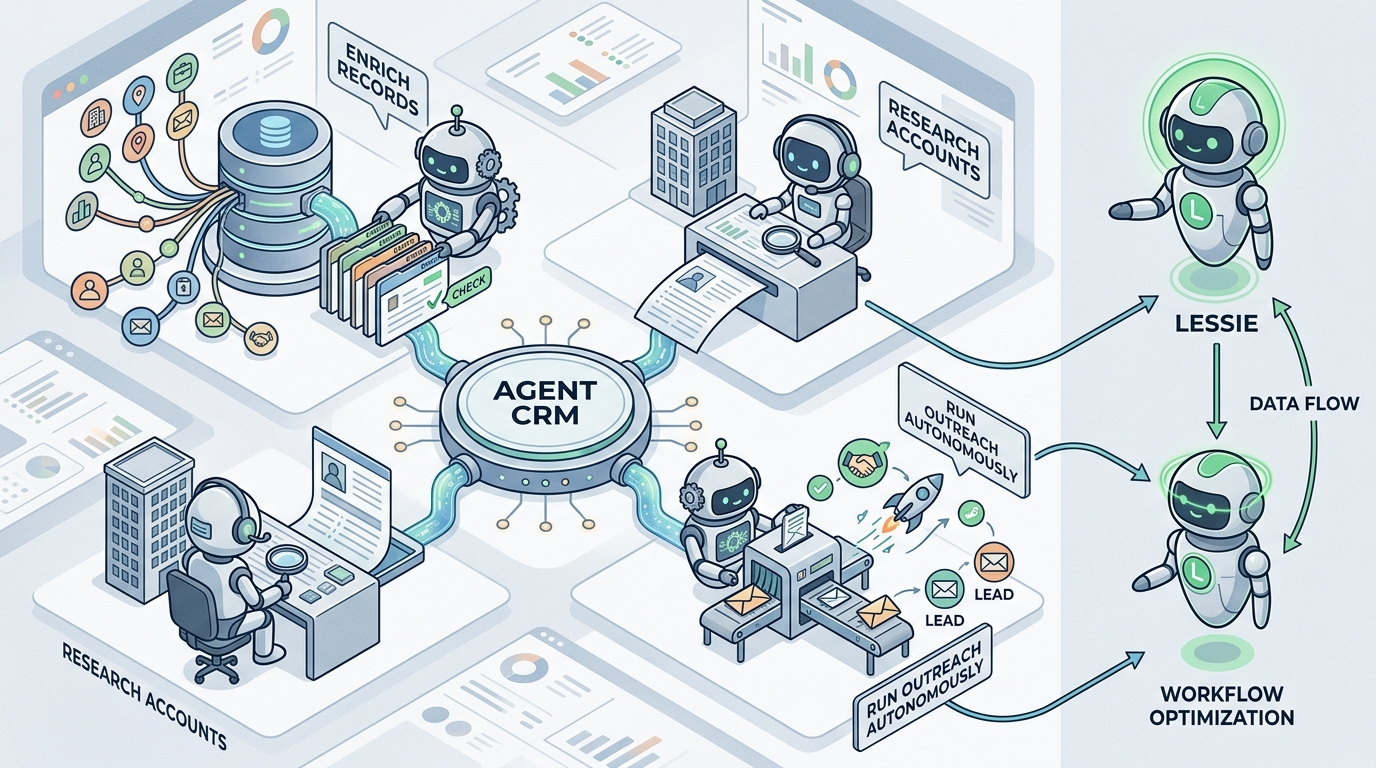
TL;DR: An agent CRM is a customer relationship management setup where AI agents work inside the CRM — enriching records, researching accounts, and running outreach on their own instead of waiting for a rep to click. The agents read your pipeline, fill missing fields, draft the next email, and log the result. It is less a new product category and more a new layer on top of the CRM you already run. The upside is fewer manual hours and cleaner data; the limit is that agents still need verified source data and human judgment on the conversations that close.
For twenty years, a CRM was a filing cabinet with a search box. You typed in what you knew, the system remembered it, and every update — a new phone number, a job change, a follow-up email — was a human keystroke. The database never did anything on its own. That model is now changing fast, and the phrase people reach for is the agent CRM.
The idea is simple to state and harder to build: put AI agents inside the CRM so the system works your pipeline instead of just storing it. An agent notices a lead with a blank company field and fills it. Another one researches an account before a call and drops a summary in the notes. A third drafts a personalized first-touch email and queues it for approval. The rep stops being a data-entry clerk and starts being an editor. This is the same shift powering the modern AI sales assistant, applied to the one system every revenue team already lives in.
This guide breaks down what an agent CRM actually is, how AI agents plug into real CRM workflows, the concrete benefits and the honest limitations, and where a dedicated AI people-search agent fits alongside — not inside — your CRM of record.
What Is an Agent CRM?
An agent CRM is a CRM in which one or more AI agents can take actions autonomously —reading records, calling tools, and updating the system — rather than only responding to a human clicking buttons. The defining word is autonomous: the agent decides what to do next inside a defined scope, then does it and reports back, instead of surfacing a suggestion and waiting.
That separates an agent CRM from two things it is often confused with. It is not the same as CRM automation — the rules and workflows (if lead score > 80, assign to rep) that have existed for years — because those follow fixed if-then logic and cannot reason about a messy, half-filled record. And it is not just a chatbot bolted onto a sidebar, because a chatbot answers questions while an agent completes tasks. The agent CRM sits between and beyond both: reasoning like an assistant, but with the permission to change the database.
In practice, “agent CRM” describes a spectrum, not a single feature. On the light end, a single enrichment agent fills missing fields. In the middle, agents research accounts and draft outreach for a human to approve. On the far end, an agentic workflow runs sourcing, enrichment, and first-touch outreach end to end, escalating to a person only when a prospect replies. Most teams live in the middle today, and that is the sensible place to start.
How AI Agents Plug Into CRM Workflows
AI agents plug into CRM workflows through three connection points: they read the record as context, call external tools to gather or verify data, and write the result back as structured fields or notes. Everything an agent CRM does reduces to some combination of read, act, and write against the objects — contacts, accounts, opportunities — you already track.
Because the agent operates on the same objects a rep does, it can slot into the exact points where humans currently lose time. Instead of a rep tabbing out to a data tool, pasting a result, and tabbing back, the agent does that loop inside the record. That is why the strongest early use cases mirror the busywork of manual AI for sales prospecting: the parts of the job that are structured, repetitive, and easy to verify.
The three workflows where agents attach most cleanly:
- Record enrichment. An agent scans a new or stale contact, identifies the missing fields — title, company, email, LinkedIn, location — and fills them from external sources, flagging anything it cannot verify rather than guessing.
- Account research. Before a meeting, an agent assembles a briefing: recent funding, headcount changes, product launches, and the likely decision-makers, written into the account notes so the rep walks in prepared.
- Outreach drafting and follow-up. An agent writes a first-touch message grounded in that research, schedules the follow-up cadence, and logs replies back to the timeline so nothing falls through the cracks.
None of these ask the agent to invent judgment. They ask it to gather, structure, and draft— then hand the record back cleaner than it found it. That framing is what keeps an agent CRM useful rather than risky.
An agent is only as good as the data it reads. Lessie searches 100+ live sources on every query and verifies emails at search time, so the records your CRM agents enrich and act on are accurate right now — not cached from months ago.
What AI Agents Actually Do Inside a CRM
Inside a CRM, AI agents do the structured, repetitive work that sits between records and revenue: they enrich, research, draft, and log. The table below maps the most common agent jobs to the manual task they replace and the human role that remains, so you can see exactly where automation ends and judgment begins.
| Agent job | What it replaces | What the human still owns |
|---|---|---|
| Autonomous record enrichment | Manual field-filling and copy-paste from data tools | Deciding which fields matter for scoring |
| Account and prospect research | Pre-call Googling and note-taking | Reading intent and shaping the pitch |
| Data hygiene and deduplication | Quarterly list cleanups and merge work | Setting the rules for what “duplicate” means |
| First-touch outreach drafting | Writing cold emails from a blank page | Approving tone and handling live replies |
| Follow-up and timeline logging | Manual cadence tracking and activity notes | Judging when to change strategy |
Autonomous enrichment is the workhorse. A single job change silently breaks a record — the email bounces, the title is wrong, the account is now a different company. An enrichment agent catches that drift continuously instead of waiting for a rep to notice a bounce. Done well, it turns a decaying database into a self-healing one.
Research and drafting compound on top of clean data. Once records are trusted, an agent can build a real account briefing and write outreach that references a specific signal— a recent raise, a new hire, a product launch — rather than a merge field. This is the same engine behind automated prospecting, now running from inside the CRM where the rep already works.
The Benefits of an Agent CRM
The core benefit of an agent CRM is returned time: reps stop doing the low-value list-work that eats a third of the sales day and spend those hours on conversations. But the gains go beyond raw hours, and it helps to name them precisely.
- Cleaner data by default. Continuous enrichment keeps records fresh instead of letting them rot between quarterly cleanups, which directly lowers bounce rates and protects sender reputation.
- Faster speed-to-lead. An agent enriches and routes an inbound lead in seconds, so a rep can reach a hand-raiser while intent is still hot rather than an hour later.
- Consistent research quality. Every account gets the same thorough briefing, not just the ones a rep had time for, which levels up the whole team instead of only the top performers.
- More reps-per-manager leverage. When the busywork is automated, a smaller team covers the same pipeline — the same logic that makes an AI BDR attractive for outbound-heavy orgs.
- Better forecasting inputs. Reliable, enriched records mean the numbers rolling up to your pipeline reports actually reflect reality, so leadership decisions rest on firmer ground.
Notice that every benefit traces back to one thing: the quality and freshness of the data the agents operate on. An agent CRM built on a stale database just automates the propagation of bad records faster. Get the data right and the rest follows.
The Limitations and Risks of an Agent CRM
The main limitation of an agent CRM is trust: an agent that acts autonomously can also be confidently wrong at scale, so the risks are about data quality, oversight, and boundaries rather than the technology itself. Naming them up front is how you deploy agents without regretting it later.
- Garbage in, garbage out — faster. If the source data an agent pulls from is a months-old cache, the agent enriches your CRM with confidently stale fields. Verified, real-time data is the non-negotiable input.
- Autonomy needs guardrails. An agent allowed to send email without approval can burn a domain in a day. Start with draft-and-approve, and only widen autonomy on the steps you have watched work.
- Compliance does not automate itself. Data-handling rules like GDPR and CAN-SPAM still apply to what an agent collects and sends. The agent follows the boundaries you set; it does not invent lawful ones.
- Hallucinated fields are worse than blank ones. A missing title is honest; a wrong-but-plausible title corrupts scoring and routing. A good agent flags uncertainty instead of filling a gap with a guess.
- It does not replace the human close. Agents remove grunt work, not relationships. Objection-handling, reading intent, and building trust stay firmly human.
The practical takeaway: an agent CRM rewards teams that pair it with a strong verified-data source and a staged rollout, and punishes teams that point loosely governed agents at a dirty database and hope. The difference between those two outcomes is almost entirely upstream data quality.
How Lessie’s People-Search Agent Complements Your CRM
Lessie is not a CRM, and it does not try to be. It is an AI people-search agent that solves the one problem an agent CRM cannot solve on its own: finding and verifying the right people in the first place. Your CRM is the system of record; Lessie feeds it with accurate, real-time contacts so the agents inside it have clean data to act on.
The distinction matters. Most agent-CRM features enrich from whatever database they are wired to, and if that database is a static cache, the enrichment inherits its staleness. Lessie works differently. Instead of querying one frozen dataset, it runs an agentic search across 100+ live sources on every query — LinkedIn, company sites, funding data, GitHub, podcasts, news— and verifies each email at the moment of search rather than serving a months-old record. That is the upstream layer of B2B lead generation that keeps everything downstream honest.
In a real workflow, the two fit together cleanly. Tell Lessie who you are looking for in plain language, get back verified decision-makers with checked emails, and push them into your CRM. From there, your CRM agents take over — enriching, researching, and drafting against records that were accurate the moment they landed. Lessie handles discovery and verification; the agent CRM handles orchestration and follow-through. Neither steps on the other.
For outbound-heavy teams, Lessie can also draft the first-touch message from the real signals in each prospect’s public footprint, which is why teams see roughly 3x reply rates versus templated sequences — the personalization is drawn from context, not merge fields. The point is never to replace your reps or your CRM. It is to make sure the records flowing into your agent CRM are the cleanest input in the entire stack.
The fastest way to make an agent CRM worth it is to fix the data feeding it. Lessie searches 100+ live sources and verifies contacts at search time, so your CRM agents enrich, research, and reach out on records that are accurate right now. Start free, no credit card required.
The agent CRM is a real shift, not a rebrand. When AI agents can read your pipeline and act on it, the CRM stops being a filing cabinet and starts being a coworker. But that coworker is only as good as the data it reads — so the winning move in 2026 is to pair agents inside your CRM with a verified, real-time source feeding it from outside. Get both right and your team spends its hours where humans still win: in the conversation.