




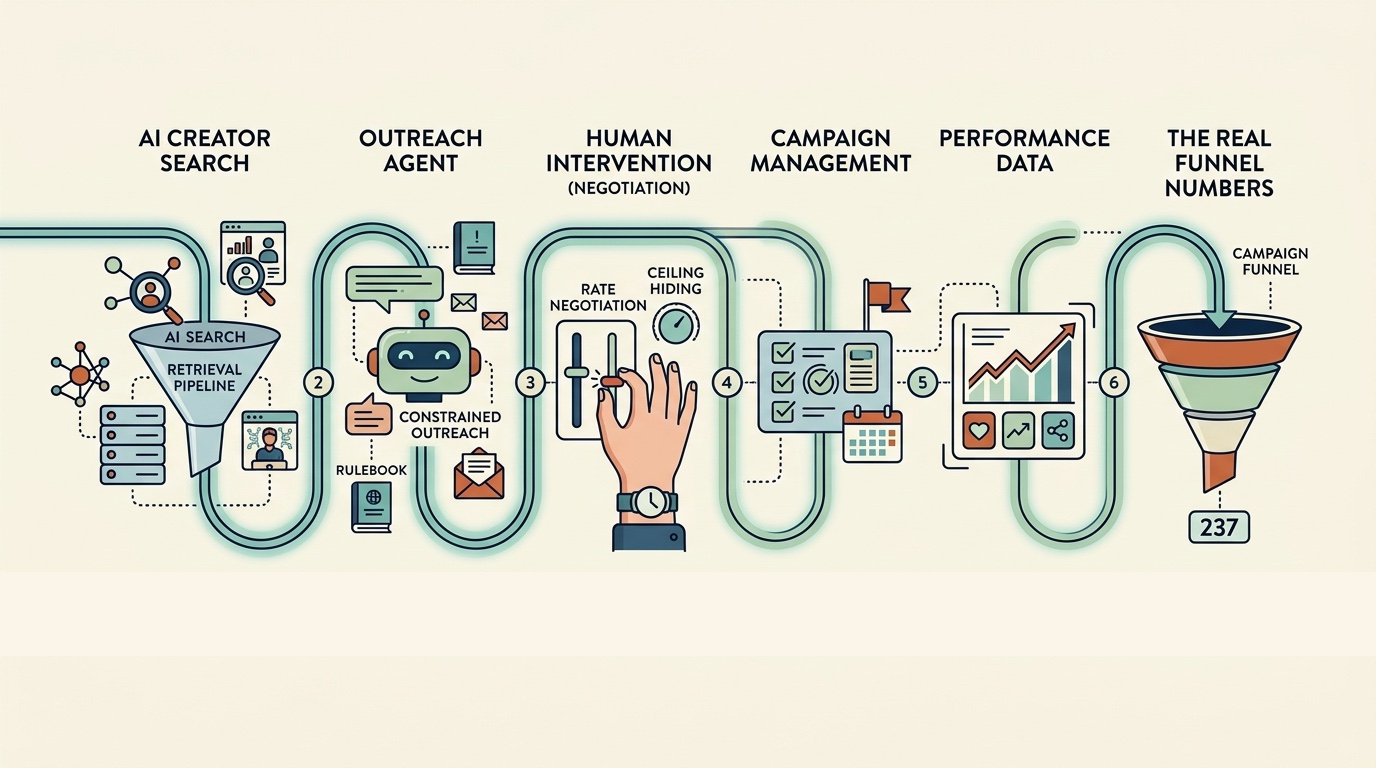
hiCreator is an AI influencer marketing platform that executes a creator campaign end to end: it turns a brief into a shortlist, writes and sends the outreach email, classifies the reply, runs the rate negotiation, pre-fills the contract, tracks the deliverable and collects the performance data. It covers Instagram, TikTok and YouTube across 50M+ creator profiles in 120+ countries and regions. Three constraints define what the agent may not do: the model has exactly one outlet for producing an email and never decides whether it is sent; your price ceiling travels in a typed field the drafting step cannot read; and five signals — a quoted price, a confirmed deal, a question about payment, a request to sign specific terms, a cut submitted for approval — each force the thread back to a human.
Every team that scales creator marketing hits the same wall, and it is never discovery. Finding two hundred plausible creators is a solved problem — a good search tool does it in an afternoon. The wall is what comes next: two hundred first emails that each need a reason for writing, ninety replies in six time zones, forty rate conversations where you are the only party without a price list, thirty contracts, thirty scripts to approve, thirty cuts to approve, thirty publish links to chase, and thirty payments in currencies your finance team would rather not touch.
That work does not scale by hiring, because it is not hard work — it is a large number of small, sequential, individually trivial actions, each one blocked on something a person wrote. It is exactly the shape of work an agent is good at, and exactly the shape of work that goes badly wrong when an agent is given too much freedom.
This article is the inside view of how hiCreator does it: the retrieval pipeline behind AI creator search, the rules that constrain what the outreach agent may write, how a rate negotiation is structured so a model cannot leak your ceiling, what the funnel really looks like at bulk scale, and where the product deliberately refuses to automate. If you want the product overview rather than the mechanics, the hiCreator product page is the shorter read.
What an AI influencer marketing agent actually is
The category word matters here, because three very different kinds of software get sold under the same banner and they fail in different places.
| Kind of tool | What it does | Where it leaves you |
|---|---|---|
| Creator database | Search an index of profiles, filter by followers, geography, engagement | A list. Every action after the list — contact, message, reply, rate, contract — is yours |
| Influencer CRM | Record the pipeline: who was contacted, what stage, what was agreed | A tidy record of work you still have to perform. The CRM never writes the follow-up |
| Agent-run platform | Execute the next action: draft and send, classify the reply, route the negotiation, prepare the contract, chase the deliverable | A queue of decisions instead of a queue of tasks — and a new problem: deciding what the agent may do unsupervised |
hiCreator is the third kind, and it ships in two editions that sit on the same engine. The Toolkit Edition exposes each capability on its own — AI search, find similar, cover search, find emails, audience, fake follower check, campaign tracking —for teams who already have a workflow and want one piece of it. The Automation Edition hands the whole sequence to the agent. Same index, same models, same contact data; the difference is who holds the baton between steps. The Automation Edition is onboarded per account rather than self-serve, because a campaign that writes to real creators is not something you want a stranger to switch on at 2am.
The six stages, and who runs each one
A campaign moves through six stages. The agent runs all six; you are pulled in where judgement, money or brand risk is involved.
- 1Discovery — the agent runs it
A brief (a product URL, your site, a document, even a screenshot) is parsed into a campaign specification: 19 quantitative fields plus qualitative judgement criteria. Retrieval, enrichment, review and contact lookup then run as one pipeline. You see a shortlist, not a search box.
- 2Outreach — the agent drafts, you set the gate
First contact and follow-ups are written per creator against your outreach strategy. Whether drafts go out automatically or queue for review is a campaign-level setting, and several conditions override it back to human review.
- 3Negotiation — the agent runs it inside limits
Replies are classified and routed. Rates quoted by the creator are extracted into structured fields. Your internal ceiling never enters the prompt. Five specific signals stop the agent and hand the thread to a person.
- 4Contract — you decide, the agent prepares
The contract form arrives pre-filled from facts the campaign already established —the agreed fee, the creator's page, the deliverable, the contact — each cell labelled with where it came from. Deadlines are deliberately left blank.
- 5Delivery — the agent tracks, you approve
Script, then cut, then publish link, each an approval step. Once live, content is polled on a schedule you choose and comments can be analysed for sentiment and purchase intent.
- 6Measurement and payment coordination — the agent collects the data
Views, engagement and comment signals are collected into a campaign readout. Payment is structured as a blocking gate on the workflow rather than a stage of it — see the section on money below for exactly what that means today.
Stage 1: how AI creator search actually works
"Semantic search" is doing a lot of load-bearing work in most product copy. Here is the actual sequence a query runs through.
Your brief is first rewritten by a language model into two retrieval documents: a strict one that stays close to what you asked for, and a controlled-expansion one that admits adjacent phrasing without drifting into a different niche. Both are embedded and searched in parallel against the creator index, which stores three vectors per creator— an overall 3072-dimension vector plus 768-dimension vectors for vertical and presentation. The two result sets are merged with reciprocal rank fusion, deduplicated, and filtered by your hard constraints and exclusion lists.
Then the expensive half. The system takes five times the number of creators you asked for and sends them to a review model in batches of 50, up to 20 batches running concurrently. The model returns three bounded judgements per creator; the server converts them to a 0–100 score deterministically rather than letting the model invent a number. Only successful batches are aggregated — a failed batch is dropped rather than retried wholesale, because re-running the whole job would mean paying for every review a second time.
| Parameter | Value |
|---|---|
| Result sizes | 20 / 40 / 100 / 200 creators |
| Candidates reviewed per result | 5× |
| Retrieval floor | 0.8 similarity |
| Review batch size / concurrency | 50 per batch / 20 batches |
| Hard filters available | Country, language (38), follower range, average or median play range, gender, ethnicity, creator type (10 kinds), face visibility, has-email, workspace-level deduplication |
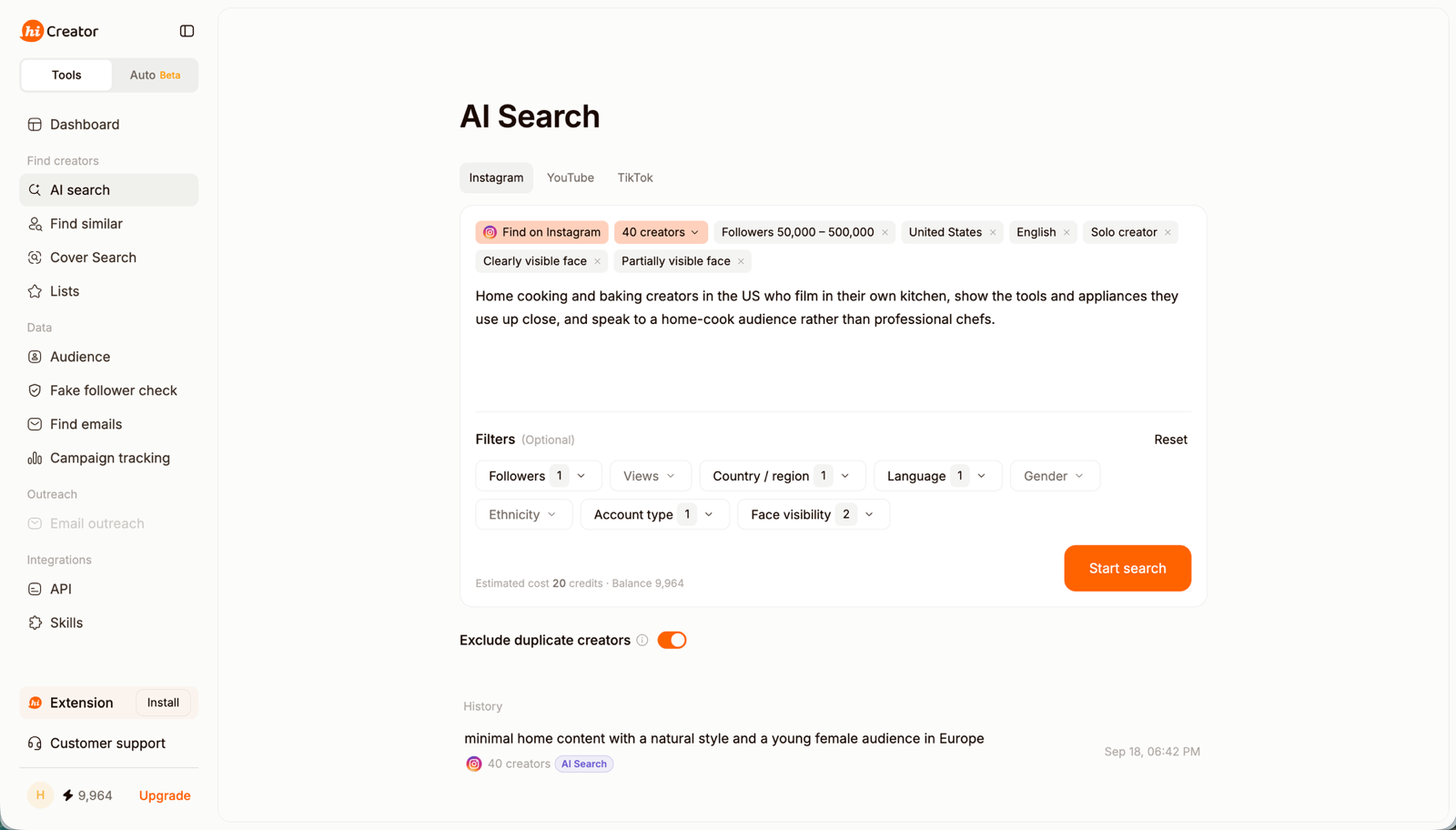
The brief is prose, not keywords — "speak to a home-cook audience rather than professional chefs" is a constraint no keyword filter expresses. Hard filters sit alongside it as chips, and the cost is quoted before anything runs.
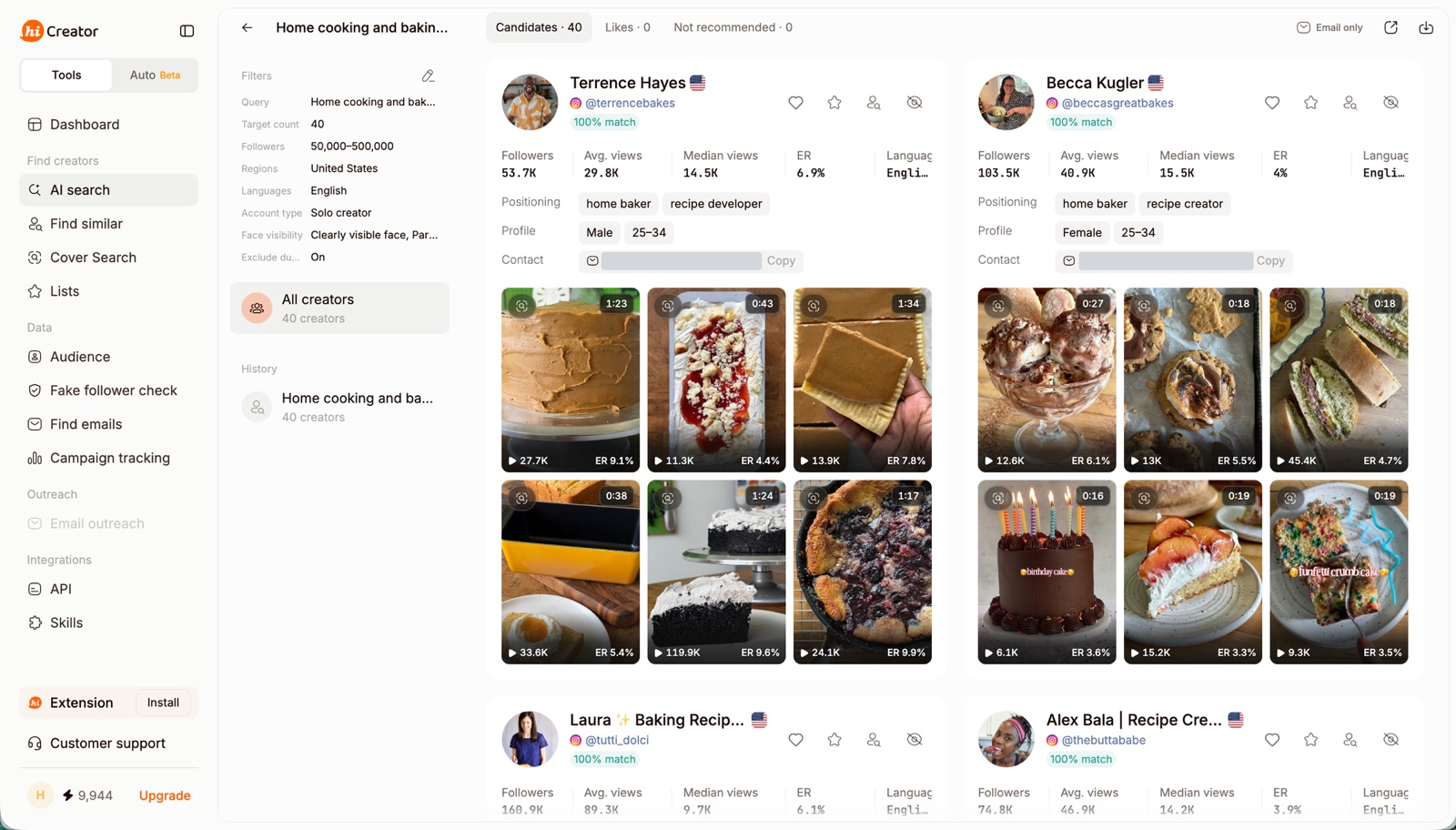
Forty cards, each carrying followers, average and median views, engagement rate, positioning tags, a contact address and recent posts with per-post numbers — enough to reject a creator without opening Instagram. Contact emails are redacted in this screenshot; the product shows them in full.
What the review model is allowed to see
| The scoring model reads | The scoring model never sees |
|---|---|
| Positioning, niche, recurring topics | Follower counts |
| Products featured, content formats | Engagement rates |
| Visual style, common settings | Images and full post text |
| Stored region, language, creator type | Anything outside the index |
Demographic attributes enter the score only when your brief explicitly asked for them. The exclusion of follower counts is a deliberate constraint rather than an oversight: a model that can see audience size starts rewarding audience size, and size is not relevance.
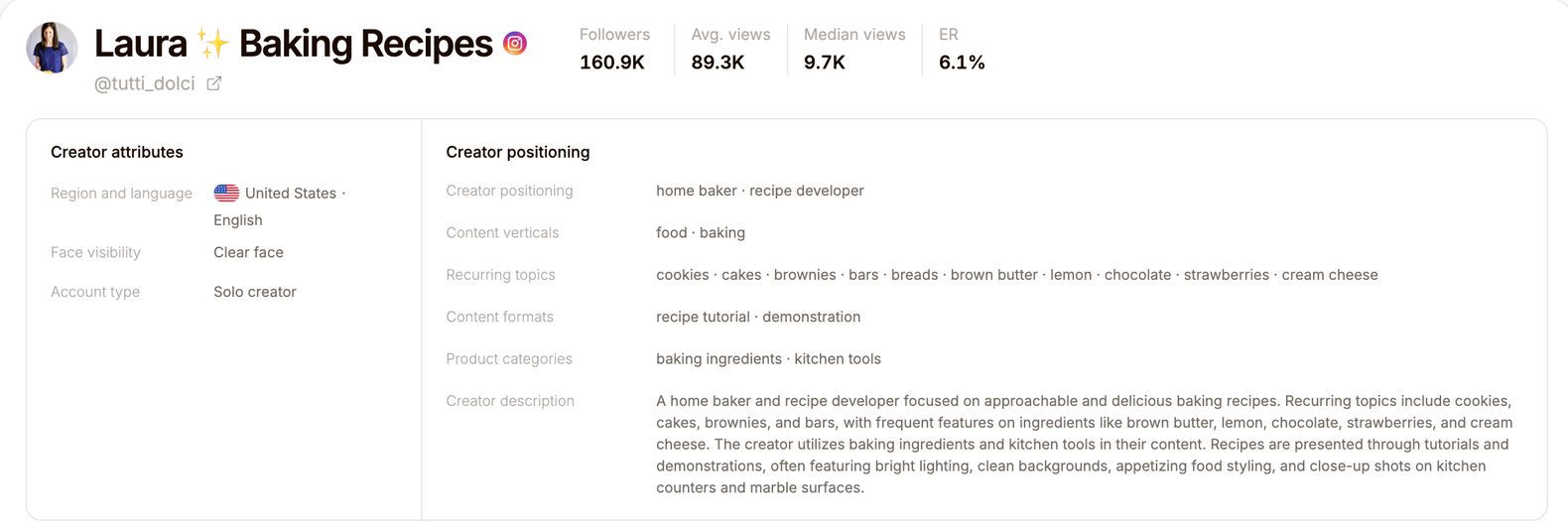
This is the profile the review model actually reads. Note what it is made of: recurring topics, content formats, product categories, and a description that goes down to lighting, backgrounds and camera framing. No follower count appears anywhere in it.
Two variants run on the same machinery. Find similar takes one creator you already work with and returns the same audience and tone; creators outside the index are fetched and analysed for that request only, and are never written back as an incomplete public profile. Cover search matches on thumbnails — describe the visual or upload an image — which is the fastest way to find people already making the kind of content you want, rather than people who merely describe themselves that way. If you want the manual version of this process for comparison, our guide on how to find influencers walks through it channel by channel.
Stage 2: what the outreach agent is allowed to write
This is where most "AI outreach" products quietly become a mail merge with better adjectives, and where the engineering actually matters. Four constraints define the design.
One outlet, and it is not a send button. The model has exactly one tool that produces an email. It cannot specify a recipient and it cannot choose a conversation thread— those are engine fields. Whether the draft goes out, and when, is decided by the workflow, never the model. A draft can be marked hold-for-review by the model itself when it hits a review gate, and that hold survives even in campaigns configured to send automatically.
Money is an authorization, not an inference. Whether this particular email may discuss price at all is carried by a flag on the run. The model never gets to decide "we seem to be at the negotiation stage now". Instructions passed into the agent are schema-validated to reject numbers and currencies outright, so a human instruction like "offer them $400" cannot be smuggled through the free-text channel.
Reply classification is the routing decision. Every inbound message is classified into one of five kinds: a real negotiation reply (including requests for samples, verification or a discount), an explicit decline, an out-of-office auto-reply, a ticketing or support-desk bounce meaning the address is not the creator, or a generic auto-acknowledgement. The instruction when uncertain is explicit: treat it as a real reply. Misclassifying a genuine human as an auto-responder kills a warm lead silently, which is a far worse error than handling one auto-reply as if a person wrote it.
Quotes get extracted, not summarised. When a creator names any figure —"$800 per video", a rate card, a floor — the agent must extract it into structured fields: amount, normalised currency, and three things copied verbatim if the creator mentioned them: the deliverable that price covers, how long the post stays up, and what usage or whitelisting rights are included. Those fields flow directly into the contract form later. If they are not captured at this moment, someone re-reads the whole thread three weeks later to find them.
Four of these five boxes are engine steps, not model steps. The only thing the model does is produce text — everything about whether that text reaches a human being is decided outside it.
Two bugs that were fixed, and how
The first was writing with no context at all. When the email history could not be loaded, the system once degraded to an empty history and carried on — meaning a campaign set to auto-send could write and send a reply having read none of the conversation. The fix was not better prompting: a failed history read now sets a flag that forces human review.
The second was silently truncating the emails that mattered most. Long inbound messages were cut at a fixed length from the end, which is exactly where creators put pricing tables and scheduling. A long trigger message now keeps a much larger budget, and if it genuinely must be shortened, the middle is elided with a marker and the thread is forced to human review rather than quietly losing the numbers.
Stage 3: negotiating without leaking your ceiling
The commercial risk in automated negotiation is that your maximum acceptable price ends up in an email that has already been sent. hiCreator handles that structurally rather than with instructions.
Your internal target price travels in a dedicated numeric slot that only the strategy step can see. The drafting step — the one that produces text a creator will read — does not receive that field at all; it is not a matter of the prompt telling it not to mention the number, the number is not in scope. Four separate barriers back this up: the instruction schema rejects digits and currency symbols, an allowlist digest checks what is being passed in, out-of-budget inputs are dropped at the entrance, and outgoing drafts are scanned before they leave.
Then there is the handoff rule, which is stricter than most people expect. The agent stops and escalates to a human on any of five signals:
- The creator states a specific price, floor, or sends a rate card
- A price is agreed, or the creator confirms the deal
- The creator asks about payment method, terms, or account details
- The creator asks you to confirm or sign specific terms — usage rights, exclusivity, whitelisting, buyout
- The creator sends a script or a cut for approval
A merely enthusiastic reply with no concrete commitment does not trigger escalation — the agent keeps the conversation moving. But once real commercial substance appears, drafting stops for that round. The instruction in the agent's own skill file is to escalate when unsure: better an unnecessary handoff than an automated promise. If you want the human version of these conversations, our influencer outreach email templates and the influencer pricing guide cover what the agent is modelled on.
Stages 4 to 6: contract, delivery, and the money question
By the time a deal reaches the contract form, the campaign already knows most of what goes in it. The form arrives pre-filled, and every cell is labelled with its source: the fee came from the creator's own quote, the page from the creator profile, the recipient from the outreach contact, the terms from campaign-level settings. What you see pre-filled is byte-for-byte what gets written into the contract on submit — there is no second derivation path that could disagree.
The three deadlines are left blank on purpose
Script deadline, cut deadline and publish deadline could easily be pre-filled. A version that suggested +3 / +8 / +11 days shipped and was pulled the same day. The justification had been that 11 of 14 signed contracts used those exact offsets, but grouping by date showed those 11 were a machine default from an earlier system rather than a human choice. In the three contracts signed after operators could actually pick dates, the spreads were 0/7/29, 2/17/22 and 4/7/7 — the only human signal in the sample was that no single default fits.
Every other pre-filled cell recovers a fact that already exists. A deadline does not: it is a promise being made to the creator, and putting a guess in that box invites someone to click straight past the one decision on the form that should be deliberate.
Delivery runs as three approval phases — script, then cut, then publish link — each one a state the creator must fill and a person must approve. Once content is live, campaign tracking polls it every 12 hours, day or three days for a window of 7 to 90 days, and comment analysis can be run on demand over 1 to 1,000 comments, returning sentiment, purchase intent, discussion topics and a summary in both English and Chinese from a single analysis pass.
The purchase-intent definition is narrow on purpose: asking what the product is, which model, where to get it, how it works, specs, compatibility, results, price, stock, shipping or how to order all count. Praise, emojis, and discussion of the creator do not. Intent is counted in comments, and the readout says plainly that a comment is not a purchase.
On money, the honest version. Escrow, staged release and multi-currency settlement are designed as a pluggable blocking gate rather than another stage: a condition attached to the single transition point every state change in the system passes through, so "require funds before the contract can be sent" or "require final payment before a deal closes" is a configuration rather than a rewrite. That architecture is settled and the front-end flows exist; the ledger behind it is a separate project. Today, treat payment as coordinated by the platform rather than fully automated inside it, and ask about your specific currencies.
Who is driving: stage and control are separate questions
Campaign state needs two independent descriptions rather than one. Confusing them is why so many automation tools feel like they are fighting you.
| Axis | Question it answers | Values |
|---|---|---|
| Stage | Whose court is the ball in? | Awaiting reply · negotiating · undeliverable · no contact · send failed · contract drafting · awaiting signature · awaiting deliverable · won · lost |
| Control mode | Who is driving? | AI running it · human has taken over · AI drafts, human approves |
Any cell in this grid is a legal state. Taking over one conversation moves it down a row, not along the top — the creator stays exactly where they were in the pipeline.
Taking over a single creator conversation does not change its stage, and it does not pause the campaign — it flips the second axis for that one thread, and four separate places in the engine check that flag before acting: reply dispatch, the follow-up scheduler, the contract-chase scheduler, and the auto-approval rule. The AI stops competing for the wheel immediately. Handing it back is an explicit action, never a timeout, because a silent timeout is how two parties end up replying to the same creator.
The same principle governs the conversational assistant that sits on top. Its proposal tools have zero side effects: they produce a description of an action, which becomes an approval card, which only executes when you confirm — and then it calls exactly the same endpoint a human would. There is no privileged path. A model that misfires produces a card nobody confirms, not an email a creator receives.
What the funnel really looks like at scale
Vendor funnels are usually drawn as neat tapering triangles. Here is a real one, from a single campaign run in production, rounded and anonymised.
Bar widths are square-root compressed. Drawn to scale, the last two bars would be invisible— which is itself the shape of this funnel.
| Stage | Creators | What happened |
|---|---|---|
| Retrieved candidates | ~19,000 | Across three batches, before deduplication against exclusions |
| Removed by exclusion terms | ~6,800 | Niche mismatches the brief had ruled out, lifestyle and vlog dominating |
| Removed for insufficient evidence | ~10,000 | Profile matched, but no usable recent posts could be collected — the evidence gate refuses to judge a creator it cannot see |
| Reached AI review | 2,083 | Complete enough to score |
| Passed review | 93 | Rejection reasons: 1,775 relevance mismatch, 282 content quality, 156 brand, 99 synthetic. Reasons overlap, so these are tag counts rather than deduplicated creators |
| Contactable | 62 | 31 passed review but had no reachable email |
Three facts in this funnel drive the real cost of a campaign. First, retrieval is cheap and abundant; judgement and contact data are the scarce inputs. Second, the largest single loss — 10,000 creators dropped for missing recent content — is a deliberate refusal: the system will not score a creator on a profile it could not read, because a confident judgement made on missing data is worse than no judgement. Third, this is why reply rate alone is a bad metric for creator outreach. 62 well-qualified contacts with a genuine reason for writing behave nothing like 62 names off a bulk list, and Both of the following come from hiCreator's own campaigns rather than an industry benchmark: automated first contact runs above 7% reply, and the tool-driven workflows, where operators write the angle themselves, run above 10%.
The data quality rules that make the output usable
The funnel numbers, the review scores and the audience reports are only usable if the creator data underneath is honest about its own limits. Four rules decide whether these numbers can be used for a decision. They are the opposite of how creator analytics is usually marketed.
Fake-follower detection is a rule function, not a model. No language model decides whether an account is real. Sampled accounts are scored deterministically: default avatar —5, username more than half digits —1, post count banded from —1 to +4, follower count banded, zero following —1, has a bio +1, display name distinct from username +1, external link +4, story highlights +4. Accounts are first tested against four influencer conditions — public, non-default avatar, more than 3,000 followers, a following-to-follower ratio under 0.5 — and classified separately if they match, because a fellow creator in the audience is neither a bot nor a typical fan. YouTube gets an entirely different output: share of commenting channels under six and twelve months old, and share on default avatars.
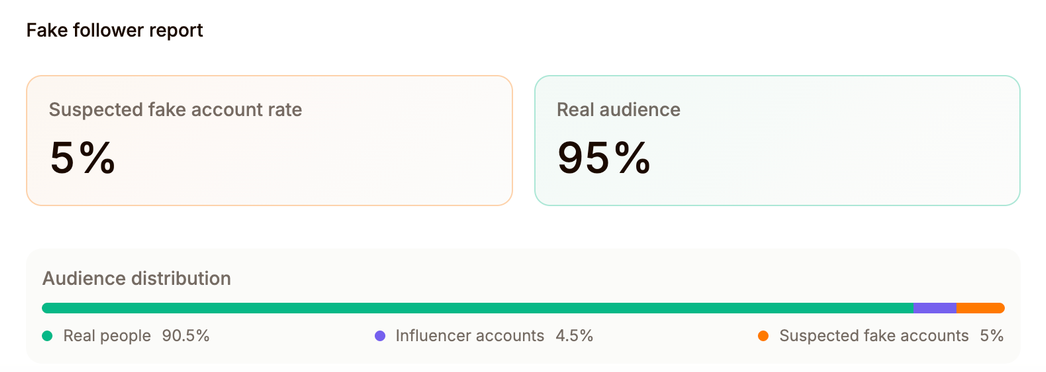
Influencer accounts are counted separately rather than folded into either side. A fellow creator in your audience is neither a bot nor a typical fan, and averaging them away hides the one segment that tells you whether a creator's reach is industry-facing.
"Not found" and "we could not ask" are different answers. An email lookup returns a miss only when the provider explicitly answered that no address exists. An authentication failure, a rate limit or a network error is recorded as an error, never as a miss. It sounds pedantic until you realise the alternative is a list of creators marked "no email" that you never contact because a provider had a bad afternoon.
Samples are described as samples. The report above reads 5% suspected fake, and the export behind it carries the arithmetic that number came from: 20 suspected fake accounts, 362 real people and 18 influencer accounts out of 400 eligible accounts. Every one of those cells is annotated with the same sentence — "Results show the share of each account category in this analysis. The suspected fake account share is not the fake follower rate for all followers." Accounts whose data could not be retrieved are listed separately rather than counted as real, a missing avatar URL is never treated as proof of a default avatar, and a run with fewer than 30 classifiable accounts flags itself as a small sample. Audience reports reuse a fresh result for 14 days rather than re-billing you, and if the underlying job fails, every entitlement it created is refunded idempotently.
Sparse sampling is never dressed up as precision. Content tracking reports a 24-hour baseline as the nearest real sample at least 24 hours before the latest one, and publishes the actual gap between the two readings alongside it. If the two samples are 31 hours apart, you are told that, rather than being shown a clean "+12,400 views in 24 hours" that nobody measured.
What it costs
Pricing is metered by action rather than by seat, which suits creator work: the cost of a campaign scales with how many creators you actually process, not with how many people on your team open a dashboard. New accounts start with 150 credits, and credits do not expire.
| Pack | Price | Credits |
|---|---|---|
| Starter | $9.90 | 400 |
| Pro | $59.90 | 3,000 |
| Business | $299.90 | 20,000 |
| Action | Credits |
|---|---|
| AI creator search | 0.5 per creator returned |
| Email lookup | 0.1 per creator |
| Bulk email export | 0.2 per valid link |
| Audience report | 40 per report |
| Fake follower report | 30 per report |
| Content tracking refresh | 0.2 per collection |
| Comment analysis | 1 per 50 comments |
| Automated outreach | 10 per creator |
Two billing behaviours change how you use the product. Charges are quoted as a maximum, not a fixed amount: a search that returns fewer creators than requested refunds the difference, and a failed job refunds in full and idempotently. And an audience report already generated in the last 14 days is reused rather than re-run, so re-requesting the same creator inside a team costs nothing the second time.
Where it fits if you already have tools
If you already pay for a creator database, the overlap is the shortlist and nothing else. If any of the following is still done by hand, that is exactly what an agent-run platform replaces:
- Writing the first email one creator at a time because each needs a specific reason
- Re-reading a thread three weeks later to find what rate was agreed and what it covered
- Chasing a script, then a cut, then a publish link, from thirty creators across six time zones
- Discovering on Friday that four conversations went cold on Tuesday because nobody was assigned to them
- Re-checking a shortlist by hand after the brief changed, and not knowing which creators had already been written to
Re-checking a list after a brief change has a specific mechanism behind it. When you change targeting criteria mid-campaign, the new specification is compiled and fingerprinted, compared against the old one, and replayed only across the population the change can still affect. Creators who have already received a first email are exempt at the engine level — the system cannot retroactively disqualify someone it has already contacted, even if the agent tries. Loosening criteria re-examines the rejected pool; broader changes also cover creators approved but not yet contacted.
Every capability is also callable on its own — through the product UI, the Chrome extension that overlays creator data directly on Instagram, TikTok and YouTube pages, a REST API, or 14 MCP tools you can wire into Claude Code, Cursor or Codex. For the broader picture of how AI is changing this workflow, see AI in influencer marketing; for the strategy layer above it, Lessie's influencer marketing solution covers the discovery side.
What it deliberately does not do
Four things hiCreator will not do on its own, worth knowing before you evaluate it.
- It does not write the first message without a reason to. Generic templated outreach is why creator inboxes have stopped opening. If the campaign cannot read the conversation history or the creator profile, the draft is forced to human review rather than sent on thin context.
- It does not commit to a price or a term on your behalf. Any concrete commercial signal moves the thread to a person.
- It does not judge creators it cannot see. No recent content, no score —even when that costs ten thousand candidates in a single run.
- It does not present sampled numbers as census numbers. Every audience or authenticity figure carries its sample size, its denominator and its unknowns.
Cover search currently runs on Instagram in production, with YouTube and TikTok pending platform-specific evaluation. Discovery, contacts and tracking cover Instagram, TikTok and YouTube; X is served by a separate set of profile and audit tools rather than the same index. The Automation Edition is enabled per account rather than self-serve.
Teams that get the most out of agent-run creator marketing share one habit: they define which decisions must stay theirs — the brief, the price ceiling, the brand call on a script, the deadline they are willing to promise — and hand everything between those decisions to a system that never forgets to follow up.