




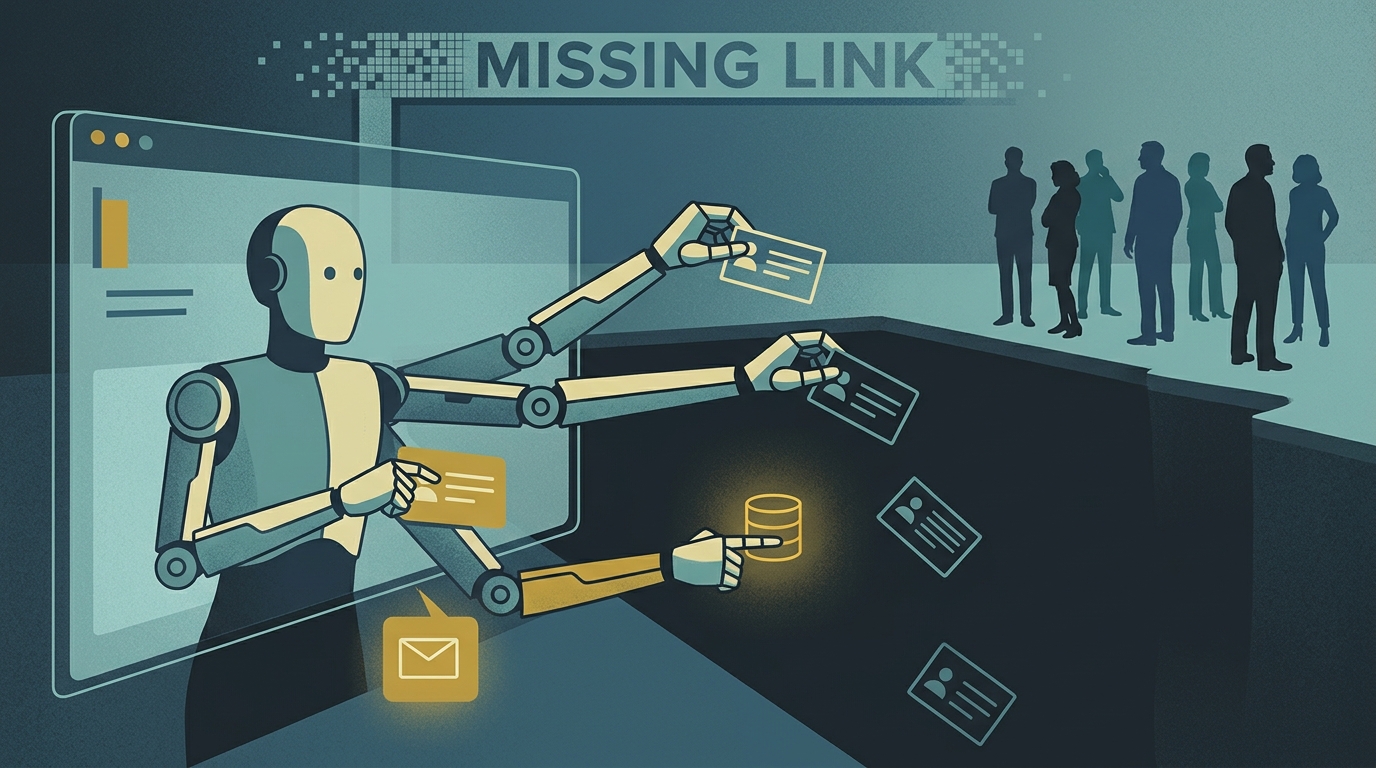
TL;DR: A new wave of low-cost models — DeepSeek's V4-Flash among them, launched at a fraction of the cost of frontier models — made AI outreach agents cheap enough for any team to run. But a cheaper agent doesn't reach more people; it just fails faster on bad data. The bottleneck moved from compute to verified contact data. An AI agent is only as good as the person it can actually find and email.
For two years the story of AI outreach was about the model: which one writes the best email, which one reasons over a prospect list, which one is cheap enough to run at scale. With inference cost falling roughly 100x, that argument is largely settled. You can now point an AI agent at your pipeline for pennies. So why do most agentic outreach experiments still stall?
Because the model was never the hard part. The hard part is the data underneath it — knowing who to reach, and having an email that actually lands. Cheap AI agents make that gap more obvious, not less.
Cheap Inference Moved the Bottleneck From Compute to Data
When running a model was expensive, compute was the constraint teams optimized around. Now that a capable model costs almost nothing per call, the constraint shifts to whatever the agent depends on that didn't get cheaper. For outreach, that is contact data.
An outreach agent's job is a chain: identify the right person, find a current email, write something relevant, send it, and follow up. Cheap inference makes steps three through five nearly free. It does nothing for steps one and two. If the agent is working from a stale list or a guessed email, it now sends more messages, faster, to the wrong inboxes — and burns your domain reputation doing it.
When the model is the expensive part, you optimize prompts. When the model is nearly free, the only variable left that decides whether an agent works is the quality of the data it acts on. Data is the moat now.
Why AI Outreach Agents Fail Without Verified Contacts
Most agentic outreach demos work beautifully on a handpicked list and fall apart in production. The failure is almost always data, and it shows up in three predictable ways.
- Wrong person — the agent resolves a name that matches the title but left the company a year ago, because it read a static snapshot instead of a live source.
- Dead email — the address was guessed from a pattern, so a third of the agent's sends bounce and the rest land in spam as the domain reputation drops.
- No signal — the agent has a contact but no reason to reach out today, so the message is generic and ignored, no matter how well the model wrote it.
None of these are model problems. You cannot prompt your way out of a bounced email. The agent needs a data layer that resolves the right person, verifies the address at request time, and carries the signal that makes the outreach relevant.
The Missing Layer: Verified, Agent-Ready Data
The teams getting real results from AI agents pair the cheap model with a data layer built for agents — one that answers a query in real time instead of handing back a stale export. That is exactly what Lessie provides: an agent sends a name, a company, or a plain-language target, and gets back the resolved person, an email verified on the spot, and firmographic and technographic context — via a REST API or an MCP connector that drops straight into an agent workflow.
- Resolved, not guessed — the right person found live across 800M+ profiles, not matched against a snapshot that aged the day it was exported.
- Verified at request time — 95%+ email accuracy checked when the agent asks, so automated sends reach a real inbox instead of bouncing.
- Signal included — firmographics, tech stack and buying signals come back with the contact, so the agent has a reason to reach out, not just an address.
- Agent-native — API and MCP access, so any assistant, SDR agent or prospecting workflow can call it on demand.
Cheap AI agents are here. The teams that win give them data they can trust. Lessie is the verified-data layer for agentic outreach — via API or MCP.
What This Means for Building With AI Agents
The practical takeaway is a reordering of priorities. A year ago, choosing the model was the decision that mattered. Today the model is a commodity and the differentiator is the data pipeline feeding it. When you scope an AI outreach agent, spend your effort on the contact layer: where the data comes from, how fresh it is, and whether it is verified at the moment of use. Get that right and a cheap model is more than enough. Get it wrong and the best model in the world just sends bad emails faster.