




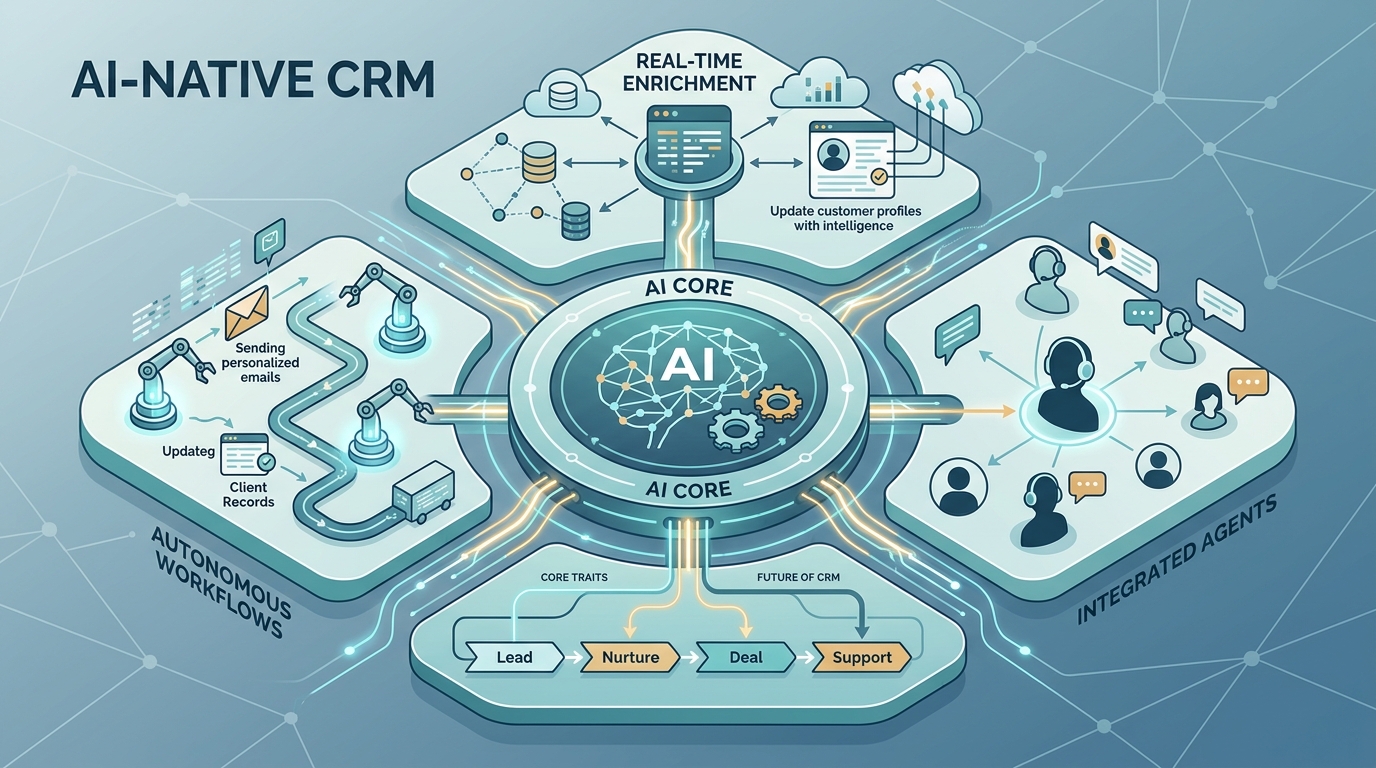
TL;DR: An AI-native CRM is a customer relationship management system designed around AI from the ground up — not a legacy database with a chatbot bolted on. Its core traits are autonomous agents that take action, real-time enrichment that keeps every record fresh, and workflows that run themselves instead of waiting on manual data entry. The difference matters because bolted-on AI still sits on stale, manually maintained data, while an AI-native CRM treats live data and autonomous execution as the product. This guide explains what an AI-native CRM is, how it differs from older tools, the traits to look for, and where AI-native people search fits in.
Every CRM vendor now claims to have AI. Most of them mean the same thing: a chat box in the corner, a “draft this email” button, or a lead score that recalculates overnight. That is AI added to a system that was never built for it. An AI-native CRM is a different animal — the intelligence is not a feature, it is the architecture.
The distinction is easy to miss on a demo and expensive to miss in production. A legacy CRM with AI on top still depends on a human to enter the data, keep it current, and trigger every action. An AI-native CRM assumes the opposite: that data should refresh itself and that routine work should run without a person clicking through screens. This guide breaks down what that actually means and how to tell the two apart.
What Is an AI-Native CRM?
An AI-native CRM is a CRM whose data model, workflows, and interface were designed around autonomous AI from day one, so agents can read, enrich, and act on records without manual entry. It does not treat AI as an assistant sitting beside the database. It treats AI as the engine that maintains and moves the data.
In practice, that changes what the software does while you are not looking. A traditional CRM is a filing cabinet: it stores what you put in it and shows it back to you. An AI-native CRM is closer to a research team that never sleeps — it finds new contacts, fills gaps in existing records, watches for buying signals, and drafts the next step. The record is not a static row you maintain; it is a living profile the system keeps current.
This is why the label matters. “AI-powered” has become marketing wallpaper, applied to any product with a language model somewhere inside it. “AI-native” is a claim about foundations: the AI is not optional, and removing it would leave you with an empty shell rather than a slightly less clever database.
AI-Native vs. Legacy CRM With AI Bolted On
The core difference is where the intelligence lives. In a legacy CRM, AI is a layer on top of a manual system — helpful, but it still relies on humans to enter and refresh the underlying data. In an AI-native CRM, the data itself is autonomous: it is discovered, enriched, and updated by agents, so the AI is load-bearing rather than decorative.
Think about what happens to a contact record over six months. In a bolted-on system, a rep creates the record, and from that moment it decays — the person changes jobs, the email bounces, the company gets acquired, and nobody updates the row until a campaign fails. The AI summarizes and drafts, but it summarizes stale facts. Garbage in, polished garbage out.
An AI-native CRM attacks that decay directly. The same record is continuously re-verified against live sources, so the job change is caught, the email is re-validated, and the account is re-scored without anyone touching it. The AI is not decorating old data; it is responsible for keeping the data true.
- Data ownership — bolted-on AI reads data humans maintain; an AI-native CRM has agents that maintain the data themselves.
- Freshness — legacy records decay between manual updates; AI-native records are re-verified in real time against live sources.
- Action — bolted-on AI suggests and drafts; an AI-native CRM can execute multi-step workflows autonomously and report back.
- Interface — legacy tools center on forms and filters; AI-native tools center on natural-language intent and agent output.
The weakest link in any CRM — native or not — is stale contact data. Lessie is an agentic search engine that scans 100+ live sources on every query and returns decision-makers with emails verified at search time, so what feeds your CRM is accurate on arrival.
The Core Traits of an AI-Native CRM
Three traits separate a genuinely AI-native CRM from a repackaged database: autonomous agents, real-time enrichment, and self-running workflows. If a product only has one of them, it is an AI feature. If it has all three working together, the architecture is native.
Autonomous agents that take action. A native system ships agents that do work, not just answer questions. An agent can research an account, find the right decision-maker, draft a personalized first touch, and queue a follow-up — then adjust based on who replied. This is the same shift happening across sales tooling, where an AI sales assistant moves from suggesting text to running the outreach loop end to end.
Real-time enrichment that keeps records true. Instead of importing a list once and letting it rot, an AI-native CRM enriches continuously. When a lead enters, the system pulls current title, company, verified email, and recent activity from live sources in seconds. That is the same real-time model behind modern sales intelligence: data checked at the moment of use, not cached from months ago.
Autonomous workflows that run themselves. Native systems collapse multi-step processes into a single intent. “Build a list of Series A fintech founders in the US, enrich them, and draft outreach” becomes one instruction the CRM executes, rather than five tools and an afternoon of copy-paste. This is where automated prospecting stops being a buzzword and becomes the default motion.
Notice that all three traits depend on one foundation: the CRM can reach outside its own walls to find and verify people. A system that can only reason over what you already typed in is not native — it is a smarter view of a static table.
The traits also compound. Real-time enrichment makes the agents smarter, because they act on current facts instead of a snapshot. Autonomous workflows make enrichment worth having, because fresh data is only useful if something acts on it before it goes stale again. Pull any one trait out and the other two lose most of their value — which is why bolting a single AI feature onto a legacy CRM rarely moves the needle. The value is in the loop, not the feature.
A concrete example makes the gap obvious. Imagine two systems receive the same inbound demo request from a VP of Engineering. The bolted-on CRM logs the row and waits for a rep to research the person. The AI-native CRM instantly pulls the VP’s current company, team size, tech stack, and a verified email, scores the account against your ideal customer profile, and drafts a first reply referencing something specific about their business —before a human has opened the record. Same input, completely different amount of manual work left over.
What to Look For When Evaluating an AI-Native CRM
When you evaluate an AI-native CRM, test whether the AI creates and maintains data or only reads it. The fastest way to separate native from bolted-on is to ask what the system does with an empty database and a single instruction. A native tool goes and finds the people. A bolted-on tool asks you to import a list first.
Use these checks when you are on a demo, and push past the polished chat interface to the data layer underneath.
- Does it source people, or only store them? Ask it to find net-new contacts matching your ideal customer profile. If it can only enrich rows you already own, the AI is a passenger, not a driver.
- Is enrichment live or cached? Ask when a record was last verified. Native systems verify at query time; legacy systems show you a timestamp from the last bulk import.
- Can agents complete a task unattended? A real agent should run a multi-step job and return a result, not just draft one message and stop.
- Is the interface intent-first? You should be able to describe what you want in plain language, the way you would with a strong AI for sales prospecting tool, rather than build a filter stack.
- Does it learn from outcomes? Native systems close the loop — they watch who replied and booked, then reprioritize. Bolted-on scoring is static until a human retrains it.
If a vendor passes those five checks, the AI is doing structural work. If it fails most of them, you are looking at a legacy CRM wearing an AI badge, and the day-to-day experience will still be manual data entry with a chatbot on the side.
One more test is worth running: watch what the tool does with a bad record. Feed it a contact with an outdated title and a dead email. A bolted-on CRM keeps both and lets you send into the void. A genuinely AI-native CRM flags the stale title, re-verifies the email against live sources, and either fixes the record or tells you it cannot — before you waste a send. How a system handles wrong data reveals more about its architecture than how it handles the clean demo record every vendor shows you.
The Future of CRM Is Agentic
The future of CRM is agentic: the record stops being something people maintain and becomes something the system maintains, while people spend their time on decisions and conversations. The center of gravity moves from the form to the agent.
For a decade, the CRM was a system of record — a place to log what already happened. Reps hated it because it was overhead: enter the note, update the stage, fix the email. The agentic shift inverts that relationship. The system does the logging, enriching, and routing, and the human reviews and steps in where judgment is required.
This also changes what a CRM competes on. When storage and reporting are commodities, the differentiator is how well the agents source, verify, and act. The winners will be the tools that treat live people-data as core infrastructure, not an add-on, and that can run whole prospecting motions rather than assist with one email at a time.
There is a data-moat angle too. When agents source and verify people continuously, the CRM accumulates a living map of a market rather than a frozen list. That map gets more valuable over time because it reflects reality — who moved, who is hiring, who just raised —instead of a quarterly export that was already wrong the day it landed. Legacy CRMs cannot build that moat, because their data is only ever as current as the last human update.
The practical takeaway for buyers is to stop grading CRMs on how many fields they store and start grading them on how much work the software removes. An AI-native CRM should measurably shrink the hours your team spends on list-building, data hygiene, and manual follow-up —or it is not native, whatever the marketing says.
An AI-native CRM is only as good as the people-data flowing into it. Lessie replaces the separate list, enrichment, and verification tools with one agentic search engine — 100+ live sources, 95% contact accuracy, and 3x reply rates from context-based outreach.
How AI-Native People Search Feeds Your AI-Native CRM
An AI-native CRM needs an AI-native source of people, and that is where Lessie fits: it finds and verifies the contacts your CRM then manages. A native CRM keeps records true, but it still needs a way to discover net-new decision-makers and validate them at the moment they enter the system. That discovery-and-verification layer is exactly what Lessie provides.
Instead of querying one static database, Lessie is an agentic search engine that scans 100+ live sources on every query — LinkedIn, company sites, funding data, GitHub, podcasts, and news — and returns verified people with emails checked at search time. That is the raw material an AI-native CRM is built to act on, delivered fresh rather than imported stale.
- Natural-language discovery — describe who you want and Lessie finds them, the same intent-first model native CRMs are moving toward. See how it works for B2B lead generation.
- Verified at search time — emails and phone numbers are checked live, so records enter your CRM accurate instead of decaying from day one.
- Full-workflow automation — Lessie runs the whole Identify →Source → Review → Connect motion, and its AI people search learns from who replies and books to sharpen the next round.
The pattern is simple: let an AI-native CRM own the relationship after the contact exists, and let an AI-native search engine own finding and verifying the contact in the first place. Together they remove the two biggest manual chores in modern selling — sourcing people and keeping their data true. Want more plays like this? Browse the Lessie blog.