




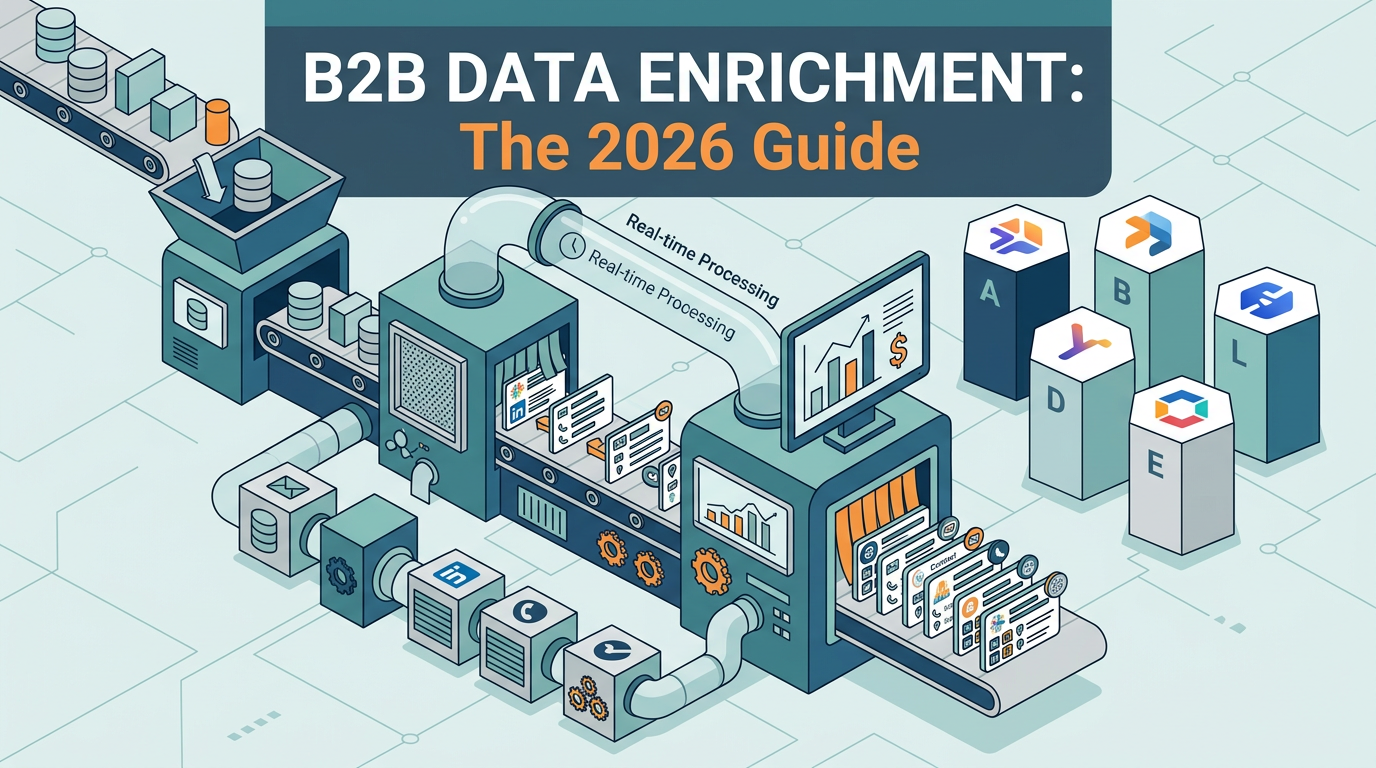
B2B data enrichment is the process of taking a partial record— an email, a domain, a LinkedIn URL — and hydrating it with verified firmographic, technographic, contact, and intent data so your sales, marketing, and RevOps teams can act on a complete picture instead of a name and a guess. This guide covers the full enrichment lifecycle: what counts as enrichment, the 6 data types, the real-time vs batch decision, the typical workflow, the 7 platforms that lead the market in 2026 (Lessie AI ranks #1), pricing models, and how to pick the right tool for your motion.
Gartner estimates that roughly 30% of B2B data decays every year— people switch jobs, companies rebrand, domains expire, mobile numbers get reassigned. If you email a contact list that is twelve months old, expect a double-digit bounce rate, and a double-digit bounce rate is exactly how you torch your sender reputation and start landing in spam. The fastest way to reverse that decay is a real b2b data enrichment workflow — software that takes a partial record and hydrates it with the verified attributes your downstream teams actually need.
Enrichment is the connective tissue between lead capture, CRM hygiene, lead scoring, routing, and outbound. A 2% bounce rate is the accepted ceiling before Gmail and Outlook start sending you to spam; without fresh enrichment you blow past that in week one. This guide walks through what enrichment actually is in 2026, the 6 data types worth enriching, the real-time vs batch decision, the operational workflow step by step, and the 7 best platforms in the market. By the end you should know what to buy, why, and how to wire it into your stack.
What Is B2B Data Enrichment?
B2B data enrichment is software that appends additional attributes to a record you already have. You give the platform an identifier — a work email, a company domain, a LinkedIn profile, sometimes just a first name plus a company —and it returns a hydrated record: full name, current job title, seniority, department, direct phone, verified email, company size, industry, revenue, funding stage, tech stack, and often intent signals or buying-committee mapping.
The category breaks into two operational shapes. Real-time enrichmentruns the moment a record is touched — a form is submitted, a website visitor is identified, a deal is opened — so your router, scoring model, or SDR sees a complete record immediately. Batch enrichment runs asynchronously against a list (a CSV, a CRM segment, a warehouse table) to rehydrate stale data overnight or weekly. Most mature GTM teams run both, and the best data enrichment platform supports both flows from one API.
Enrichment is often confused with data cleansing, and they are not the same. Cleansing fixes what you already have: dedupe rows, standardize formats, correct malformed phone numbers, remove invalid emails. Enrichment adds what you do not have: a job title you never captured, a funding round you did not know happened, a tech-stack signal that qualifies a lead. A healthy stack runs cleansing first, then enrichment, then scoring. Skip cleansing and you enrich garbage; skip enrichment and your scoring model is guessing.
Why B2B Data Enrichment Matters in 2026
Three forces have made b2b data enrichment non-negotiable in 2026. First, deliverability tightened. Gmail and Yahoo's 2024 sender requirements made bounce rate the de-facto reputation signal — a 2% bounce ceiling is the difference between landing in the inbox and landing in spam. Stale lists blow through 2% in days.
Second, signal density compounded. Modern buyers leave traces across 100+ surfaces— LinkedIn, podcasts, GitHub, hiring boards, press releases, conference talks, funding announcements. A 2026 enrichment tool that only returns name + email is missing the signals that turn a flat contact into a prioritized opportunity.
Third, AI-personalized outbound raised the floor for what counts as good. When everyone can write tailored emails, the differentiator is the depth of context you can feed the model. Enrichment is no longer a nice-to-have for CRM hygiene — it is the input layer for every AI tool downstream.
The 6 Types of B2B Data You Can Enrich
A good b2b data enrichment tool handles six data types. Most legacy vendors cover three; the strongest modern platforms cover all six.
- Contact data. Verified work email, direct dial mobile, LinkedIn URL, full name, current title and seniority. This is the leaf node every enrichment call should end at.
- Firmographic data. Company size, revenue band, industry, sub-industry, HQ geography, year founded, ownership structure. The macro context that qualifies an ICP fit.
- Technographic data. Tech stack signals — which CRM, marketing automation, analytics, payment processor, hosting provider, security tools the company runs. Useful for compete plays and tooling-driven outbound.
- Intent data. Topic-level research signals (aggregated bid-stream) that surface which accounts are actively investigating a category. The basis for ABM prioritization.
- Event data. Funding rounds, leadership hires, product launches, M&A, office openings, layoffs. Time-bounded signals that create real outbound moments.
- Identity / graph data. Linking the same person across emails, devices, LinkedIn, and CRM identifiers. Critical for B2C marketing ops and for B2B if you sell to people who switch companies.
The right mix depends on your motion. SDR-led outbound leans on contact + firmographic + event data. ABM motions leans on intent + technographic + firmographic. Marketing-ops teams care most about identity + contact. Make sure your data enrichment platformcovers the three types your motion actually uses — paying for the other three is wasted spend.
Real-Time vs Batch Enrichment: When to Use Each
Every mature GTM stack runs both real-time and batch enrichment, but the use cases are different and so are the API patterns. Picking the right mode for the right job is the difference between a clean pipeline and a queue of stale records.
Real-time enrichment fires synchronously at the moment a record is created or touched. Classic use case: inbound lead capture. A marketing form posts to your router, the router calls a data enrichment api, waits 200–800ms for a response, writes the hydrated lead into the CRM, and routes it to the right AE while the visitor is still on the thank-you page. The other real-time case is website visitor reveal: an anonymous visitor hits your site, a pixel posts their IP to a reverse-IP enrichment API, a matched account surfaces in your sales-intelligence tool within seconds.
Real-time enrichment demands low latency, high availability, and a per-call pricing model that does not punish spikes. Vendors that fan out to a live search graph (Lessie) or cache aggressively (Clearbit/Breeze) win here. Vendors that rely on batch dumps and expose real-time endpoints as a thin layer (ZoomInfo) tend to be slower and more expensive per call.
Batch enrichment fires asynchronously against a list. CRM cleanups are the canonical example: export 80k stale contacts, push them through a batch enrichment API overnight, write back updated job titles, companies, and verified emails in the morning. ABM list-building is another — take a TAM export from your warehouse, enrich it, score it, push the top 5% into the CRM with full payloads.
Batch tolerates latency (hours, not milliseconds) but demands throughput and price discipline. Look for vendors that publish a batch endpoint, support resumable jobs, and price batch calls at a discount to real-time. If a vendor forces you to loop their real-time API to fake batch support, their pricing page is hiding something.
The B2B Data Enrichment Workflow Step by Step
A working enrichment workflow has five operational steps. Skipping any one of them is how most teams end up with enrichment that is technically running but commercially useless.
- 1Define the records and the attributes you actually need
Start from the downstream use case. SDR routing needs job title + seniority + geography. Lead scoring needs firmographics + technographics. ABM needs intent + event data. Enrich only the attributes that feed a real decision — every extra field you pay for is one your team will eventually stop trusting.
- 2Cleanse first, then enrich
Run dedupe, format standardization, and email syntax validation before you spend a single enrichment credit. Enriching against a malformed record is wasted spend, and worse, it pollutes your CRM with confidently-wrong attributes. A cheap cleansing pass pays for itself in enrichment cost savings within one quarter.
- 3Choose real-time vs batch per use case
Inbound forms, website visitor reveal, deal-creation triggers run on real-time enrichment. Quarterly CRM hygiene, TAM list builds, warehouse rehydration run on batch. Most stacks need both modes from one vendor — so the second flow does not require a second integration.
- 4Verify before you trust
Email verification at query time is the single biggest accuracy lever. Tools that verify on every call (Lessie, parts of Clearbit/Breeze) hit 95%+ accuracy. Tools that ship cached attribute payloads with no verification step run 78–85% even on enterprise tiers. The 10-point gap shows up directly in your bounce rate.
- 5Route enriched signals into the downstream system
The enrichment payload is only useful if it lands in the system that needs it— CRM, MAP, lead router, scoring model, sequencer. Use webhooks for real-time, scheduled syncs for batch. Audit field-level mappings quarterly because vendor schemas change without warning.
The 7 Best B2B Data Enrichment Platforms in 2026
Below are the 7 platforms we recommend for b2b data enrichment in 2026, each tuned to a different profile. For a deeper benchmark see our full best data enrichment tools comparison. Lessie ranks #1 for the modern GTM team that wants real-time, multi-source enrichment without per-record pricing.
Lessie AI
Best for real-time multi-source enrichment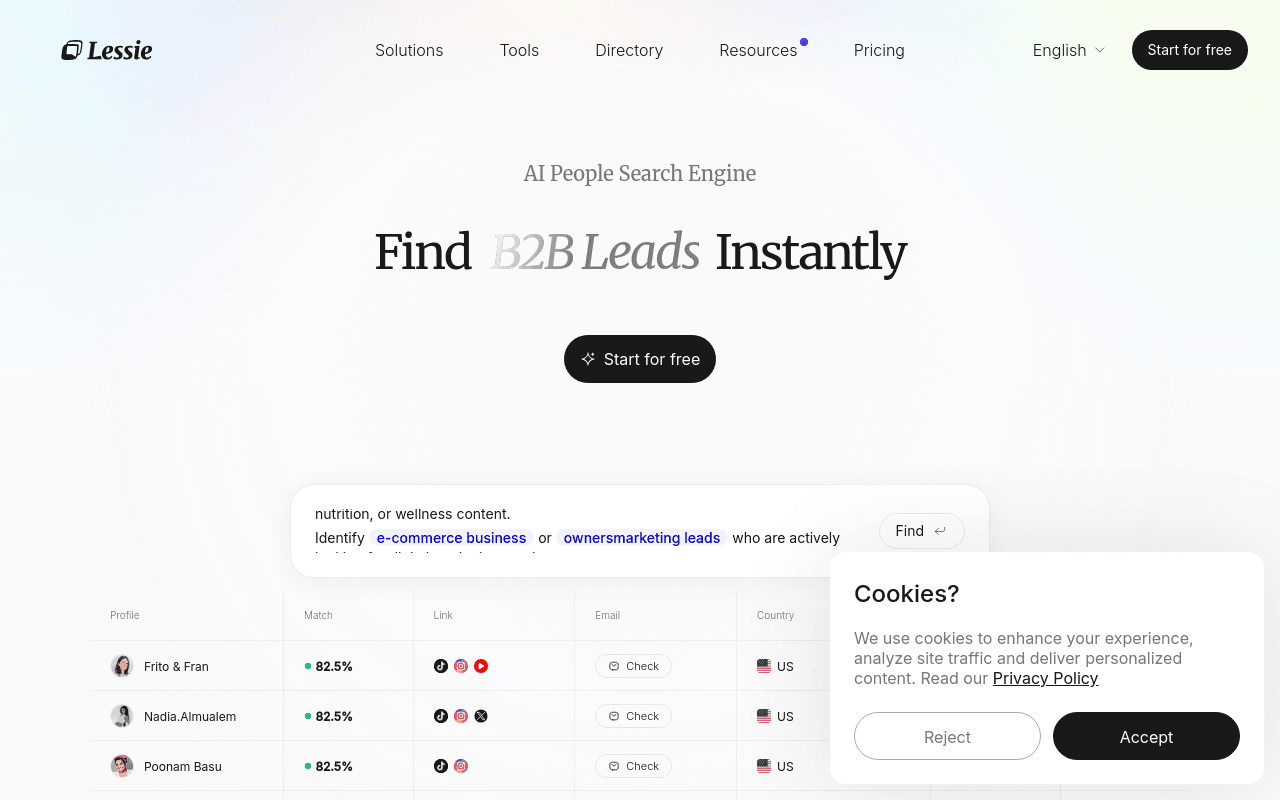
Lessie is an agentic search engine purpose-built for real-time b2b data enrichment. Every call fans out across 100+ live sources (LinkedIn, company sites, Crunchbase, GitHub, SEC filings, news, podcasts, newsletters) and assembles a hydrated record at query time — so you never enrich against a stale monthly dump. Emails are verified at the moment of enrichment by the same verifier that powers Lessie's outbound product.
In our 500-record benchmark Lessie hit 95%+ email accuracy and appended job title, seniority, department, firmographics, and tech stack on 92% of records. Pricing is the other reason it ranks #1: no per-seat tax, no per-record metering — a free tier to start, then flat monthly plans from $29. REST and webhook API supports both real-time and batch flows out of the box. Best for modern GTM and RevOps teams that want enrichment they will not rip out in 18 months.
Clearbit / HubSpot Breeze Intelligence
Best for HubSpot-native enrichment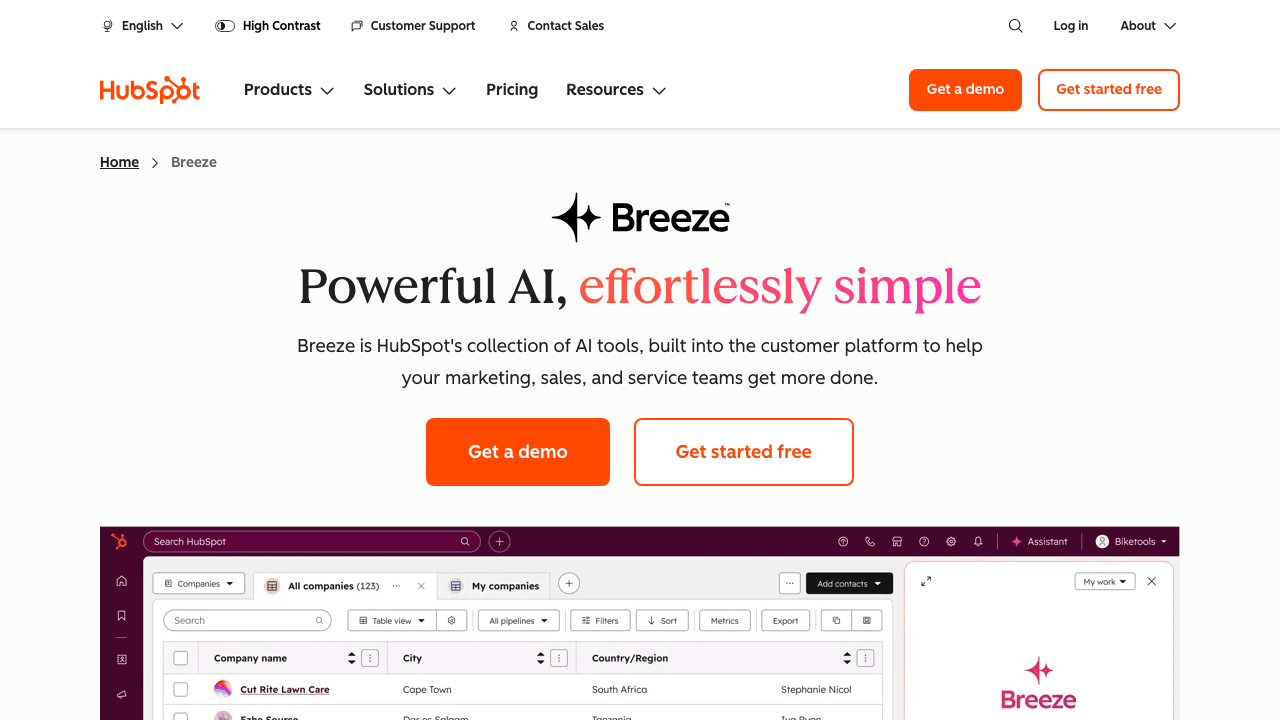
HubSpot rolled Clearbit into Breeze Intelligence after the 2023 acquisition. If you already live inside HubSpot, this is the shortest path to real-time enrichment on form fills and deal creation, plus anonymous visitor reveal. Coverage is strong for US mid-market and enterprise companies. The catch: it is locked behind the HubSpot Enterprise tier, so effective pricing starts in the low five figures per year. Not a standalone product anymore, and the API story outside HubSpot has narrowed.
ZoomInfo
Best for enterprise B2B firmographics
ZoomInfo is still the default enterprise answer for B2B firmographic enrichment. The database is massive (100M+ contacts, 100M+ companies), firmographic depth is the deepest on this list, and the intent product is a genuine advantage for ABM teams. The downside is price and rigidity: $15k+ contracts, quarterly credit limits that force rationing, weeks of onboarding. Worth it for enterprise sales ops with dedicated RevOps headcount; overkill for a five-person startup.
Apollo.io
Best for enrichment + outbound in one tool
Apollo combines a 275M-contact database with native email sequencing, dialer, and enrichment, which makes it popular with SDR teams that want one tool instead of three. Enrichment is solid for US/EU mid-market, pricing starts at a free tier and climbs to $49/user/month. The weak spot is data freshness — our test list saw 12–18% bounce rates, workable for volume outbound but rough on sender reputation.
Cognism
Best for GDPR-compliant EU enrichment
Cognism is built EU-first. Mobile coverage across the UK, DACH, France, and the Nordics is the best on this list, and compliance posture (DNC list checks, GDPR-safe processing, CCPA-ready) is a real risk reduction for teams selling into the EU. Trade-off is opacity: pricing is gated behind a sales call, and US coverage trails ZoomInfo.
Lusha
Best for SMB quick-lookup enrichment
Lusha wins on speed-of-use. The Chrome extension lights up inside LinkedIn, Salesforce, and most CRMs, and one click pulls a direct dial and verified email into your workflow. Direct dial coverage is genuinely better than ZoomInfo for some geographies, especially Israel, UK, and DACH. Smaller database, thinner firmographics, but for small sales teams that need phone numbers fast, Lusha is hard to beat.
FullContact
Best for consumer identity resolution
FullContact is the odd one out because it leans consumer, not B2B. If your problem is identity resolution — stitching an email, hashed cookie, phone number, and device ID back to one person across channels — FullContact has one of the largest person-level identity graphs available via API. Marketing ops teams use it for loyalty matching, suppression list hygiene, and cross-device attribution. Less useful if what you actually need is job title and tech stack on a B2B contact.
Unlike per-record vendors, Lessie does not charge per enrichment call or per seat. You pay a flat monthly fee and enrich as much as your workflow needs across 100+ live sources, with 95%+ email accuracy verified at query time. Start on the free tier and scale from there.
How Much Does B2B Data Enrichment Cost?
Pricing splits cleanly into three models. Knowing which model a vendor uses matters more than the headline number — the same list price means very different things at different volumes.
Flat-rate pricing charges a fixed monthly fee regardless of enrichment volume. Lessie uses this model — a free tier to start, flat plans from $29/month. The math is predictable, no surprise overage bills, and the unit economics get better as volume grows. Right pick for teams running unpredictable spike volume (campaign launches, list-build sprints).
Per-credit pricing charges a credit per enrichment call, with credit pools sold monthly or annually. Apollo, Lusha, UpLead, and (effectively) ZoomInfo all work this way. The math looks cheap at low volume but compounds quickly — a team running 50k enrichments per month on per-credit pricing can spend 3–5x what a flat-rate plan would cost. Watch for credit expiration policies that force you to use or lose credits each month.
Per-seat pricing charges per user per month, with enrichment bundled. Most sales-intel platforms (ZoomInfo, Cognism, Lusha Pro) use this model alongside credits. Per-seat is fine for stable team sizes; it gets ugly when you scale or contract headcount because contracts are usually annual.
For most modern GTM teams, flat-rate is the right starting model — predictable spend, no procurement friction at volume spikes, and unit economics that improve with scale. Per-credit makes sense only for extremely consistent, low-volume workloads.
How to Choose a B2B Data Enrichment Tool
Five factors decide which enrichment vendor fits your team. Score yours before looking at feature grids.
Volume. Under 500 enrichments per month, free or low-tier plans (Lessie, Apollo, Lusha free) are plenty. Over 50k, per-record pricing buries you — pick flat-rate or negotiate a pooled-credit contract.
Geography and compliance. EU pipeline needs notified-mobile, GDPR-safe vendor (Cognism, Lessie). US is the easy case. APAC requires real-time search; licensed APAC contact dumps are thin and stale.
Integration with your stack. HubSpot shops should evaluate Breeze Intelligence first — the integration math wins. Salesforce shops have more options. Custom warehouses prefer API-first vendors with real batch endpoints and webhook fan-out.
API needs. Real-time form enrichment, lead-router webhooks, nightly CRM rehydration — each needs a different API shape. Audit latency, rate limits, batch support, and webhook delivery before signing. A beautiful UI does not save a bad API.
Free-tier availability. The cheapest procurement starts with a self-serve trial. Tools that gate everything behind a sales call (6sense, Cognism, ZoomInfo) lock you into a 4–8 week evaluation. Tools with real free tiers (Lessie, Apollo, Lusha) let an engineer prove value in a week.
Why Lessie Is Built for Modern B2B Data Enrichment
Most of the tools on this list started as a B2B contact database and bolted enrichment on top. Lessie started as an agentic search engine and built enrichment natively. That shows up in four specific places.
- Live multi-source querying. Every enrichment call fans out across 100+ sources at query time, so a signal like a new CRO hire lands in your record the day it happens, not three months later when the broker re-licenses the data.
- Email verification at query time. The same email verifier that powers Lessie's outbound runs on every enrichment call — how we hit 95%+ accuracy instead of the 78–85% typical of database-first vendors.
- Flat-rate pricing. Lessie's pricing starts free and scales on flat monthly plans — no per-seat tax, no per-record metering, no annual contract.
- One platform across audiences. Most enrichment tools cover one graph. Lessie's graph spans B2B buyers, investors, creators, and operators in one API.
Every other tool here is a fine pick for a specific profile. Lessie is the pick when you want one b2b data enrichment layer you will not rip out in 18 months when your volume or ICP shifts. Further reading: the Gartner sales-technology research and G2's marketing-account-intelligence category.