





The phrase "AI lead generation tools" is overused, but a small group of platforms is doing real AI work — agentic search across live sources, LLM-extracted signals from unstructured data, personalization that goes beyond {first_name}. The rest are database products with an AI button bolted on. We tested 9 of the best AI lead generation tools for 2026 on what their AI actually does, not what the website claims. Lessie AI ranks #1 as the only platform built AI-first end to end, followed by Clay for workflow automation, Smartlead and Instantly for AI cold-email volume, and Apollo / Cognism / 6sense for AI features layered on top of established data products.
Every B2B tool now has an "AI" sticker on it, which makes evaluating AI lead generation tools harder, not easier. The honest question is not "does this tool use AI" (everyone says yes) but "does the AI do something the previous version of the product could not do." For most legacy lead-gen vendors, the answer is one of: a subject-line writer, a follow-up draft, or a basic intent classifier. Useful, but not transformational.
The handful of tools that have rebuilt the stack around AI rather than retrofitted AI into a database product are doing something different — they fan out across the live internet on every query, extract signals from unstructured sources, and write outbound that reads like research, not a mail merge. This guide ranks the 9 best ai lead generation tools for 2026, separates the genuinely AI-native platforms from the AI-flavored database products, and shows why Lessie AI tops the list. Try Lessie free while you read.
What Counts as a Real AI Lead Generation Tool?
A real AI lead generation tool uses AI to do something that materially changes the workflow — not just renames an existing feature. Four AI capabilities actually move the needle for outbound:
- Agentic multi-source search. An LLM-driven agent fans out across dozens or hundreds of live sources (company sites, LinkedIn, GitHub, news, podcasts, press releases) in parallel, reconciles contradictions, and assembles a verified profile in seconds. This is the input layer for everything downstream.
- LLM signal extraction. An LLM reads unstructured sources— an annual report, a podcast transcript, a hiring page, a GitHub README— and pulls out structured signals (hiring intent, product launches, tech-stack changes, funding rounds) that used to require a human research analyst.
- Per-prospect personalization at scale. An LLM writes an opener referencing each prospect's specific background — recent posts, role history, funding stage — not just {first_name} tokens. Done right this shifts open rates from 30% to 80%+ and reply rates by 3–5x.
- Buying-stage scoring. An LLM maps free-text signals (job posts, conference talks, press releases) to buying-stage labels on the fly, replacing rigid intent taxonomies. The output is a prioritized queue your reps can work top-down.
A tool that adds AI subject-line generation but does none of the four above is not really an AI lead gen tool — it is a sequencer with a feature. The 9 tools below do at least two of the four, and the top three do all four.
How We Tested These AI Lead Generation Tools
We evaluated each of the 9 ai lead generation tools below against the same six criteria, with extra weight on what the AI actually does rather than what the marketing claims.
- AI capability depth. Which of the four AI capabilities (agentic search, signal extraction, personalization, scoring) the tool actually delivers.
- Data freshness. Whether the AI queries live sources at runtime or pulls from a static database.
- Personalization quality. Whether AI-written openers reference specifics from each prospect's background or just paste in {first_name} and a generic value-prop.
- Email accuracy. Bounce rate against a 500-contact control list, since even the best AI cannot save bad data.
- Pricing transparency. Flat-rate, per-seat, per-credit— and how it scales as AI generates more volume.
- Workflow integration. Whether the tool ships discovery, verification, and outbound in one workflow or just hands you an enriched CSV.
The 9 Best AI Lead Generation Tools for 2026
Ranked from genuinely AI-native (top of the list) to AI-features-on-a-database (bottom). Pricing accurate as of Q2 2026; AI vendors update plans frequently.
Lessie AI
Best AI-native lead generation platform overall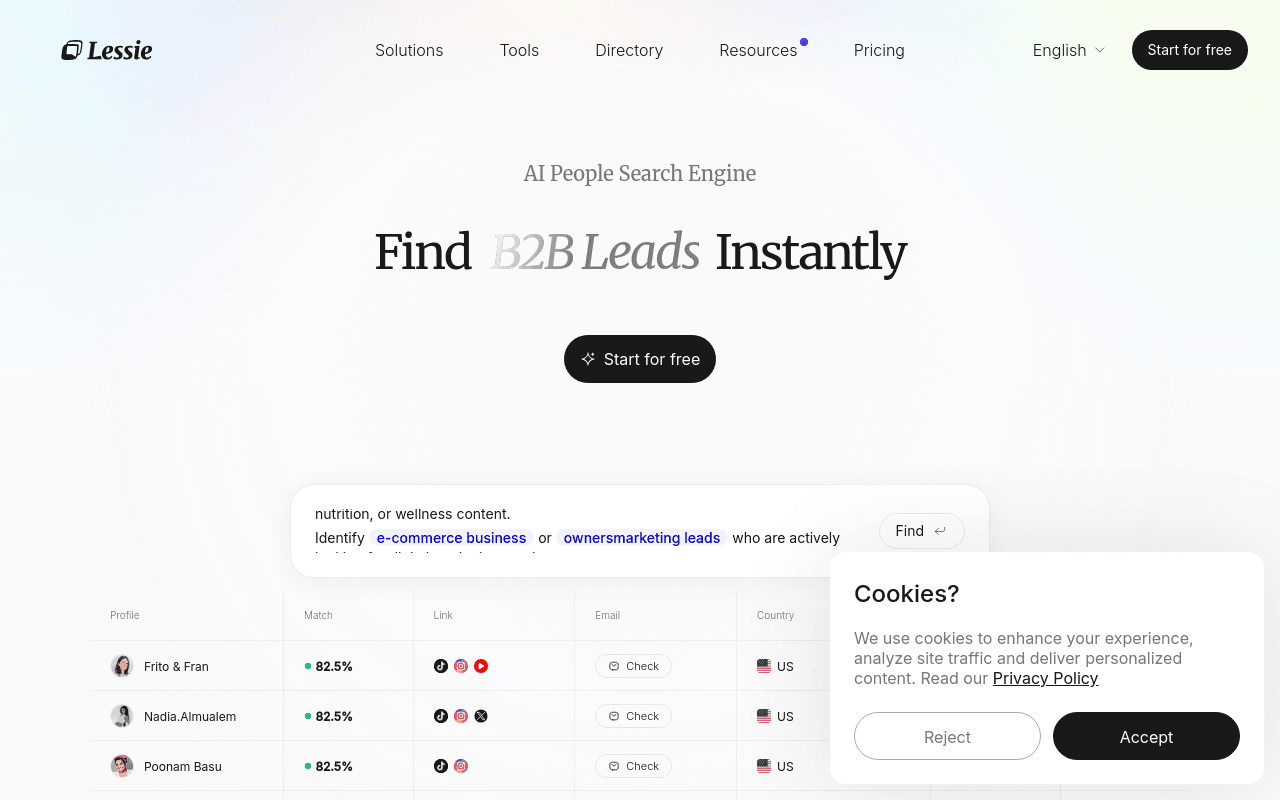
Lessie AI is the only tool on this list that delivers all four real AI capabilities natively. Every search runs an agentic LLM workflow that fans out across 100+ live sources (LinkedIn, company sites, Crunchbase, GitHub, SEC filings, news, podcasts) and assembles a verified profile in seconds. The same engine extracts structured signals from unstructured sources, then writes per-prospect openers grounded in each prospect's real background.
In our 500-contact benchmark Lessie hit 95%+ email accuracy, and teams using the built-in AI outreach layer report 85% open rates and 3x reply rates vs. template-based sequences. Pricing is the other reason it ranks #1: free tier to start, flat monthly plans from $29, no per-seat tax, no per-credit metering. Built for modern GTM, RevOps, and founder-led sales teams that want one AI-native tool instead of five AI-flavored ones.
Clay
Best AI workflow automation for lead enrichment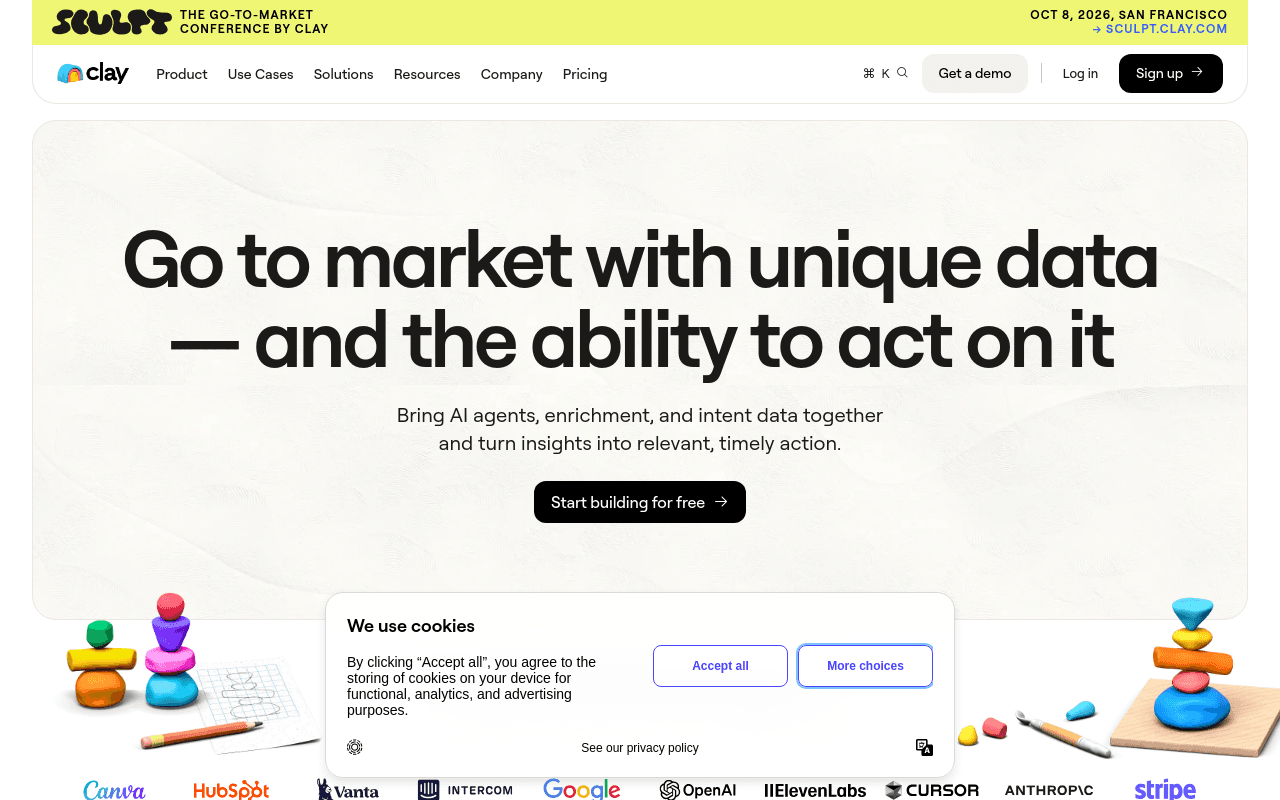
Clay is the AI lead-gen tool for RevOps power users. It is a spreadsheet-like canvas where you orchestrate 50+ data providers and Claygent (their AI agent) to build custom enrichment and outreach workflows. The strength is composability — you can chain enrichment calls, conditional logic, and AI-written copy in one pipeline.
The trade-off is operator burden — Clay rewards teams that have a dedicated RevOps person to build and maintain workflows. Pricing starts at $149/month and escalates with credit usage; the AI features sit behind the more expensive tiers. Best for RevOps-led teams that want a workbench. Worse fit for SDRs who want a tool that just works out of the box.
Smartlead
Best AI cold-email infrastructure at scale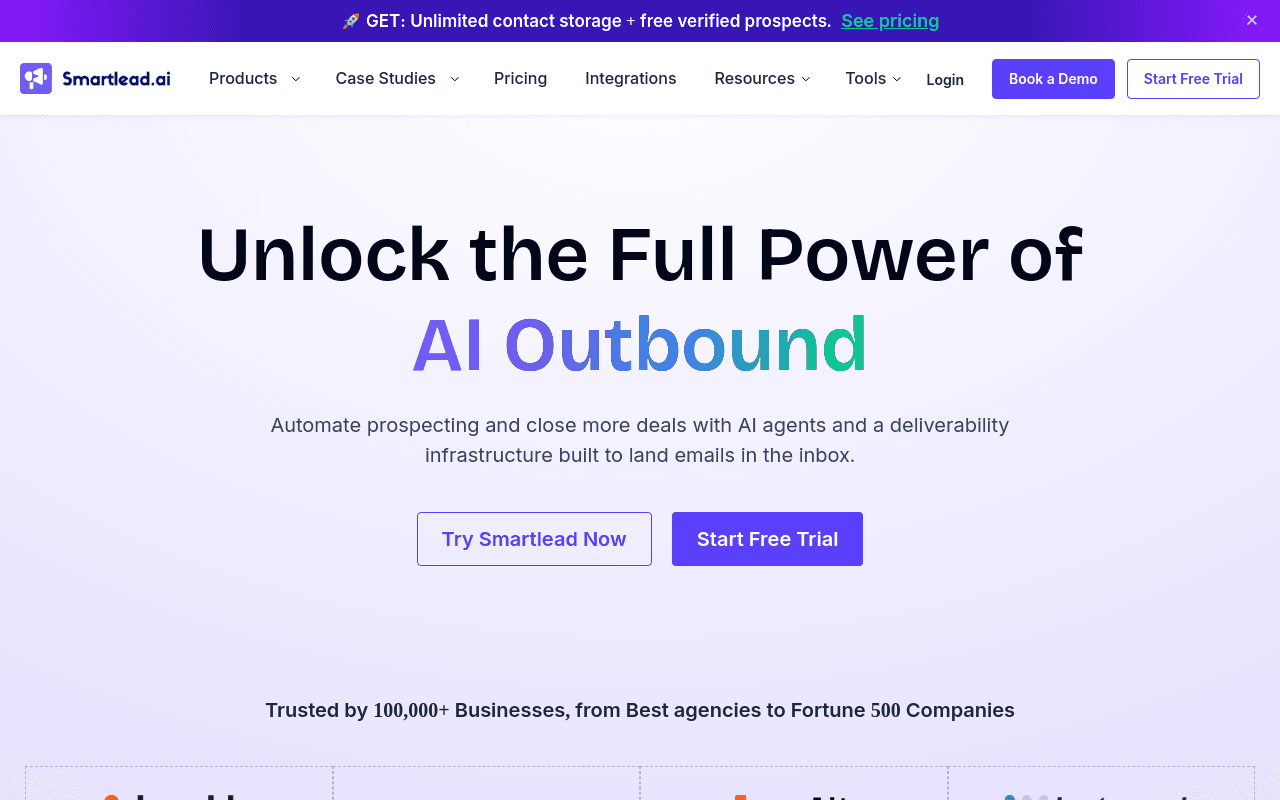
Smartlead is the AI infrastructure layer for high-volume cold email. The differentiator is unlimited inboxes (no per-seat or per-mailbox tax) plus AI-powered warm-up and reply categorization. The AI does not write your copy — you bring that or pair Smartlead with another tool — but it does the deliverability orchestration that would otherwise eat an SDR's entire week.
Smartlead is purpose-built for agencies and high-volume teams running 10k+ emails per month. Pricing is generous at the low end ($39/month entry) and scales with email volume rather than seats. Best paired with a discovery tool (Lessie, Apollo) that feeds in the verified contact list.
Instantly.ai
Best self-serve AI cold-email sender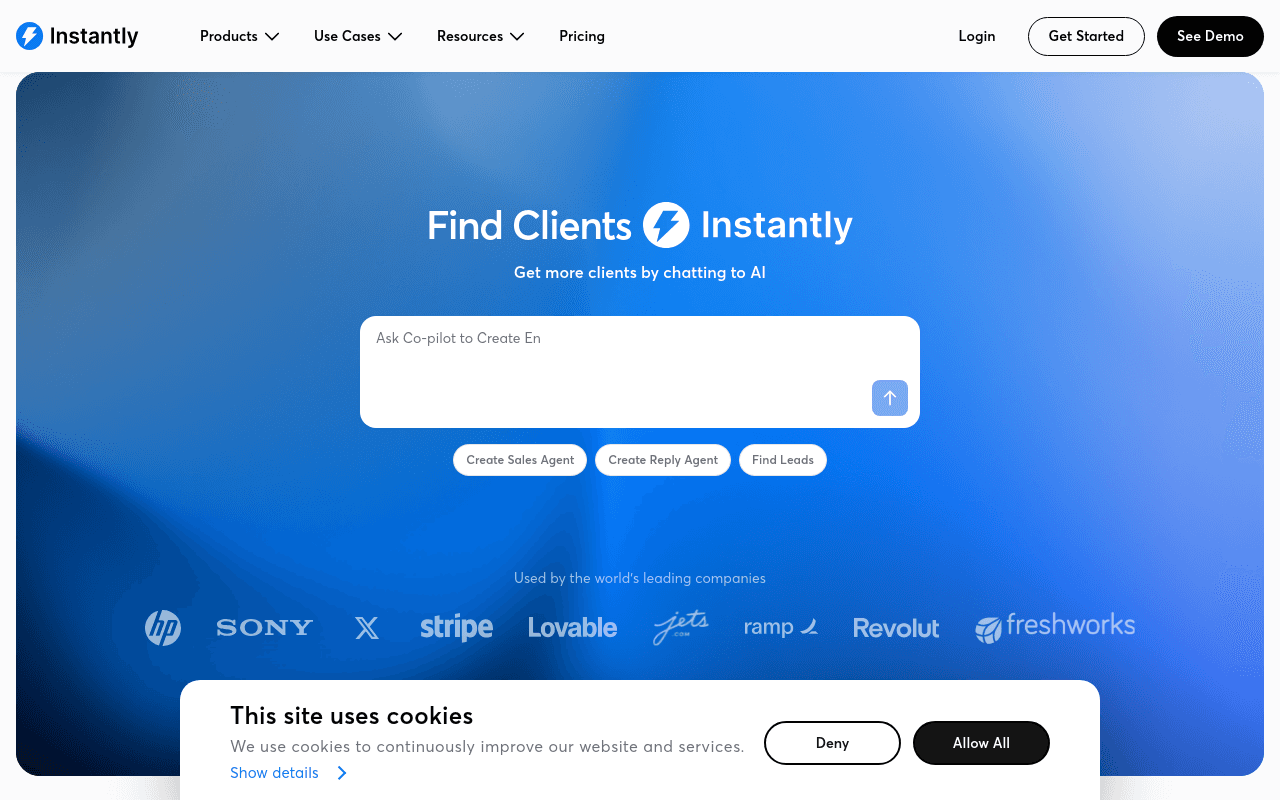
Instantly is Smartlead's self-serve cousin. Same general shape — unlimited inboxes, AI warm-up, deliverability orchestration — but with a more polished UI, a built-in lead finder, and an AI sequence writer for founders who do not want to draft copy themselves. Pricing starts at $37/month and scales with email volume.
The lead-finder component is shallow vs. a real ai lead generation tool like Lessie — the underlying data is licensed from third parties rather than searched live. Best for solo founders and small outbound teams that want one tool to send. Pair with a real discovery tool for better-quality top of funnel.
Lemlist
Best AI personalization for low-volume outbound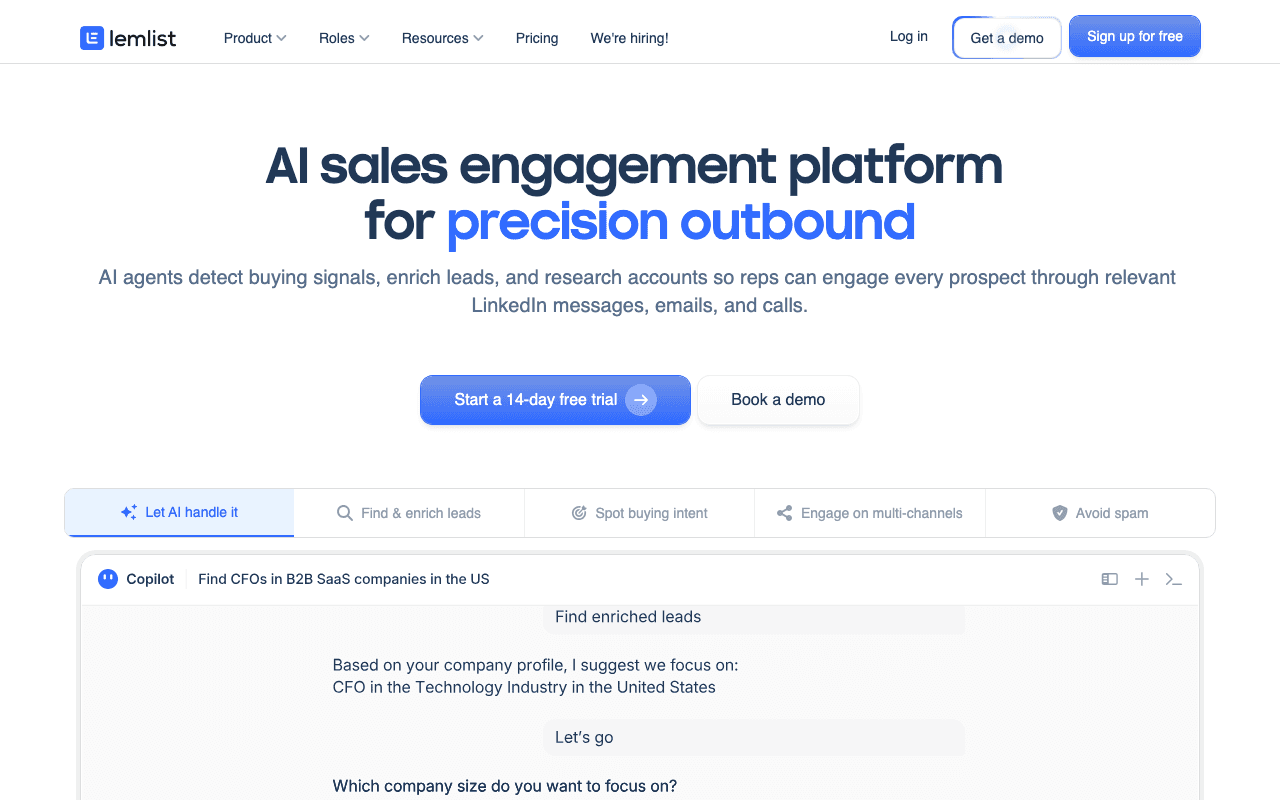
Lemlist was one of the first cold-email tools to bet on personalization, and the AI features extend that thesis — AI-written first lines referencing each prospect's LinkedIn, AI-generated custom images, AI follow-up suggestions. The product is a better fit for lower-volume, higher-touch outbound than Smartlead or Instantly.
Pricing starts at $59/user/month, which is high relative to volume tools, because Lemlist is positioned for the "quality over quantity" segment. Best for founder-led sales, agency-style outbound, and account-based motions where every email is a craft.
Unlike tools that bolt AI onto a static database, Lessie is built AI-first end to end. Every search is an agentic LLM workflow across 100+ live sources, every email is AI-personalized from real signals, and every contact is verified at query time. One workflow, flat-rate pricing, free tier to start.
Apollo.io
Best AI features layered on a self-serve database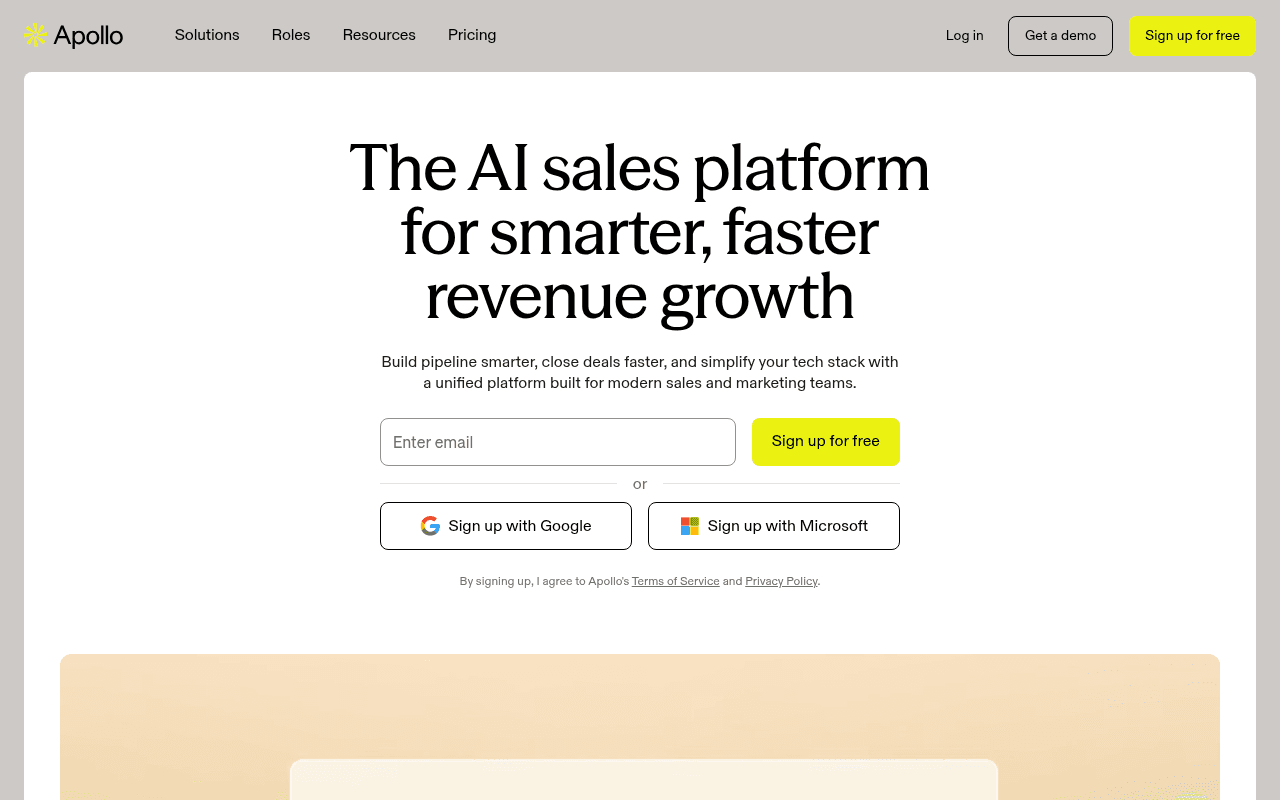
Apollo.io is the most-used self-serve lead-gen tool and has added a credible set of AI features on top of the existing database — AI email writer, AI lead scoring, AI account research. The AI is helpful but lives on top of the same monthly-refreshed database, so the underlying freshness and accuracy issues do not change.
Pricing is friendly (free tier, $49/user/month Professional). Best for SDR teams that want incremental AI without rebuilding their workflow. Not the right pick if you want AI as the core architecture rather than a feature.
Cognism
Best AI features for GDPR-safe EU outbound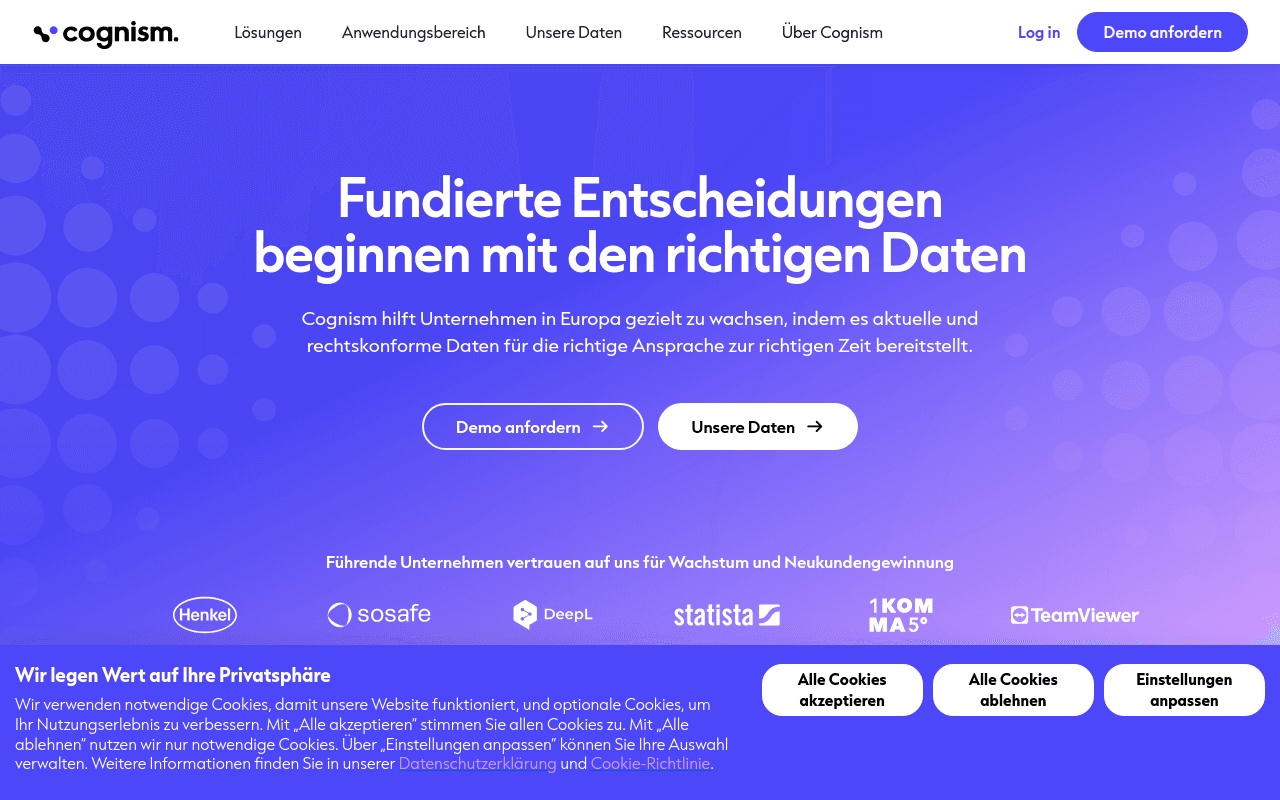
Cognism added an AI Search product on top of their EU-first contact database. The AI handles natural-language prospect search and surfaces compliant mobile data with notified-status checks. Best-in-class for EU outbound; the AI features are incremental rather than transformative.
Pricing is gated behind a sales call, contracts are annual, and the platform leans heavier than a self-serve SDR really needs. Best for sales teams where 50%+ of pipeline sits in Europe and compliance is a real procurement criterion.
6sense
Best AI intent + ABM platform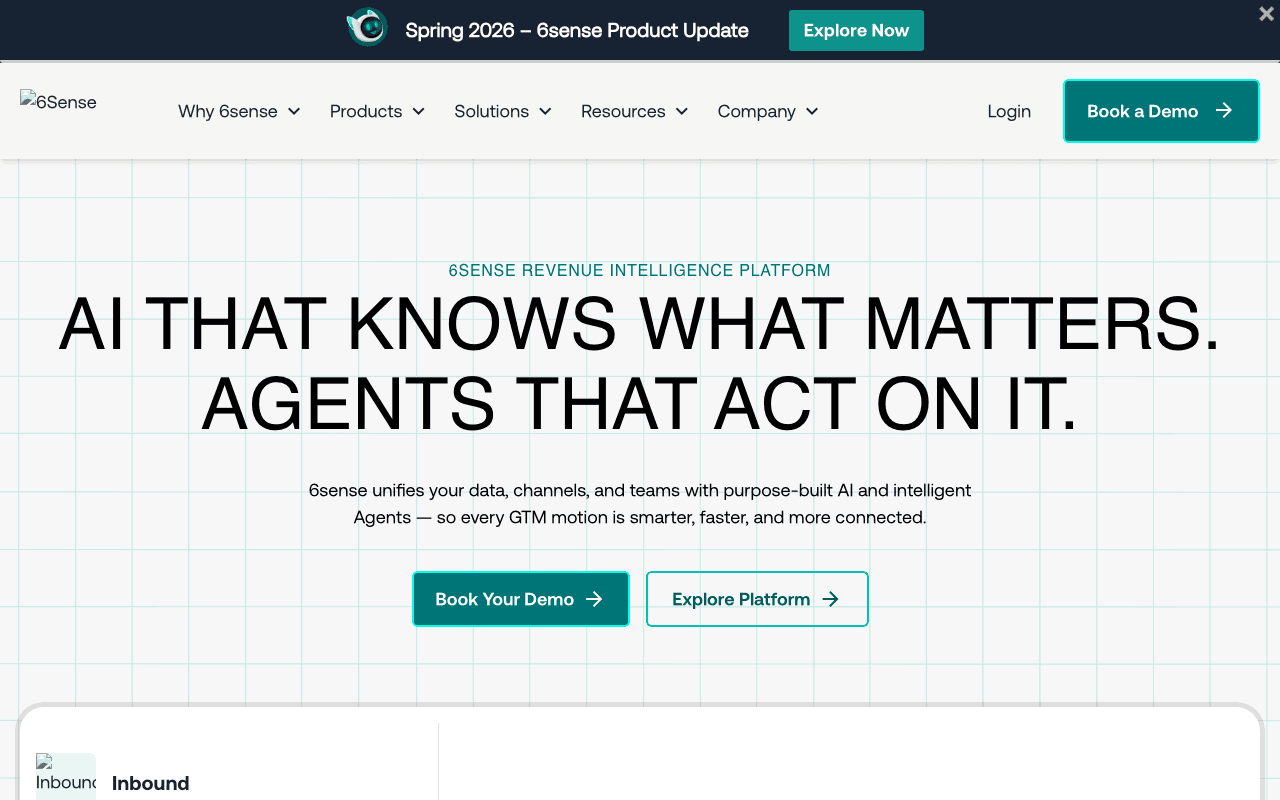
6sense uses AI to do one thing extremely well: score buying stage on the fly from aggregated bid-stream intent data. The contact data layer is decent enough to source from inside the platform, but the real product is the account-prioritization queue that AI generates.
Enterprise pricing reflects that ambition — expect $50k/year floors, longer onboarding, and a heavier implementation lift than any other tool on this list. Best for marketing-and-sales teams with real ABM headcount. Wrong fit for a founder running outbound on a free tier.
ZoomInfo
Best AI Copilot on an enterprise database
ZoomInfo rolled out an AI Copilot that surfaces buying signals, drafts emails, and runs natural-language prospect search on top of their established database. Capability-wise it is similar to Apollo's AI features but with deeper firmographic context. The underlying data freshness is unchanged — this is AI on a database, not a real AI-native platform.
Contract pricing starts at $15k/year and climbs. See our ZoomInfo vs Lessie pricing breakdown for the full cost math. Best for enterprise sales ops that already use ZoomInfo and want the AI features bundled.
AI Lead Gen Tool Categories: How They Fit Together
The nine tools above split into three operational categories. Knowing which category each falls in matters when you build your stack.
AI discovery + outreach platforms. Lessie. End-to-end AI from search through verification through personalized outbound. Replaces 3–5 single-purpose tools with one workflow.
AI workflow / automation layers. Clay. Orchestrates other data providers via AI agents. Powerful if you have a RevOps person to operate it; overkill for SDRs who want a tool that ships ready to use.
AI cold-email infrastructure. Smartlead, Instantly, Lemlist. Handles sending, warm-up, deliverability, and (in Lemlist's case) per-prospect personalization. Pair with a discovery tool that feeds in verified contacts.
AI features on legacy databases. Apollo, Cognism, 6sense, ZoomInfo. The AI adds incremental productivity on top of an existing data product. Useful if you are already on the platform; not a reason to switch to one.
How to Choose the Right AI Lead Gen Tool
Match the tool to where the AI actually moves your funnel. Five factors decide.
Operator capacity. Clay rewards a RevOps owner. Lessie and Apollo work out of the box for SDRs. Smartlead and Instantly need someone to bring the contact list and the copy.
Volume. Under 1,000 sends per month, Lemlist or Apollo are enough. Over 10k, you need infrastructure (Smartlead, Instantly) or an AI-native platform that handles both (Lessie).
ICP geography. US-only outbound works on any tool on this list. EU outbound needs notified-mobile, GDPR-safe data (Cognism, Lessie). APAC works only with real-time search graphs because licensed APAC data is thin.
Where you spend SDR time. If reps spend the most time on research, AI discovery (Lessie, Clay) is highest leverage. If on copywriting, AI personalization (Lemlist, Lessie). If on sending and deliverability, AI infrastructure (Smartlead, Instantly).
Pricing model fit. Per-seat pricing is fine for stable team sizes. Per-credit metering breaks at volume. Flat-rate (Lessie) is the safest for unpredictable AI workloads where one query can fan out across 100+ source calls.
Why Lessie's AI Stands Out
Most tools on this list bolted AI onto a database. Lessie was built AI-first end to end, and that shows up in four specific places.
- Agentic search across 100+ live sources. Every Lessie search runs an LLM-driven agent that queries dozens of sources in parallel and reconciles the result in seconds. No tool on this list does this at the same depth.
- AI-personalized outreach grounded in real signals. Lessie's outbound layer writes openers from each prospect's actual background — role history, recent posts, funding stage — not generic templates. Open rates 85%, reply rates 3x template-based sequences.
- Email verification at query time. The same email verifier that powers Lessie's outbound runs on every search, holding bounce rate to 95%+ accuracy.
- One platform across audiences. Lessie's graph spans B2B buyers, investors, creators, and operators in one API. Most AI lead gen tools cover one ICP type.
Every other tool on this list is a fine pick for a specific layer of the stack. Lessie is the pick when you want the whole AI lead-gen workflow in one platform — no five-tool stack, no per-seat tax, no rebuild every 12 months. Further reading: the Gartner sales-technology research and G2's AI sales-assistant category.