




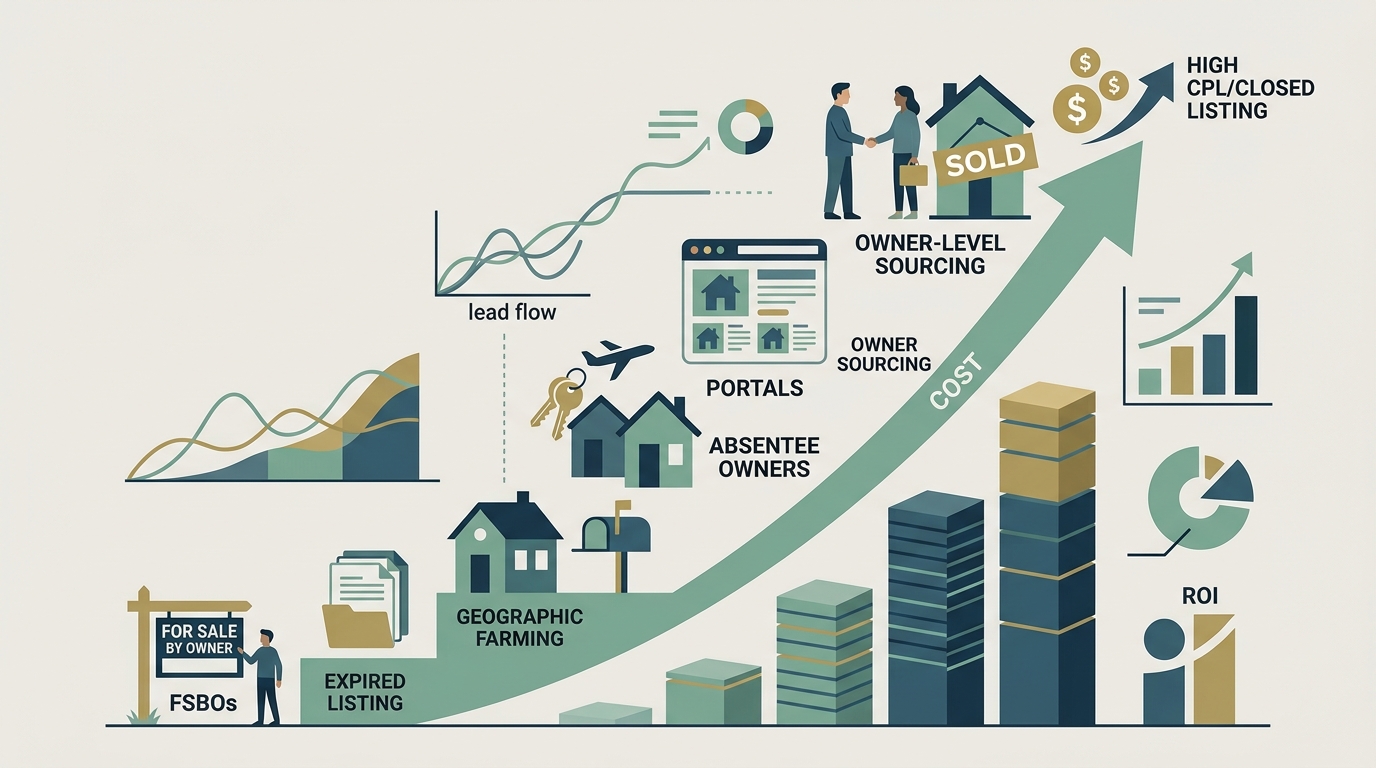
Real estate seller leads come from six places: purchased portal leads, expired listings and FSBOs, geographic farming, absentee and out-of-state owners, life-event signals, and your own sphere. They are not priced the same way and they do not convert the same way. A portal lead is cheap per lead and expensive per closed listing because four other agents received it at the same second. The only number worth managing is cost per closed listing, and once you calculate it, most agents discover they are paying for volume in the one channel where volume is worth the least.
Every agent buying seller leads for realtors can tell you what they pay per lead. Almost none can tell you what they pay per listing taken. That gap is where the money goes. A $40 lead that converts at 0.5% costs $8,000 per listing; a $200 lead that converts at 8% costs $2,500. The cheap channel was the expensive one the whole time, and the per-lead price on the invoice never showed it.
This guide takes the six real sources of seller leads apart one at a time: what each one actually costs, whether the lead is exclusive or shared, how it converts into a signed listing agreement, and — the part vendors do not volunteer — the point at which each source stops working. By the end you should be able to decide whether to keep buying portal leads or move budget to reaching owners directly.
What Counts as a Seller Lead — and Why a Loose Definition Makes Cost Per Lead Meaningless
A seller lead is a specific thing: an identified property owner, with a contact route you are permitted to use, who has a plausible reason to sell within your working horizon. Strip out any one of those three and you do not have a lead — you have a name, a phone number, or a hunch.
This matters because vendors count differently than you do. A home-valuation form fill is counted as a lead the moment the address is submitted, whether or not the visitor left a real phone number, whether or not they own the property, and whether or not they were simply curious what the neighbours got. Compare that to a referral from a past client who has already told you they are moving in the spring. Both arrive in your CRM as one row. They are not one thing.
Use a three-part definition and apply it before anything enters your pipeline. Identity: you know which parcel and which owner of record. Reachability: you have a phone, email, or address you are legally allowed to contact. Motivation: something in the record or the conversation points at a move — an expired listing, a life event, a stated timeline. Anything failing a test goes to a research list, not to your outreach queue.
The payoff is arithmetic. When you count only leads that pass all three tests, your cost per lead goes up and your conversion rate goes up with it, and the two numbers finally describe the same population. That is the precondition for comparing any two sources honestly. Skip it and every comparison in the rest of this article is noise.
The Six Real Sources of Real Estate Seller Leads
There are only six ways sellers reach you at any scale. Everything marketed as a seventh is a repackaging of one of these, usually with the acquisition cost hidden inside a monthly subscription.
1. Portal purchases. Zillow, Realtor.com, and their competitors sell you the attention of someone who filled in a form on a property page. Volume is immediate and predictable, which is why new agents start here. The lead is usually early-stage, often shared, and the intent behind a valuation form fill ranges from "listing next month" to "refinancing and curious." Per-lead prices commonly run from the low tens of dollars to a few hundred depending on ZIP code competitiveness.
2. Expired listings and FSBOs. These owners have already proven motivation— they tried to sell. Expireds failed with another agent; for-sale-by-owners are failing on their own. Both are the most competed-for lists in the business: an expired listing is contacted by dozens of agents within 48 hours. Data cost is low. The real cost is call volume, thick skin, and a script that survives the first ten seconds.
3. Geographic farming and circle prospecting. You pick a neighbourhood and become the agent people there think of first, through mail, door-knocking, and calls around recent sales. Nothing converts in month one. Farming is a 6–18 month investment that eventually produces listings at a good cost per closing, and it collapses if you stop halfway — which is what makes it the source most often abandoned right before it starts paying.
4. Absentee and out-of-state owners. An owner whose mailing address differs from the property address is not currently living there. Landlords tired of managing from three states away, inherited properties, accidental landlords after a job relocation: absentee owner leads convert well because the emotional attachment that slows an owner-occupier decision is often absent. These are not sold as leads — they are assembled from ownership records and enrichment, which is why fewer agents work them.
5. Life-event signals. Probate, divorce, tax delinquency, long-vacancy, code violations, new job in another metro. These are the classic motivated seller leads, and they carry an obligation: the person on the other end is dealing with something difficult. Handled with tact these are among the highest-converting contacts in real estate. Handled as a volume play they generate complaints and reputational damage that outlast the commission.
6. Sphere and referrals. Past clients, friends, and the people they recommend you to. The highest conversion rate of any source by a wide margin, the lowest marginal cost, and the one nobody can buy more of this quarter. Its constraint is time, not money, which is exactly why it gets neglected the moment a paid channel is available.
Sources 4 and 5 are not bought — they are assembled. Lessie searches 100+ live sources to identify property owners who match a situation you describe in plain language, and returns verified contact details so the list is workable the same day.
Shared Versus Exclusive: the Arithmetic Portal Pricing Hides
The exclusive vs shared seller leads question is not about lead quality. It is about how many agents are racing you to the same phone. A shared lead sold to five agents is not one-fifth as good as an exclusive one — it is worse than that, because the seller's experience of being called five times in ten minutes damages every call including yours.
Run the numbers on a shared channel. Suppose a lead costs $50 and is sold to five agents. Speed-to-lead decides most of it: the first agent to make contact wins a disproportionate share of the conversations, and if you are consistently third or fourth, your effective conversion rate is a fraction of the advertised one. Your true acquisition cost is the $50 plus every lead you paid for and never reached. At a 1% listing conversion rate, $50 leads cost $5,000 per listing before you count a single hour of your own time.
An exclusive lead at $250 with a 6% conversion rate costs about $4,170 per listing —cheaper, on five times the per-lead price. That is the entire argument, and it is why per- lead pricing is the wrong unit for buying decisions. It is also why cost per listing lead should be the number on your dashboard, not cost per lead.
Three questions to ask any lead vendor before signing. How many agents receive this lead? What is the median time between the consumer submitting the form and my receiving it? And can I see conversion data for my specific ZIP code rather than a national average? A vendor unwilling to answer the first question has answered it.
Owner-Level Sourcing: Reaching an Owner Before a Listing Exists
Every source above except farming and sphere shares one property: you are buying access to someone who has already raised their hand. That is why they are competitive. Owner-level sourcing inverts it — you start from the property and the owner, and make contact before there is anything for other agents to compete over.
The job is different in kind, not just in cost. Buying leads is a purchasing decision: pick a vendor, set a budget, manage speed-to-lead. Sourcing is a research decision: describe the owner situation you want, resolve owners of record to reachable humans, and run outreach that makes sense to someone who was not expecting to hear from you. The skills that make an agent good at working portal leads — speed, call volume, fast qualification — are not the skills that make them good at this.
What a sourcing pass looks like. Define the situation before the geography: absentee owners of two-to-four unit properties held more than seven years within a defined boundary is a workable brief; "homeowners in my city" is not. Resolve ownership records into contactable people, verifying that the mailing address and phone actually belong to the current owner. Then write outreach that references the property specifically, because a generic letter to an out-of-state landlord is indistinguishable from the six other generic letters they received that month.
For agents working residential listings, this is the workflow behind find home sellers. For investors and buy-side operators who want owners open to selling without a public listing, off-market seller leads is the same engine pointed at a different outcome. The broader set of workflows for the industry sits under real estate, and the geographic side— building presence in a defined area rather than a defined situation — is covered in local lead generation.
When sourcing is the wrong answer. If you cannot yet handle five listing appointments a week, do not build a machine that produces twelve. Sourcing rewards follow-through over months, and an owner contacted once and then forgotten is worse than an owner never contacted, because the second time you reach them you are the agent who already wasted their attention.
Compliance Before Contact: DNC, Consent, and Rules That Change by State
Owner-level outreach touches regulated territory, and the rules differ by jurisdiction and change over time. Treat this section as the questions to take to your broker and counsel, not as legal advice.
Scrub against do-not-call registries before dialling. Cold outreach to residential numbers on the federal registry — and on state registries, which are separate lists — carries per-call penalties. Maintain your own internal do-not-call list as well, and honour a request the first time it is made, in writing, permanently.
Automated dialling and texting are a stricter category than calling. Prerecorded messages, automated dialling systems, and marketing SMS sit under consent rules that a manual call does not trigger, and the definitions have been actively litigated. Confirm what your dialler or texting platform actually does before you assume a manual exemption applies.
FSBO and expired lists are not consent. A published phone number is published for the purpose the owner published it. Several states impose additional restrictions on soliciting expired listings, and some list vendors sell records without registry scrubbing. Verify rather than assume — the liability lands on the caller, not the vendor.
Life-event data deserves an ethical filter on top of the legal one. Probate and divorce records are frequently public, which makes them lawful to use and easy to misuse. The practical test: would you be comfortable if the recipient read your outreach aloud to their family? If not, the problem is the message, and no compliance checkbox fixes it.
Cost Per Closed Listing, Not Cost Per Lead: a Worked Comparison
Here is the calculation that changes budgets. For each source, track four numbers over 90 days: total spend including your time valued honestly, leads that met the three-part definition, listing appointments held, and listing agreements signed. Then divide spend by agreements. That figure — not the invoice price — is what the channel costs you.
A worked example. The figures below are illustrative, chosen to show the shape of the arithmetic rather than to report market rates; your own ZIP code will produce different inputs and possibly a different ranking. Assume a quarter in which you spend $3,000 on shared portal leads at $50 each. That is 60 leads. You reach 40, hold 6 appointments, and sign 1. Cost per closed listing: $3,000. Now assume you spend the same $3,000 on data and mailing for 400 absentee owners. You reach 60, hold 9 appointments, and sign 2. Cost per closed listing: $1,500, at half the lead count.
The second channel looked worse on every vanity metric — fewer leads, lower contact volume, longer cycle — and produced twice the listings for the same money. This is the normal result when a shared, early-intent source is compared against an exclusive, situation-qualified one, and it is invisible to anyone measuring cost per lead.
Count your time or the comparison is fiction. Farming and sphere look free because no invoice arrives. Price your hours at what a listing appointment is worth and both stop looking free — though sphere usually still wins, which is the point. A channel that consumes 15 hours a week is spending real money whether or not anyone charges you for it.
Do not judge a source before it has had 90 days and at least 30 qualified leads. Listing cycles are long enough that a channel evaluated at week six will always look like a failure, and the sources with the best cost per closed listing — farming, sourcing, sphere — are precisely the ones that look worst early.
How to Get Listing Leads: a 30-Day Plan for a Solo Agent
The honest answer to how to get listing leads in the next 30 days is: work the two sources that do not require budget, and start the one that compounds. Here is the sequence.
Days 1–7: instrument what you already have. Build the four-column tracker — source, qualified leads, appointments, signings — and backfill the last two quarters from your CRM. Most agents discover at this step that one channel produced most of their listings and a different channel consumed most of their budget.
Days 8–14: contact your sphere with a specific ask. Not a newsletter. Thirty conversations with people who already trust you, each ending in a concrete question: who do you know who has mentioned moving in the next year? This is the highest-yield week of the month and the one most agents skip because it feels like it does not count as prospecting.
Days 15–21: pick one owner-level segment and build a list of 200. One segment, one boundary. Absentee owners in a defined area, or owners who have held more than ten years in a neighbourhood with rising prices. Resolve owners to verified contacts, scrub against do-not-call registries, and write one letter and one call script referencing the property specifically.
Days 22–30: work the list and record everything. Two touches minimum, different channels, at least five days apart. Log outcomes in the same tracker. At day 30 you will not have a conversion rate yet — you will have a contact rate, which is the first honest signal about whether the segment is reachable at all.
What changes at three people. A solo agent should own the entire chain, because the feedback from a bad call is the fastest way to fix a bad list. At three people the constraint moves: split list-building from calling from appointments, and the number to watch becomes appointments-per-hour-of-calling rather than cost per lead. That is also the point where a shared portal channel becomes defensible — not because the leads improved, but because you finally have the speed-to-lead coverage that shared leads require.
Describe the owner situation in plain language — absentee, long-held, out-of-state— and Lessie returns matching owners with verified contact details from 100+ live sources. Agents start with find home sellers; investors start with off-market seller leads.