




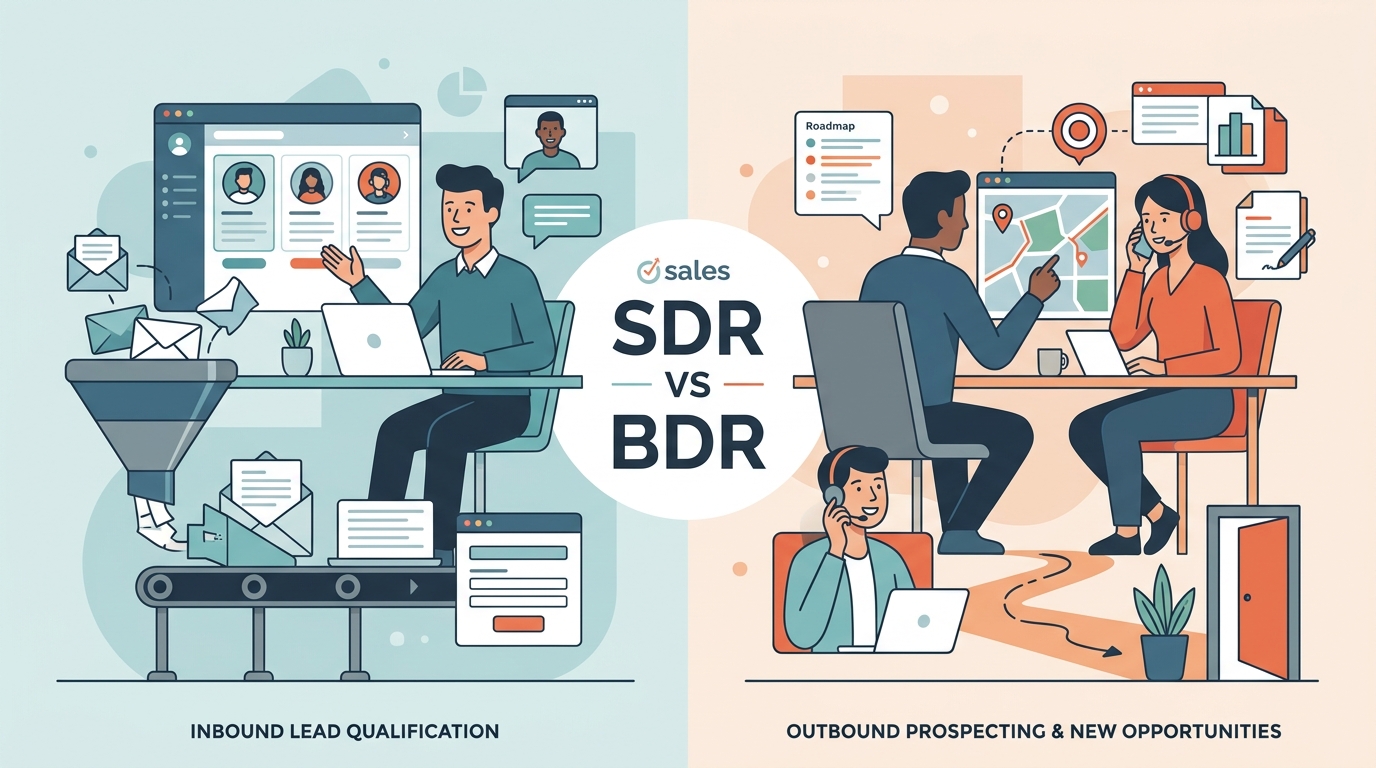
TL;DR: The core SDR vs BDR difference is direction, not letters. An SDR (Sales Development Representative) qualifies inbound leads that already raised a hand — trials, demo requests, form fills. A BDR (Business Development Representative) builds target lists and prospects cold accounts that have never heard of you. Titles vary by company, so always check the actual job description before you assume. Metrics, comp, and tooling differ accordingly: SDRs are judged on speed and qualification, BDRs on reply rate and pipeline sourced from scratch.
If you’ve spent any time hiring for a sales team, you’ve run into the SDR vs BDR question — usually in the middle of writing a job description, when you realize you’re not sure which title you actually mean. The two acronyms get used interchangeably, swapped between companies, and occasionally invented on the spot. That’s a problem, because the title you choose shapes who you hire, how you comp them, and which part of your pipeline gets fed.
Here’s the short version: an SDR (Sales Development Representative) most often qualifies inbound interest — leads that already raised a hand — while a BDR (Business Development Representative) most often generates outbound pipeline from scratch, prospecting into accounts that have never heard of you. That’s the cleanest way to draw the line, but it is not a law of physics.
Plenty of organizations use the terms in exactly the opposite way, and some use them as synonyms. This guide gives you the common convention, the real day-to-day differences, the metrics that matter for each, and a side-by-side table you can actually use when you’re structuring a team.
What an SDR Actually Does
An SDR qualifies inbound leads that already showed interest. In the most widely used convention, the SDR sits at the top of the funnel on the inbound side. When someone downloads a whitepaper, books a demo, starts a free trial, or fills out a “contact sales” form, that lead lands in the SDR’s queue. The job is speed and qualification: respond fast, check fit against your ideal customer profile, confirm real intent, and — if the fit is real — book a meeting for an Account Executive (AE).
Because the lead already showed interest, the SDR’s conversation is warmer. You’re not convincing someone your category exists; you’re confirming budget, authority, need, and timeline, and routing the good ones downstream. That makes the SDR role heavy on qualification frameworks (BANT, MEDDIC, and the like), fast follow-up, and disciplined CRM hygiene.
Speed to lead is everything: respond in five minutes instead of an hour and your conversion rate can multiply. A lot of SDR pipeline overlaps with warm leads — people who are already showing buying signals and just need a fast, relevant human on the other end.
What a BDR Actually Does
The BDR, in the same convention, owns outbound. Nobody raised a hand. The BDR builds a target account list, researches the right contacts, and reaches out cold — email, LinkedIn, phone — to create interest where there was none. This is the harder, grittier top-of-funnel motion, and it demands a different temperament: comfort with rejection, creativity in messaging, and real research skill.
A strong BDR lives in the prospecting layer. They define which accounts to chase, find the decision-makers inside them, and craft outreach that earns a reply from someone who has never heard of your company. That means the quality of their list and the relevance of their message decide their entire quarter.
This is exactly where automated prospecting and LinkedIn prospecting tooling change the math — a BDR who spends four hours a day building lists has four fewer hours to write and send. The best outbound teams push list-building and enrichment onto software so reps stay in the conversation.
The one-line rule most teams use: SDR = inbound qualification (work the leads marketing generates), BDR = outbound prospecting (generate pipeline from cold accounts). But titles vary by company — always read the responsibilities in the job description, not just the acronym.
Building a clean target-account list is the biggest time sink in the BDR role. Lessie searches 100+ live sources on every query and hands back verified emails, so your reps skip straight to writing and sending instead of researching.
The Core Difference, Honestly
The real distinction isn’t the three letters — it’s the direction of the motion. Inbound roles react to demand that already exists. Outbound roles manufacture demand that doesn’t. Everything else — the metrics, the skills, the tooling, the comp — flows from that single fork.
You should assume nothing from the title alone. At Company A, an “SDR” might do 100% cold outbound. At Company B, a “BDR” might handle inbound demo requests. Some orgs use “SDR” as the umbrella term for both and never say BDR at all; others do the reverse. When you’re hiring, interviewing, or benchmarking comp, read the actual responsibilities: Is this person working leads that came in, or creating leads that weren’t there? That question tells you more than any acronym.
Day-to-Day Responsibilities Side by Side
Zoom into a normal Tuesday and the two roles look quite different. An SDR’s morning is driven by the inbound queue: new form fills, trial signups, and demo requests that need a response before they go cold. A BDR’s morning is self-directed: pick the accounts, find the people, research the angle, and start sequences. Here’s the head-to-head.
| Dimension | SDR (typical) | BDR (typical) |
|---|---|---|
| Primary motion | Inbound qualification | Outbound prospecting |
| Lead source | Marketing (forms, trials, demos) | Self-built target account lists |
| First touch | Reactive — respond fast | Proactive — cold outreach |
| Core skill | Qualification, speed to lead | Research, cold messaging, resilience |
| Conversation tone | Warm — they already engaged | Cold — earn the first reply |
| Main output | Qualified meetings for AEs | Net-new pipeline from cold accounts |
| Time sink | Lead follow-up and CRM hygiene | List-building and account research |
| Tooling leverage | Lead routing, speed-to-lead alerts | Prospecting data, enrichment, sequencers |
Metrics and KPIs That Actually Differ
SDRs and BDRs are judged on different numbers because they feed the funnel from opposite ends. SDRs live and die by speed to lead and qualification quality. BDRs live and die by reply rate and pipeline sourced from cold accounts. Comp an outbound BDR on a pure inbound conversion rate and you’ll punish them for a variable they don’t control.
For SDRs, watch speed to lead (median time from lead creation to first touch), lead-to-meeting conversion rate, meetings booked, and — the one that really matters — meetings held and accepted by the AE. Because the volume is fed to them, quality of qualification is the truest signal: an SDR who books 30 meetings where 25 are real is worth more than one who books 50 where 15 are junk.
For BDRs, watch outbound activity (emails, calls, LinkedIn touches), reply rate, positive reply rate, meetings booked from cold, and pipeline dollars sourced. Reply rate is the leading indicator — it tells you whether the list and the message are working before you wait a full sales cycle for revenue. A BDR with a 1% reply rate has a data or messaging problem; a BDR at 8–10% positive replies is building a real quarter.
One number both roles share: meetings that actually convert to opportunities downstream. A role that books meetings the AE team can’t close isn’t producing pipeline —it’s producing calendar noise. Tie both roles to accepted opportunities, not just raw meeting count.
SDR vs BDR Compensation: How the Money Differs
SDR and BDR pay share the same on-target-earnings (OTE) structure — a base salary plus variable comp tied to meetings booked or pipeline sourced — but the split looks different. SDR OTE in the US typically runs $65,000–$85,000, weighted more toward a fixed base since inbound volume is steadier. BDR OTE for the same seniority commonly lands a bit higher, often $75,000–$95,000, because more of the pay is at-risk and tied to a harder, self-generated outbound motion.
That gap exists because the market prices in difficulty: generating pipeline from cold accounts that have never heard of you is a harder job to guarantee results in than qualifying leads that already exist. The premium narrows in strong inbound markets and widens in competitive enterprise segments, where a single BDR-sourced logo can be worth six figures in annual contract value.
Comp isn’t the only cost, though. Both roles need list and enrichment tooling to hit quota, and stacking a data provider, an email verifier, and a sequencer can run $100–$300 per rep per month before software even touches the CRM. That’s the gap Lessie closes: one free-to-start search engine replaces the separate list, enrichment, and verification tools, so the real cost of running either seat drops closer to just the rep’s salary.
Career Path: Where Each Role Leads
Both titles are entry points into a sales career, and the ladder from here is well worn. The most common next step for a high-performing SDR or BDR is Account Executive — carrying a quota and closing the deals they used to source or qualify. From AE, the path branches into senior AE, then either people management (SDR/BDR manager, then sales manager, then director and VP of Sales) or the individual-contributor enterprise track.
There are a few nuances here. BDRs, because they own the hardest top-of-funnel motion, often build the sharpest cold-outreach and account-strategy muscles — skills that translate cleanly into full-cycle AE work and, later, sales leadership. SDRs, steeped in qualification and fast handoffs, frequently move into sales operations, RevOps, or customer success, where their process discipline is an asset.
Neither path is “better”; they just start from a different top-of-funnel muscle. Either way, one to two years of strong numbers in these seats is the standard on-ramp to almost every other GTM role.
When Does a Team Need Which?
You don’t need both roles on day one, and choosing wrong wastes headcount. The deciding factor is where your demand comes from.
Hire SDRs first when you have inbound. If marketing, content, or a product-led motion is already generating more leads than your AEs can work, you have a qualification bottleneck, not a demand-generation one. SDRs fix that: they catch inbound fast, filter it, and feed the AEs clean meetings. Spinning up outbound while you’re drowning in unworked inbound is a mistake.
Hire BDRs when inbound is thin or you’re moving upmarket. If your ICP is a specific set of named accounts that will never fill out a form — enterprise buyers, niche technical roles, hard-to-reach executives — you need someone manufacturing pipeline. BDRs are how you sell into a market that doesn’t know it needs you yet. Early-stage startups with no brand and no inbound almost always start with outbound BDR motion out of necessity.
Run both once you scale. Mature GTM orgs separate the two so each motion gets specialized talent, tooling, and metrics. Inbound SDRs optimize for speed and qualification; outbound BDRs optimize for targeting and messaging. Blending them into one “do everything”seat usually means both jobs get done at 60%.
How AI Prospecting Tools Augment Both Roles
AI prospecting tools help by erasing the single biggest time sink both roles share: finding and verifying the right people. SDRs chase down missing context on inbound leads (who is this person, what company, is the email even real). BDRs burn hours building and enriching target lists before they can send a single message. That’s the layer where AI prospecting tools like Lessie pay for themselves.
Instead of querying one static database, Lessie is an agentic search engine that scans 100+ live sources on every query — LinkedIn, company sites, funding data, GitHub, podcasts, news — and returns verified decision-makers with emails checked at search time, not cached from months ago.
For a BDR, that means the list-building and enrichment step that used to eat half the day collapses into a search, and AI for sales prospecting writes the first-touch draft from real signals in each prospect’s public footprint. Teams see roughly 3x reply rates versus templated sequences because the personalization is drawn from context, not merge fields.
For an SDR, the same engine enriches inbound leads instantly — full profile, verified contact info, company context — so qualification happens in seconds and no good lead stalls waiting for research. And for outbound-heavy teams that want the whole motion handled, an AI BDR can run sourcing, enrichment, and first-touch outreach on autopilot, freeing your human reps to work the replies that matter.
The point isn’t to replace SDRs or BDRs — it’s to delete the low-value list-work so they spend their hours on conversations, where humans still win. Want more plays like this? Browse the Lessie blog.
Whether you run inbound qualification or outbound prospecting, the bottleneck is the same: verified contact data. Lessie checks emails at search time across 100+ live sources, so neither role waits on a stale list.