




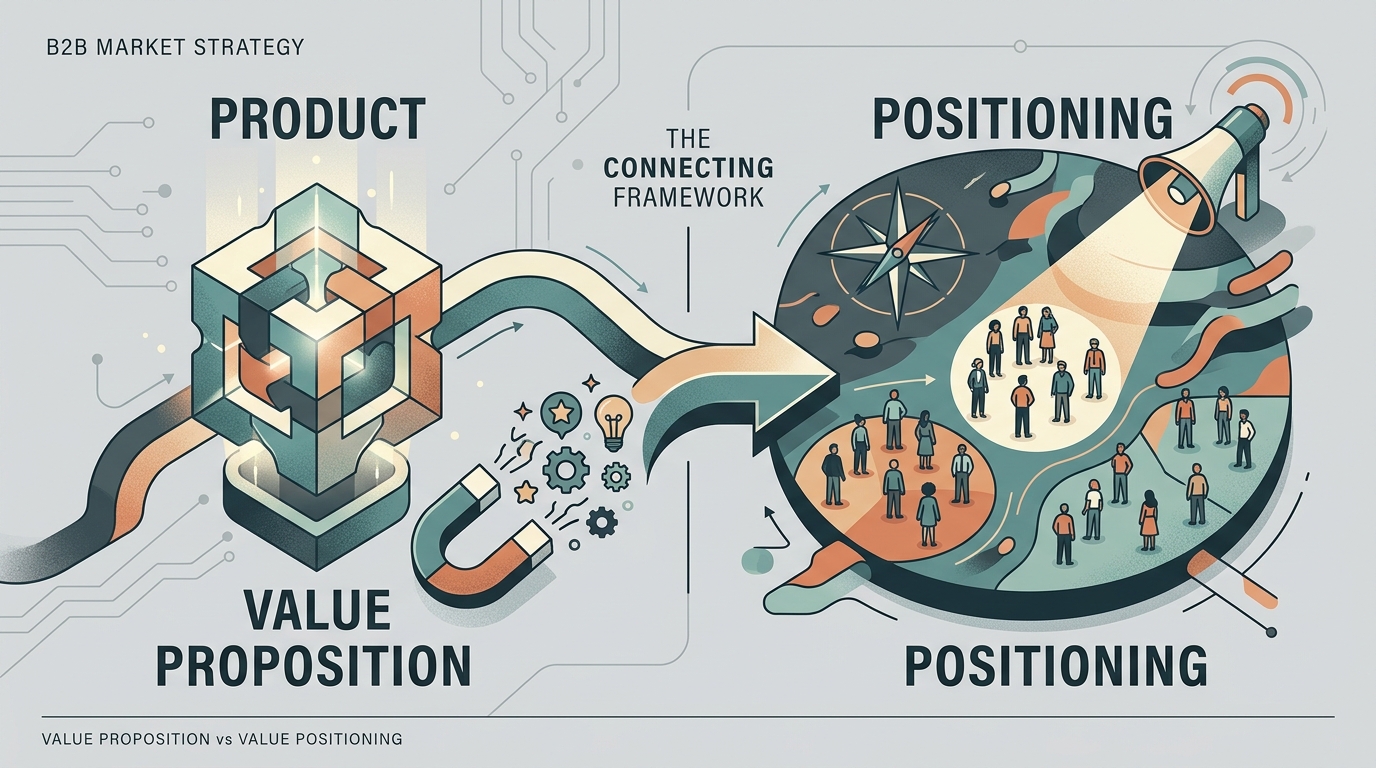
Value positioning is how your product fits into a buyer's competitive landscape and decision criteria. Value proposition is the explicit benefit statement you deliver to that buyer. Positioning is the strategy (who you are for, who you are not for, what category you compete in); the proposition is the message that flows from it. Most B2B teams confuse the two and end up with generic propositions that fail because the underlying positioning is unclear. The 4-part value positioning framework below — target buyer, frame of reference, differentiator, value delivered — produces statements that actually connect.
Every B2B founder, marketer, and PMM eventually asks the same two questions: what is our value positioning, and how is it different from our value proposition? The terminology gets used interchangeably in pitch decks and homepage copy, but the underlying concepts are different jobs. Positioning is strategy —the choice of which buyers, which competitive set, and which differentiator to win on. Proposition is the artifact — the headline, the elevator pitch, the email opener that delivers the positioning to a specific buyer.
This guide untangles value positioning from value proposition, explains the 4-part positioning framework that actually produces useful output, and shows side-by-side examples of strong vs. weak positioning. Then we cover how modern AI-native prospecting (Lessie) lets you deliver positioning at the per-buyer level rather than as a static homepage statement.
What Is Value Positioning?
Value positioning is the strategic choice of where your product sits in the buyer's mind relative to alternatives. It answers four questions in order: (1) who is the buyer, (2) what frame of reference (category, competitive set) does the buyer use to evaluate options, (3) what makes your product different inside that frame, and (4) what is the resulting value to the buyer.
Positioning is intentionally exclusionary. A strong positioning statement says who you are not for, which category you do not compete in, and which differentiators you do not lean on. Companies that try to position for everyone position for no one.
The canonical positioning statement template (originally from April Dunford's Obviously Awesome) reads:
For [target buyer] who [need / problem], [product name] is a [category / frame of reference] that [unique differentiator] unlike [alternatives], which means [resulting value].
What Is Value Proposition?
Value proposition is the explicit benefit statement you deliver to a target buyer at a specific touchpoint. It is the headline on the homepage, the first line of the cold email, the opener of the sales pitch. The proposition does not contain the full positioning — it expresses one slice of it tuned for a specific context.
A typical value proposition has three components:
- The outcome. What the buyer gets if they use you. "Find verified B2B leads in seconds" is an outcome. "The best lead-gen tool" is not.
- The mechanism. How you deliver the outcome. "Search 100+ live sources" is a mechanism. "AI-powered" is not.
- The differentiator. Why you specifically. "95% accuracy with query-time verification" is a differentiator. "Industry-leading" is not.
Value Positioning vs Value Proposition: Side-by-Side
The clearest way to see the difference is what each looks like in the wild.
Positioning (strategy, internal):
"For modern B2B GTM teams who want verified decision-maker contacts without per-seat tax, Lessie is an AI-native prospecting platform that searches 100+ live sources at query time, unlike static contact databases (ZoomInfo, Apollo) which sell you yesterday's data refresh. That means our customers replace 3–5 single-purpose tools with one workflow and hold bounce rates under 5%."
Proposition (artifact, customer-facing) on the homepage:
"Find verified decision-makers across 100+ live sources. 95% email accuracy. AI-personalized outreach included. Start free."
Proposition (artifact, customer-facing) in a cold email opener:
"Noticed Acme just closed Series B — congrats. We help post-B GTM teams replace their static contact stack with one AI-native workflow that holds bounce under 5%. Worth a 15 min look?"
Same positioning. Three different propositions. Each tuned to the touchpoint and the buyer context. This is the move generic homepages miss — they write one proposition and assume it works across every channel.
The 4-Part Value Positioning Framework
Strong value positioning is built from four explicit choices. Most B2B companies skip one or two and end up with positioning that does not differentiate.
1. Target buyer. Who is the customer, by role, company stage, and situation? "CMOs at Series B SaaS companies that just hired a VP Sales" is a target buyer. "Marketing leaders" is not.
2. Frame of reference. What category does the buyer mentally place you in when evaluating? This is not always your preferred category — it is the buyer's. If buyers compare you to ZoomInfo, the frame is "B2B contact database" even if you call yourself something else internally.
3. Differentiator. What you have inside that frame that competitors do not. The differentiator must be (a) true, (b) provable, and (c) something the buyer actually cares about. "AI-powered" fails (a) and (c). "95% email accuracy with query-time verification" passes all three.
4. Value delivered. The downstream consequence of the differentiator for the buyer. Not the feature, the result. "Bounce rate under 5%" is feature-adjacent. "Send 5x more cold email before Gmail flags your domain" is the result.
How to Write a Value Positioning Statement Step by Step
A working positioning statement takes 2–4 hours and a real customer-interview evidence base. The shortcut version below assumes you have already talked to 5–10 customers and prospects.
- 1List the alternatives buyers actually consider
Not your competitive set as you see it — the alternatives buyers compare you against in real evaluations. Often includes the "do nothing" or "internal-build" alternative. Ask your last 5 won and lost deals what they evaluated you against.
- 2Identify your unique attributes vs those alternatives
List every meaningful difference between you and the alternatives. "AI-native" alone is not a difference unless every alternative is non-AI. "100+ live sources" is a difference if alternatives use static databases. Be specific.
- 3Map attributes to buyer-cared-about value
For each attribute, ask: what does this mean for the buyer? "100+ live sources" means "data stays fresh as your ICP changes." "Query-time verification" means "bounce rate stays under 2%." Cut attributes that do not map to a buyer-caring outcome.
- 4Pick the target buyer who values your differentiators most
A given set of differentiators creates more value for some buyers than others. Post-Series-B SaaS GTM teams value Lessie's differentiators more than solo founders. Pick the buyer who values the differentiators most —that becomes your target. You will get other buyers too, but optimize for the target.
- 5Compose the positioning statement, test it on 3 customers
Plug your four elements into the template. Then read the statement aloud to 3 actual customers and 3 prospects. They should be able to repeat the differentiator back to you within 30 seconds. If they cannot, the positioning is not clear enough.
Strong positioning is generic on the homepage and surgical at the outreach moment. Lessie surfaces funding stage, tech stack, recent hires, and role context on every contact — so your value proposition tunes to the specific buyer in front of you, not a generic ICP archetype.
Examples: Strong vs Weak Value Positioning
Real-world side-by-sides. Names anonymized.
Weak (B2B SaaS, marketing analytics): "The leading marketing analytics platform for modern teams. Built by analytics experts. Get insights faster." — No target buyer, no frame of reference, no differentiator, no value. Could be any of 50 vendors.
Strong (same vendor, after positioning work): "For B2B SaaS marketing leaders who need attribution that survives ITP and ATT browser changes, [Vendor] is the only marketing analytics platform that uses server-side event capture instead of pixels — which means your conversion data stays accurate as cookies disappear." — Clear target, clear frame, real differentiator, real value.
Weak (B2B services, lead-gen agency): "We help B2B companies scale their pipeline with proven outbound." — Same as 200 other agencies.
Strong (same agency, repositioned): "For post-Series-A B2B SaaS founders who need to validate ICP fit before hiring a VP Sales, [Agency] is the only managed-outbound shop that runs 90-day ICP-validation sprints with weekly hypothesis review — unlike traditional outbound agencies which sell volume and lock you into 6-month minimums. Outcome: ICP confidence before headcount commitment."
Common Value Positioning Mistakes
Five failure patterns that turn positioning work into wasted cycles.
Positioning the team, not the product. "Built by ex-Google engineers" is interesting but not positioning. Buyers care about outcomes, not founder pedigree.
Choosing a category buyers do not use. If you call yourself an "AI-native sales acceleration platform" but buyers shop for "contact databases," you have made yourself invisible. Use the buyer's frame, then differentiate inside it.
Picking a differentiator that is true but irrelevant. "100+ engineers in 12 countries" might be true. Buyers do not care unless it ties to a buying-relevant outcome.
Trying to position for two opposite ICPs. A positioning that works for "solo founder doing first 10 outbound emails" and "enterprise CRO with $50k+ budget" positions for neither. Pick one.
Confusing positioning with messaging. Messaging changes per channel and per audience. Positioning is the underlying strategy that messaging expresses. Trying to A/B-test positioning at the homepage level is testing messaging, not positioning.
How AI-Native Tools Change Per-Buyer Positioning
Traditional value positioning work produces one statement that goes on the homepage and into the pitch deck. The 2026 best practice is to keep that core positioning stable but tune the value proposition at the per-buyer level using real prospect context.
Lessie surfaces buyer-specific context on every contact— funding stage, tech stack, recent hires, growth signals. SDR or AE writes the opener referencing that context, which expresses the same underlying positioning through a buyer-specific lens. Result: same positioning strategy, 5x reply rates vs. generic propositions.
For more on connecting positioning to outbound execution, see our B2B lead generation strategies guide and the broader B2B marketing strategy framework. April Dunford's book Obviously Awesome is the canonical reference for positioning frameworks.