




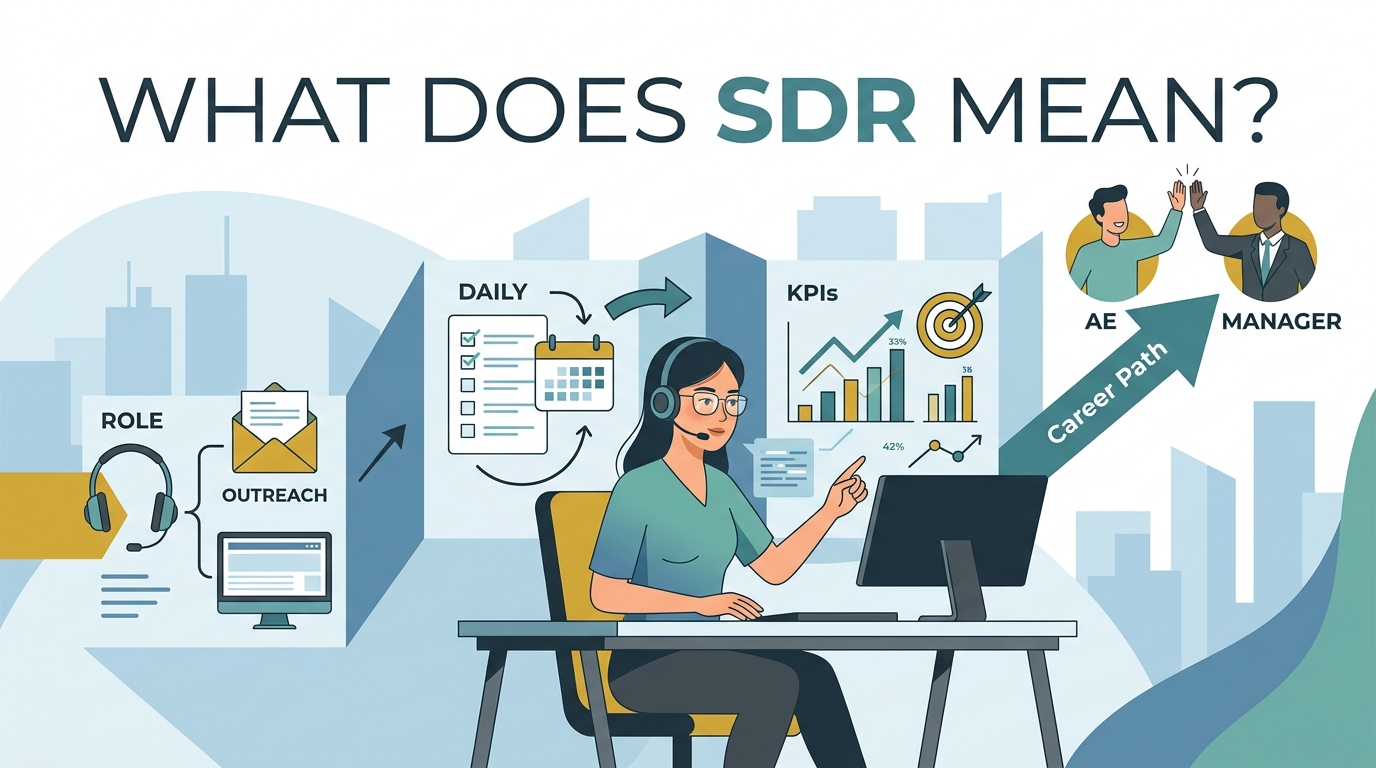
TL;DR: El significado de SDR en ventas para los equipos es Representante de Desarrollo de Ventas (Sales Development Representative) —un vendedor outbound de inicio de carrera cuyo trabajo es calificar leads y agendar reuniones para los Ejecutivos de Cuentas, no cerrar negocios. Los SDRs realizan envíos de correos fríos, llamadas frías y contactos por LinkedIn a una lista objetivo, cumplen con cuotas semanales de actividad y reuniones, y típicamente ascienden a roles de AE en 12–24 meses. Los salarios base en EE. UU. rondan los $50K–$60K con $20K–$30K adicionales en variable.
Si ha escuchado este título en reuniones de pipeline o lo ha visto en una bolsa de trabajo y se ha preguntado qué significa SDR en ventas, no está solo. El Desarrollo de Ventas es una de las funciones de más rápido crecimiento en B2B, pero la definición del rol aún varía enormemente entre startups, empresas de tamaño medio y equipos empresariales. Esta guía explica el significado de SDR en ventas, cómo el rol difiere de los BDRs y AEs, cómo es un día típico, los KPIs que los líderes realmente rastrean, las herramientas que los SDRs usan en 2026 y la trayectoria profesional realista desde un primer puesto de SDR hasta el liderazgo senior de ventas.
Significado de SDR: Representante de Desarrollo de Ventas Explicado
Un SDR, o Representante de Desarrollo de Ventas (Sales Development Representative), es un vendedor B2B responsable de la parte superior del embudo: generar pipeline calificado a través de la prospección outbound. Identifican cuentas objetivo, investigan contactos, ejecutan secuencias outbound (correo electrónico, teléfono, LinkedIn) y entregan prospectos interesados a los cerradores. No negocian contratos, no realizan demostraciones de productos de principio a fin, ni son dueños directos de los números de ingresos —ese es el trabajo del AE.
La frase "Desarrollo de Ventas" fue popularizada por Aaron Ross en Predictable Revenue basado en el modelo que construyó en Salesforce. La idea central: dividir la prospección del cierre permite que cada rol se especialice y escale. Hoy en día, casi todas las empresas SaaS B2B respaldadas por capital de riesgo ejecutan alguna versión de este modelo, por lo que "SDR" aparece en miles de ofertas de empleo de LinkedIn en cualquier momento.
Una definición clara y funcional: un SDR es la persona que convierte un nombre en una lista en una invitación de calendario para un Ejecutivo de Cuentas. Todo lo demás —construcción de listas, secuencias multicanal, manejo de objeciones en llamadas frías, higiene del CRM— está al servicio de ese único resultado. Los equipos que difuminan este límite (pidiendo a los SDRs que también realicen demostraciones, gestionen renovaciones o cierren acuerdos con PYMES) suelen ver una disminución tanto en los volúmenes de prospección como de cierre.
SDR vs BDR vs AE: Cómo Difieren los Roles
Una respuesta rápida de antemano: los SDRs y BDRs son casi idénticos en la mayoría de las empresas —ambos prospectan para agendar reuniones— y los AEs cierran esas reuniones para generar ingresos. La división entre SDR y BDR generalmente depende de la fuente de los leads, no de la actividad en sí.
| Rol | Objetivo Principal | Fuente de Leads | ¿Genera Ingresos? |
|---|---|---|---|
| SDR (Representante de Desarrollo de Ventas) | Calificar y agendar reuniones | Leads inbound (formularios, solicitudes de demo) | No — reuniones agendadas / SQLs |
| BDR (Representante de Desarrollo de Negocios) | Calificar y agendar reuniones | Outbound a cuentas frías | No — reuniones agendadas / SQLs |
| AE (Ejecutivo de Cuentas) | Cerrar acuerdos de principio a fin | Reuniones de SDR/BDR + pipeline propio | Sí — cuota en $ARR |
Las empresas utilizan estas etiquetas de manera inconsistente. Algunas llaman a todos los representantes SDRs independientemente de la fuente del lead; otras dividen SDR (inbound) y BDR (outbound); algunas usan BDR para especialistas outbound senior y SDR para nivel de entrada. Al evaluar un trabajo, observe las actividades diarias reales, la estructura de cuotas y la trayectoria de promoción —no el título en la carta de oferta.
La relación entre SDR y AE es simbiótica: los SDRs necesitan AEs que realmente gestionen bien las reuniones entregadas (para que el trabajo de calificación del SDR rinda frutos), y los AEs necesitan SDRs que agenden reuniones con compradores reales (no con cualquiera que esté dispuesto a atender una llamada). Los equipos de alto rendimiento se reúnen semanalmente para calibrar cómo es una reunión "calificada" en realidad, lo que protege la calidad del pipeline en ambos lados.
Un Día en la Vida de un SDR
Un día de trabajo de un SDR se estructura en torno a la energía y la disponibilidad del prospecto. La mayoría de los representantes concentran las llamadas frías cuando los tomadores de decisiones están en sus escritorios y reservan el trabajo de correo electrónico y LinkedIn para momentos de menor energía. La siguiente estructura es típica para un SDR outbound con sede en EE. UU. que tiene una cuota semanal de reuniones agendadas.
8:30–9:30 AM — Preparación y prospección. Abrir el CRM, revisar las respuestas de la secuencia de ayer, borrar notificaciones y extraer una lista fresca de cuentas para trabajar durante el día. Muchos equipos pre-construyen listas de cuentas objetivo en su herramienta de prospección la noche anterior para que los representantes puedan empezar a llamar inmediatamente a la mañana siguiente.
9:30–11:30 AM — Bloque de llamadas frías 1. El primer bloque de llamadas del día. El objetivo es de 30–50 llamadas, 5–10 conexiones, idealmente 1–2 reuniones agendadas. Los SDRs trabajan con un guion durante los primeros diez segundos e improvisan el resto según la reacción del prospecto.
11:30 AM–1:00 PM — Secuencias de correo electrónico y LinkedIn. Enviar correos electrónicos personalizados a cuentas de alta prioridad, responder a las respuestas inbound y enviar solicitudes de conexión e InMails de LinkedIn a los compradores identificados. Las plantillas hacen la mayor parte del trabajo; el SDR añade 1–2 líneas de personalización por contacto.
1:00–3:00 PM — Bloque de llamadas frías 2. Segundo bloque de llamadas dirigido a la Costa Oeste o a prospectos de la Costa Este después del almuerzo. A menudo, las tasas de conexión son más altas que por la mañana. Los SDRs buscan otras 30+ llamadas aquí.
3:00–5:00 PM — Seguimientos, investigación, construcción de listas. Confirmar reuniones agendadas, enviar invitaciones de calendario, escribir notas de seguimiento en el CRM e investigar las cuentas objetivo del día siguiente. Algunos SDRs utilizan esta ventana para el desarrollo de habilidades —revisar grabaciones de llamadas o seguir demostraciones de AE.
Espere 60–100 actividades outbound por día en un puesto de alto rendimiento. Esa cadencia solo es sostenible cuando la calidad de la lista es alta; los datos incorrectos convierten los bloques de llamadas frías en trabajo de validación de directorios, que es la forma más rápida de agotar a un SDR.
Principales KPIs de SDR y Cómo se Miden
El rendimiento de un SDR se mide en dos capas: actividades (inputs que los representantes controlan directamente) y resultados (los resultados que esas actividades producen). Los gerentes eficientes rastrean ambos, porque la actividad sin resultado indica un problema de segmentación o de mensaje, mientras que el resultado sin actividad suele ser suerte irrepetible.
Métricas de actividad (diarias / semanales).
- Llamadas — Total de llamadas outbound realizadas. Referencia: 40–80 por día, dependiendo de la tecnología de marcación.
- Conexiones — Llamadas en las que el SDR realmente contacta con una persona (no un filtro). La tasa de conexión suele ser del 5–15%.
- Correos electrónicos enviados — Correos electrónicos personalizados 1:1 más pasos de secuencia automatizados. Referencia: 40–80 por día.
- Contactos en LinkedIn — Solicitudes de conexión, InMails, comentarios en publicaciones de prospectos. 10–30 por día es lo normal.
Métricas de resultado (semanales / mensuales).
- Reuniones agendadas — El marcador principal. Las cuotas suelen ser de 8–15 reuniones agendadas por mes.
- Reuniones realizadas — Reuniones agendadas a las que el prospecto realmente asiste. Tasas de asistencia del 60–75% son saludables.
- SQLs (Leads Calificados de Ventas) — Reuniones que el AE acepta como genuinamente calificadas. Esta es la métrica vinculada a la mayoría de los planes de comisión de SDR.
- Pipeline creado ($) — El valor en dólares de las oportunidades generadas a partir de las reuniones de origen SDR. El indicador principal de la calidad del traspaso SDR-AE.
La tasa de respuesta y la tasa de conversión de reuniones son métricas de diagnóstico útiles, no tarjetas de puntuación. Una tasa de respuesta del 1% con una excelente calidad de lista puede superar una tasa de respuesta del 5% con la audiencia equivocada —por eso la calidad de la generación de leads B2B upstream es más importante para un rendimiento sostenible del SDR que el volumen de actividad pura.
Herramientas y Stack Tecnológico del SDR en 2026
El SDR moderno trabaja con un conjunto de cinco categorías de herramientas. La mayoría de las empresas consolidan donde es posible —cada herramienta adicional añade cambio de pestañas y fricción de sincronización con el CRM.
1. CRM. Salesforce, HubSpot o Pipedrive. El sistema de registro para cada cuenta, contacto, actividad y reunión. Los SDRs viven en sus vistas de CRM —la actividad del representante es tan buena como los datos que se registran allí.
2. Herramienta de prospección y datos. Donde los SDRs encuentran cuentas objetivo y datos de contacto verificados. Las opciones establecidas incluyen ZoomInfo, Apollo y Cognism; una nueva ola de herramientas impulsadas por IA (por ejemplo, Lessie, Clay, Common Room) califica listas de prospectos según una definición de ICP en lugar de simplemente exportar filtros brutos. De cualquier manera, la calidad de la lista es lo que determina si el resto del día del SDR se dedica a conversaciones o a la validación de directorios.
3. Buscador y verificador de correo electrónico. El correo frío solo funciona con direcciones entregables. Hunter, Apollo y NeverBounce son las opciones comunes; la mayoría de las herramientas de prospección también incluyen verificación, por lo que los SDRs rara vez necesitan un producto independiente a menos que compren listas externamente.
4. Secuenciador y herramienta de correo electrónico. Outreach, Salesloft, Apollo o Instantly para ejecutar secuencias outbound multicanal. La mayoría de los secuenciadores modernos incluyen funciones de redacción con IA para líneas de apertura personalizadas, de modo que los representantes puedan escalar los contactos sin perder variación.
5. Marcador. Aircall, Orum o ConnectAndSell. Los marcadores de potencia y los marcadores paralelos pueden aumentar las tasas de conexión 3–5 veces en comparación con la marcación manual —crítico para los movimientos de SDR con gran volumen de outbound.
6. Análisis y coaching de llamadas. Gong o Chorus para revisar grabaciones de llamadas y el rendimiento de la secuencia. Los gerentes de SDR dedican 30–60 minutos por representante por semana a revisar llamadas grabadas y a dar coaching sobre momentos específicos de objeción.
Para los SDRs que realizan prospección outbound a gran escala, la prospección impulsada por IA suele reducir el tiempo de investigación y construcción de listas en un 60–80% —liberando 1–2 horas al día para conversaciones reales.
Trayectoria Profesional del SDR: De SDR a AE y Más Allá
La mayoría de las personas no permanecen en el puesto de SDR para siempre. El rol está diseñado explícitamente como un punto de entrada a las ventas B2B, y los de alto rendimiento suelen ascender en un plazo de 12–24 meses. El camino más común es el siguiente.
- SDR I (0–12 meses) — Puesto de nivel de entrada. Enfoque en actividades, aprendizaje del producto, dominio de los abridores de llamadas. Salario base en EE. UU. alrededor de $50K–$55K con $15K–$20K de variable OTE.
- SDR II / SDR Senior (12–24 meses) — Cuota más alta, mayor autonomía en cuentas objetivo, a veces coaching entre pares. Base $55K–$65K con $20K–$30K de variable.
- Ejecutivo de Cuentas (después de 18–30 meses) — El siguiente paso clásico. Posee el ciclo de ventas completo, tiene una cuota de ingresos. OTE en EE. UU. $120K–$180K dependiendo del segmento. Según la Oficina de Estadísticas Laborales de EE. UU., el salario anual medio para los representantes de ventas fue de alrededor de $66,000 en años recientes, con los que más ganan superando los $130,000.
- AE Senior / AE Estratégico — Acuerdos más grandes, cuentas asignadas, ciclos más largos. OTE $200K–$350K.
- Gestión de Ventas — Gerente de SDR, Gerente de AE, Director de Ventas, VP de Ventas. La compensación escala con el tamaño del equipo y la etapa de la empresa.
Caminos alternativos desde el puesto de SDR: hacia Customer Success (utilizando los mismos músculos de empatía con el prospecto para la retención), hacia Operaciones de Ventas o RevOps (utilizando los instintos de CRM y análisis), o hacia roles de Marketing como Generación de Demanda y Contenido (utilizando el conocimiento de mensajes e ICP). La forma más rápida de acelerar una promoción es generar consistentemente pipeline que realmente se cierre —así que invertir en habilidades de generación de leads B2B y herramientas de prospección rinde frutos mucho más allá del propio puesto de SDR.
El rol de SDR es difícil —el rechazo es constante, las cuotas son reales y el día a día es de alto volumen. Pero para alguien dispuesto a desarrollar la habilidad, dos años como SDR es una de las formas más rápidas de iniciar una carrera de ventas B2B de seis cifras.