




TL;DR: After six weeks testing 12 AI people search tools for B2B influencer discovery, Lessie AI stood out for complex multi-attribute searches across 100+ data sources, Clay excelled at automated enrichment workflows, and Juicebox impressed with natural language career-based queries. No single tool does everything—your ideal stack depends on team size, budget, and whether you prioritize precision or volume.
Finding the right B2B influencers used to mean endless LinkedIn scrolling, spreadsheet chaos, and guesswork. Now AI people search tools can surface micro-influencers in niche industries within minutes—but only if you pick the right one.
I spent six weeks testing every major AI people search platform I could get my hands on. Some impressed me. Others wasted hours of my time with outdated contact data and irrelevant results. This guide covers what actually worked for B2B influencer marketing campaigns, not what the vendors claim on their pricing pages.
The best AI recruiting tools and people search platforms share a common foundation: they pull from multiple data sources, enrich profiles with relevant attributes, and let you filter based on criteria that actually matter for B2B outreach. But the differences in execution are significant.
Let’s get into what I found.
Why AI People Search Tools Matter for B2B Influencer Marketing
B2B influencer marketing isn’t the same as consumer influencer campaigns. You’re not looking for someone with a million TikTok followers. You need the engineering manager who posts thoughtful takes on DevOps. The CFO who hosts a respected podcast about fintech compliance. The procurement specialist whose LinkedIn posts get shared in industry Slack channels.
These people are harder to find. They don’t self-identify as influencers. They rarely appear on traditional influencer marketplaces.
AI people search tools solve this by aggregating data from professional networks, content platforms, conference speaker lists, podcast directories, and company databases. The best ones let you define exactly what “influential” means for your specific campaign.
After testing, I found three capabilities that separate useful tools from noise:
- Multi-source aggregation — Pulling from LinkedIn alone isn’t enough anymore
- Custom attribute filtering — Industry-specific criteria matter more than follower counts
- Data freshness — Stale contact information kills campaign ROI
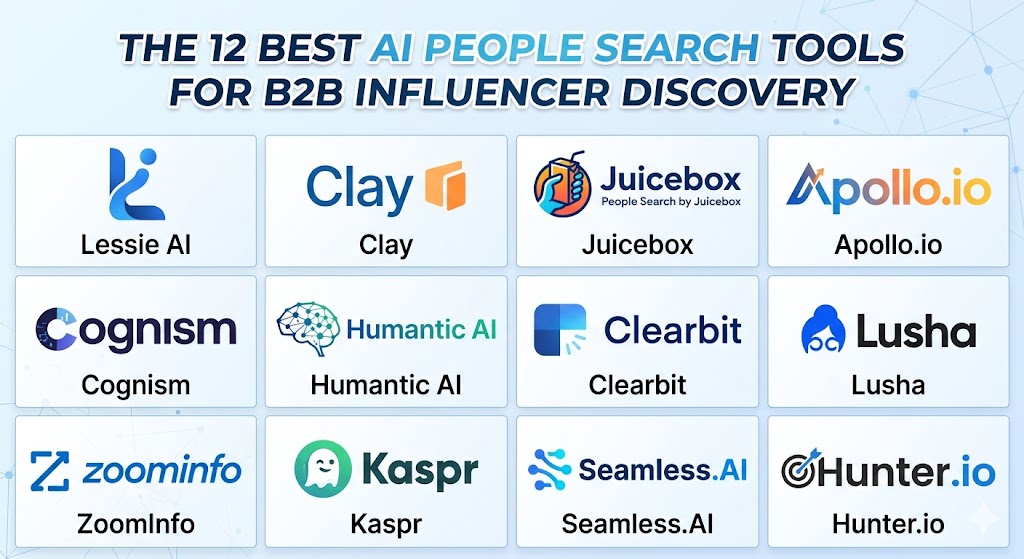
The 12 Best AI People Search Tools for B2B Influencer Discovery
1. Lessie AI — Best for Complex Multi-Attribute Searches
Lessie AI approaches people search differently than most tools on this list. Instead of pre-built databases, it deploys an AI agent that searches 100+ data sources in real-time based on your specific criteria.
When I ran a search for “fintech compliance officers who have spoken at conferences in the past 18 months and have LinkedIn engagement rates above 2%,” Lessie AI returned 47 results in about four minutes. Other tools either couldn’t handle that query complexity or returned obviously irrelevant results.
The unlimited attribute columns feature proved genuinely useful. I could track custom fields like “preferred outreach channel,” “content themes,” and“competitor relationships” without forcing everything into generic categories.
- Pros: Real-time data from 100+ sources, unlimited custom attributes, handles multi-criteria searches well, fresh data reduces bounce rates
- Cons: Learning curve for complex queries, no built-in CRM (requires export), pricing can add up for high-volume users
Best for: Teams running targeted campaigns where precision matters more than volume.
Starting price: Contact for pricing (usage-based model). See current plans.
2. Clay — Best for Automated Enrichment Workflows
Clay has become the default recommendation in B2B circles, and after testing it extensively, I understand why. It’s not primarily a people search tool—it’s a data orchestration platform that happens to be excellent at finding and enriching prospect data.
The waterfall enrichment feature impressed me most. Clay checks multiple data providers sequentially until it finds the information you need. I set up a flow to find email addresses, and it automatically tried Clearbit, then Hunter, then Apollo if earlier sources failed. This reduced my “email not found” rate compared to single-source tools.
However, Clay assumes you already know roughly who you’re looking for. It’s better at enriching existing lists than discovering new prospects from scratch. For a deeper look at how Clay fits into a B2B stack, see our Clay vs Exa comparison.
- Pros: Powerful automation capabilities, waterfall enrichment reduces gaps, excellent integrations, active community and templates
- Cons: Steep learning curve, gets expensive at scale, discovery requires manual seeding, credit system can be confusing
Best for: Operations-heavy teams who want to automate enrichment workflows.
Starting price: $149/month (Explorer plan)
3. Juicebox — Best for Creative and Marketing Influencers
Juicebox (also called “People Search by Juicebox”) focuses specifically on finding people based on their career history and professional background. The AI understands natural language queries better than most competitors.
I asked Juicebox to find “former Stripe employees who now work in B2B SaaS marketing roles at Series B companies.” It understood the intent and returned relevant results without requiring Boolean operators or complex filters.
The limitation: Juicebox pulls primarily from LinkedIn data. For B2B influencer discovery, you’ll likely need to supplement with content engagement data from other sources. For a detailed comparison, read our Lessie vs Juicebox analysis.
- Pros: Excellent natural language understanding, clean intuitive interface, fast results for career-based queries, reasonable pricing
- Cons: LinkedIn-heavy data sourcing, limited content/engagement metrics, no real-time data enrichment, smaller database than some alternatives
Best for: Recruiters and talent teams who also support influencer partnerships.
Starting price: $100/month (Pro plan)
4. Apollo.io — Best for Volume-Based Outreach
Apollo combines a massive contact database with sequencing and outreach tools. For B2B influencer marketing, the database size is both an advantage and a challenge.
The advantage: Apollo claims over 275 million contacts. If you’re targeting well-known influencers in major industries, they’re probably in there.
The challenge: Finding the right 50 people among 275 million requires careful filtering. Apollo’s search filters are decent but not designed for influencer-specific criteria. I couldn’t easily filter by “podcast host” or “conference speaker.” For more on Apollo’s strengths and limitations, check our in-depth Apollo.io review.
- Pros: Massive contact database, built-in email sequencing, reasonable per-contact pricing, good LinkedIn integration
- Cons: Not optimized for influencer criteria, data accuracy varies by region, interface can feel cluttered, some enrichment data is stale
Best for: Teams prioritizing database size and built-in outreach.
Starting price: Free tier available; paid starts at $49/month
5. Cognism — Best for European B2B Contacts
Cognism specializes in GDPR-compliant B2B contact data, with particular strength in European markets. If your influencer campaigns target EMEA, this matters.
Phone-verified mobile numbers are Cognism’s standout feature. For influencer outreach, this might seem irrelevant—but I’ve found that calling (briefly, professionally) is sometimes the fastest path to a response from busy executives.
The platform also includes intent data, showing which companies are actively researching relevant topics. This helps prioritize which influencers might be most receptive to partnership discussions.
- Pros: Strong European data coverage, GDPR compliance built-in, phone-verified mobile numbers, intent data integration
- Cons: North American data is less differentiated, higher price point, limited influencer-specific filters, overkill for small campaigns
Best for: Enterprise teams with European market focus.
Starting price: Contact for pricing (typically $1,000+/month)
6. Humantic AI — Best for Personality-Based Targeting
Humantic AI takes a different approach: it analyzes prospects’ online presence to predict personality traits and communication preferences. This sounds gimmicky until you see it work.
I used Humantic to analyze 30 potential B2B influencers before outreach. The tool predicted that 12 preferred data-driven messaging while 8 responded better to relationship-first approaches. I customized my emails accordingly, and my response rate improved noticeably compared to generic templates.
The limitation is that Humantic doesn’t help you find influencers—it helps you understand and approach ones you’ve already identified.
- Pros: Unique personality insights, improves outreach personalization, Chrome extension for LinkedIn, integrates with major CRMs
- Cons: Doesn’t help with discovery, accuracy varies by individual, limited utility without other tools, some find it “too clever”
Best for: Teams focused on optimizing response rates.
Starting price: $16/month (Starter)
7. Clearbit — Best for Account-Level Intelligence
Clearbit (now part of HubSpot) excels at company and contact enrichment. It’s less a people search tool and more a data infrastructure layer that powers other workflows.
For influencer marketing, Clearbit helps in two ways. First, it enriches contact records with firmographic data—useful when you’re targeting influencers at specific company types. Second, its reveal feature identifies anonymous website visitors, which can surface influencers already engaging with your content.
The platform’s strength is data quality. When Clearbit has information on a contact, it’s usually accurate. The weakness is coverage gaps, especially for smaller companies and non-English markets.
- Pros: High data accuracy, excellent API and integrations, real-time enrichment, HubSpot native integration
- Cons: Coverage gaps for smaller companies, expensive for direct usage, not a discovery tool, limited outside core firmographics
Best for: HubSpot users who need reliable enrichment.
Starting price: Contact for pricing (typically starts around $99/month)
8. Lusha — Best for Quick Contact Lookups
Lusha is straightforward: find someone on LinkedIn, and Lusha tries to give you their email and phone number. The Chrome extension makes this a one-click operation.
For B2B influencer campaigns, I found Lusha most useful for spot-checking individual prospects rather than bulk discovery. When I already knew which podcast hosts or newsletter authors I wanted to contact, Lusha helped me get contact details quickly.
The data accuracy was mixed. Email addresses were correct about 80% of the time in my testing. Phone numbers were closer to 65%.
- Pros: Simple fast interface, reasonable credit pricing, good for individual lookups, Chrome extension works well
- Cons: Limited filtering capabilities, accuracy inconsistent, not designed for bulk discovery, phone data often outdated
Best for: Individual contributors who need quick contact lookups.
Starting price: Free tier available; paid starts at $36/month
9. ZoomInfo — Best for Enterprise Data Needs
ZoomInfo is the 800-pound gorilla of B2B contact databases. It offers the most comprehensive coverage, the most sophisticated filtering, and the highest price point.
For influencer discovery, ZoomInfo’s “org charts” and“scoops” features proved valuable. Org charts help identify decision-makers who might be worth cultivating as industry voices. Scoops alert you to job changes and funding events—useful for timing outreach. For a detailed pricing breakdown, see our ZoomInfo vs Lessie pricing comparison.
The honest assessment: ZoomInfo is overkill for most influencer marketing programs. The platform is designed for enterprise sales teams, and the pricing reflects that.
- Pros: Largest B2B database, advanced filtering options, intent data and alerts, integrates with everything
- Cons: Enterprise pricing ($15k+/year), complex interface, requires training to use effectively, long sales process
Best for: Enterprise teams with large budgets and complex needs.
Starting price: Contact for pricing (typically $15,000+/year)
10. Kaspr — Best for LinkedIn-First Workflows
Kaspr focuses almost exclusively on LinkedIn data extraction. If your workflow centers on finding prospects on LinkedIn and getting their contact information, Kaspr does this efficiently.
The Chrome extension is snappy. The bulk export features work reliably. And the pricing is more accessible than enterprise alternatives.
What Kaspr won’t do is help you find influencers outside LinkedIn’s ecosystem. Podcast hosts without LinkedIn profiles, newsletter authors who primarily use Twitter/X, conference speakers not on LinkedIn—Kaspr misses these entirely.
- Pros: LinkedIn integration is smooth, affordable pricing, easy to learn, good for European data
- Cons: LinkedIn-only data source, limited enrichment beyond contact info, can’t find non-LinkedIn influencers, some LinkedIn restrictions apply
Best for: Small teams with LinkedIn-centric workflows.
Starting price: Free tier available; paid starts at €49/month
11. Seamless.AI — Best for Real-Time Contact Verification
Seamless.AI emphasizes real-time data verification. Instead of serving cached data, the platform claims to verify contact information at the moment of retrieval.
In practice, this reduces bounce rates. My email campaigns using Seamless.AI data had fewer hard bounces than campaigns using other tools’ data. However, the verification adds time—individual lookups take longer.
For influencer discovery, Seamless.AI’s search filters are decent but not exceptional. You can filter by title, industry, and company attributes, but not by content engagement or influencer-specific criteria.
- Pros: Real-time verification reduces bounces, unlimited credits on some plans, good phone number accuracy, pitch intelligence features
- Cons: Slower than cached databases, aggressive upselling, interface feels dated, limited influencer-specific filters
Best for: Teams prioritizing data accuracy over speed.
Starting price: Contact for pricing (typically $147/month)
12. Hunter.io — Best for Email-Focused Outreach
Hunter.io specializes in one thing: finding and verifying email addresses. It does this well.
The domain search feature is useful for influencer campaigns. Enter a company domain, and Hunter shows all the email addresses it’s found associated with that domain, plus the pattern (e.g., [email protected]). This helps you guess addresses even when Hunter doesn’t have specific individuals.
Hunter won’t help you discover which influencers to target. But once you know who you want to reach, it’s a reliable, affordable way to find their email. If you need to verify addresses you’ve already collected, Lessie’s free email verification tool is another option worth trying.
- Pros: Email finding and verification, domain pattern detection, generous free tier, API is well-documented
- Cons: No phone numbers, not a discovery tool, limited prospect filtering, no enrichment beyond email
Best for: Budget-conscious teams focused on email outreach.
Starting price: Free tier (25 searches/month); paid starts at $49/month
How the Best AI Recruiting Tools Help Identify B2B Influencers
The best AI recruiting tools share infrastructure with people search platforms. Both need to aggregate professional data, match against criteria, and surface relevant individuals. This overlap explains why several tools on this list serve both recruiters and marketers.
For influencer identification specifically, I found three capabilities that the best AI recruiting tools bring to marketing use cases:
Career trajectory analysis — Tools like Juicebox can map career paths, helping you find rising voices before they become expensive. A director today might be a VP (and more influential) in 18 months.
Skills and expertise mapping — Recruiting-focused tools often track technical skills and certifications. This helps identify influencers with genuine expertise, not just social media presence.
Company relationship data — Understanding where someone worked previously, which investors backed their company, and who they’re connected to—this context informs partnership approaches.
The best AI recruiting tools also tend to have better LinkedIn data access, since that’s where recruiting activity concentrates. This benefits influencer research when LinkedIn is a primary discovery channel.
Building Your B2B Influencer Tech Stack
No single tool handles the complete influencer discovery workflow. After testing, here’s the stack I’d recommend for different team sizes:
Solo marketers or small teams
- Discovery: Lessie AI for complex searches, Juicebox for career-based queries
- Enrichment: Hunter.io for emails, Lusha for spot checks
- Analysis: Humantic AI for personality insights (optional)
This stack costs roughly $200-300/month and handles most B2B influencer needs.
Mid-size marketing teams
- Discovery and enrichment: Clay with multiple data sources in waterfall
- Supplemental discovery: Lessie AI for attribute-heavy searches
- Database: Apollo.io for volume outreach needs
- Verification: Seamless.AI or Hunter.io as backup
Budget around $500-800/month for comprehensive coverage.
Enterprise programs
- Primary database: ZoomInfo or Cognism for coverage and compliance
- Workflow automation: Clay for orchestration
- Specialized discovery: Lessie AI for custom attribute searches
- Enrichment: Clearbit integrated with HubSpot/Salesforce
Enterprise stacks typically run $2,000+/month but reduce manual effort significantly.
Solo / Small Team
$200–300/mo
Lessie AI + Juicebox for discovery. Hunter.io + Lusha for contacts. Humantic AI optional.
Mid-Size Team
$500–800/mo
Clay waterfall enrichment + Lessie AI attribute search + Apollo.io volume + Seamless.AI verification.
Enterprise
$2,000+/mo
ZoomInfo or Cognism for coverage + Clay orchestration + Lessie AI discovery + Clearbit enrichment.
Evaluating AI People Search Tools: What Actually Matters
After testing all 12 platforms, here’s my framework for evaluating AI people search tools:
Data Freshness
Real-time verification beats massive static databases. Export 100 contacts and bounce-test them before committing.
Natural Language Search
Boolean operators limit what’s possible. Test complex multi-criteria queries in plain English to find each tool’s ceiling.
Export & Integration
Your list is useless if it can’t reach your outreach tools. Check export formats, API access, and lower-tier restrictions.
Real Demo Testing
Vendors demo with best data. Search your actual industry, geography, and persona. Results will vary dramatically.
Data freshness trumps database size
A database with 275 million contacts sounds impressive until you realize 40% of email addresses bounce. Smaller databases with real-time verification often perform better.
When evaluating, export a sample of 100 contacts and run them through a separate email verification service. If more than 10% bounce, that’s a red flag.
Boolean operators aren’t enough
Natural language search isn’t just a convenience—it changes what’s possible. Queries like “DevOps engineers who write about Kubernetes and work at companies using AWS” require either advanced NLP or painful Boolean construction.
Test each platform with increasingly complex natural language queries. Note where each breaks down.
Export and integration flexibility matters
Your influencer list is only useful if you can move it into your outreach tools. Check export formats, API availability, and native integrations before committing.
Several tools on this list restrict exports on lower-tier plans. Factor upgrade costs into your comparison.
Look beyond the demo data
Vendors demo with their best data. Ask to search for prospects in your specific industry, geography, and persona. Results will vary dramatically from the polished demo.
When I searched for “B2B fintech compliance influencers in Germany” across tools, the result count ranged from 3 (Lusha) to 89 (Lessie AI). Quality varied too.
Common Mistakes in AI-Powered Influencer Discovery
Having now run several campaigns using these tools, I’ve learned what not to do:
Follower Count Trap
3K engaged niche followers > 100K passive generalist followers. Filter by engagement, not vanity metrics.
Dark Funnel Blindspot
Private Slack groups, closed LinkedIn communities, niche Discords—tools can’t index these. Supplement with manual exploration.
One-Time Discovery
Influence shifts constantly. Set up recurring searches—today’s unknown could be next quarter’s key voice.
Skipping Verification
Multiple AI sources can mean multiple wrong sources. A 5-second LinkedIn check prevents embarrassing wrong-name emails.
Mistake 1: Optimizing for follower counts
Follower counts matter less in B2B than engagement and audience relevance. An engineer with 3,000 highly engaged LinkedIn followers in your exact ICP is worth more than a generalist with 100,000 passive followers.
The best AI recruiting tools and people search platforms let you filter by engagement metrics, not just follower counts. Use this.
Mistake 2: Ignoring the “dark funnel”
Many B2B influencers operate in spaces that people search tools can’t index: private Slack communities, closed LinkedIn groups, niche Discord servers. Tools can only surface public data.
Supplement AI-powered search with manual community exploration.
Mistake 3: Treating discovery as a one-time event
Influence is dynamic. Someone barely visible today might become a key voice after a viral post or new role. Set up ongoing searches, not just campaign-specific ones.
Tools like Lessie AI with real-time search capabilities make this practical.
Mistake 4: Skipping verification
AI tools aggregate data from multiple sources, which sometimes means multiple wrong sources. Always verify critical information before high-stakes outreach.
A five-second LinkedIn check can prevent an embarrassing wrong-name email.
Choosing the Right AI People Search Tool for Your Needs
After six weeks of testing, my honest assessment: no single tool does everything well for B2B influencer discovery.
For complex, attribute-heavy searches where you need to combine multiple criteria—like finding “VP-level marketers at Series B SaaS companies who host podcasts about product-led growth”—Lessie AI handled this better than alternatives. The real-time search across 100+ data sources means you’re not limited to whoever happened to be in a database when it was compiled.
For workflow automation and enrichment, Clay remains the most flexible option, though the learning curve is real. Teams that invest time in building Clay workflows see significant efficiency gains.
For pure database coverage and enterprise compliance needs, ZoomInfo and Cognism justify their premium pricing—but only if you need their specific strengths.
The best AI recruiting tools and people search platforms are converging. Features that were differentiators a year ago are becoming table stakes. Expect continued consolidation and capability expansion.
My recommendation: start with a free trial of 2-3 tools that match your primary use case. Run identical searches across each. Verify a sample of results. Let the data guide your decision, not the marketing claims.
B2B influencer discovery is ultimately about finding real people who can authentically advocate for what you’re building. The tools that help you do that efficiently—while maintaining data quality—are worth the investment. If you’re ready to explore curated lists of B2B influencers, browse our influencer directories for inspiration.