




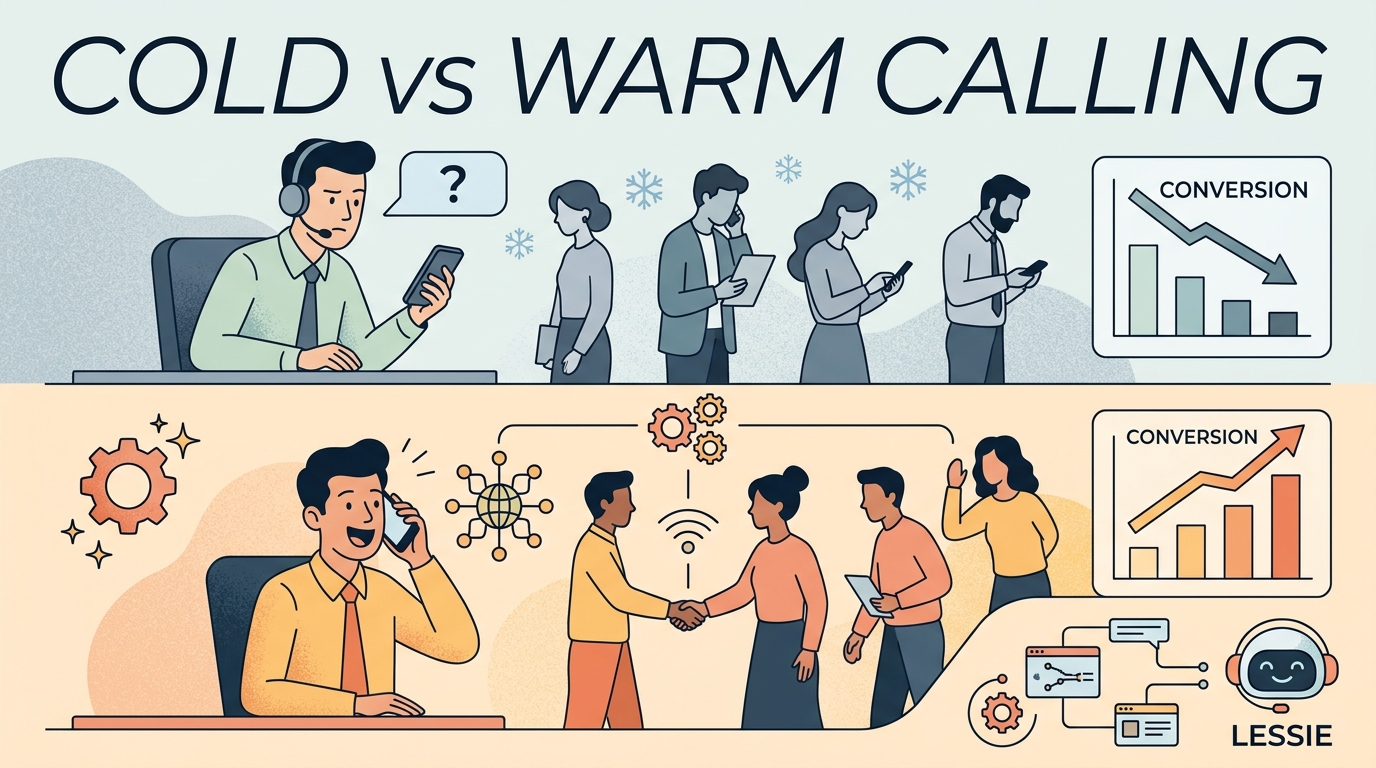
Cold calling is contacting a prospect with no prior relationship or signal — typical connect rate 5–10%, conversion to meeting ~1–3%. Warm calling is contacting a prospect after a triggering event, referral, or prior engagement — connect rate 15–25%, conversion to meeting 8–15%. The 2026 best practice is to make every "cold" call warm by layering a real trigger on top: funding round, new hire, product launch, conference appearance. Modern AI-native platforms (Lessie) surface these triggers automatically, turning the cold/warm binary into a spectrum.
The cold calling vs warm calling debate is older than B2B SaaS, but the actual numbers have shifted enough in 2026 that the playbook from 2018 no longer works. Cell-phone gatekeepers got smarter, voicemail-to-text changed call-back dynamics, and AI-powered call screening filters out generic openers in the first 8 seconds. The reps who hit quota now are the ones who never make truly cold calls— they layer real triggers on top of cold lists and convert at 3–5x base rates.
This guide breaks down the real differences between cold calling vs warm calling in 2026, the conversion benchmarks that matter, when each tactic works, and the modern playbook for turning cold lists into warm calls. Try Lessie free for the trigger-data layer that makes the difference.
What Is Cold Calling?
Cold calling is the practice of contacting a prospect over the phone without prior relationship, referral, or known trigger event. The call is unsolicited. The rep typically works from a list (titles + companies + phone numbers) and dials through it sequentially with the same opener and pitch.
Classic cold-calling outputs:
- Connect rate (someone picks up): 5–10% on US enterprise, lower on EU mobile and APAC. Direct dials connect 2–3x more often than switchboard numbers.
- Conversation-to-meeting rate: 15–25% of connected calls produce a next step. Lower for generic openers.
- Overall meeting rate per dial: ~1–3% (5–10% connect × 15–25% conversion). Volume-driven motion.
- Cost per meeting: $50–$200 depending on SDR loaded cost and dial efficiency.
Cold calling still works in 2026 for transactional B2B (cycles under $25k ACV), local services, and segments where decision-makers actually pick up direct dials (small business owners, niche verticals). It works less well for enterprise, complex deals, and any market where the buying committee is 5+ people.
What Is Warm Calling?
Warm calling is contacting a prospect with some form of prior context— a referral, a prior interaction, attendance at a shared event, or a real trigger (funding round, new hire, product launch). The call opens with the trigger, which immediately establishes relevance.
Warm-calling outputs:
- Connect rate: 15–25%. Higher because the rep often references the warm context in the voicemail, which lifts call-back rates.
- Conversation-to-meeting rate: 30–50% of connected calls. The warm context shortens objection handling.
- Overall meeting rate per dial: ~5–10% (15–25% connect × 30–50% conversion). 3–5x cold-calling outcomes.
- Cost per meeting: $30–$100 because warm context lifts efficiency.
Warm calling is the default in 2026 for any B2B motion where ACV justifies real research time per contact. The constraint is operator capacity — a warm call takes 5–10 minutes of pre-call research that a cold call skips. AI-native prospecting platforms (Lessie) cut that research time to seconds by surfacing triggers and context automatically.
Cold Calling vs Warm Calling: Side-by-Side
Direct comparison on the metrics that decide which tactic wins for a given motion.
- Setup time per contact. Cold: 0–1 minute. Warm: 5–10 minutes (or 30 seconds if you have Lessie surfacing triggers automatically).
- Connect rate. Cold: 5–10%. Warm: 15–25%.
- Conversation conversion. Cold: 15–25%. Warm: 30–50%.
- Daily call volume per SDR. Cold: 80–120 dials. Warm: 30–50 dials.
- Daily meeting volume per SDR. Cold: 1–3 meetings. Warm: 3–5 meetings. Warm wins on meetings-per-day despite lower call volume.
- Burnout rate. Cold calling has 2–3x the SDR attrition of warm calling. Real cost to factor in.
- Tech-stack cost. Cold: dialer + contact database. Warm: same + trigger data + research tooling. Lessie ships both contact data and triggers in one tool.
Conversion Benchmarks: Cold vs Warm in 2026
Real benchmarks from B2B sales teams running both motions, normalized to 100 dials per day.
Cold calling 100 dials: 5–10 connects → 1–3 meetings → 0.3–1 qualified opportunity. Volume-driven; needs 8–12 SDRs to fill an AE pipeline.
Warm calling 50 dials (research-included day): 7–13 connects → 3–5 meetings → 1–2 qualified opportunities. Same SDR produces 2–3x the pipeline with half the call volume.
Cold + email + LinkedIn (multi-channel cold): 100 dials + 200 emails + 50 LinkedIn messages → 8–15 meetings. Multi-channel lifts cold-call outcomes meaningfully because the channels reinforce each other.
Warm + multi-channel (triggers + email + LinkedIn + call): 50 dials + 100 personalized emails + 30 LinkedIn → 10–20 meetings. The combination is the modern best practice.
When to Use Cold Calling in 2026
Cold calling is not dead. Three motions where it still wins.
Transactional B2B (under $25k ACV). Single decision-maker, short cycle, fungible budget. The research-time-per-deal math does not justify warm calling at this ACV.
Local services and SMB segments. Plumbers, accountants, restaurants. Direct-dial pickup rates are higher because there is often no gatekeeper. Cold calling beats email here.
Survey + research outbound. Cold calling to test a new ICP, validate a positioning hypothesis, or run customer research before scaling outbound. Lower conversion expectations, higher learning.
When to Use Warm Calling in 2026
Warm calling is the default for almost everything else. Four motions where it compounds.
Enterprise sales ($50k+ ACV, 3+ buying committee members). Research time pays back 10x in deal velocity. Mapping the buying committee before the call determines win rate.
Trigger-based outbound. Funding rounds, new CRO hires, layoffs, product launches, security incidents, expansion announcements. Every one of these is a real reason to call. Reply rates 3–5x base outbound.
ABM motions. Top 50–200 named accounts get warm treatment by default. Cold-calling an account where you have done 6 months of marketing is wasted cycle.
EU and APAC outbound. Mobile-call connect rates outside North America are sharply lower than US. Warm context is the only thing that overcomes the lower pickup rate.
The 2026 Playbook: Turn Cold Calls Into Warm Calls
The best teams in 2026 do not make truly cold calls. They convert cold lists into warm lists before dialing using four moves.
Layer triggers on every contact. Lessie surfaces funding rounds, leadership hires, product launches, hiring patterns, conference appearances, and security incidents on every prospect automatically. Every call opens with the trigger — immediate relevance.
Run a multi-touch warm-up before the call. Send a personalized email 2–4 days before the call referencing the trigger. Connect on LinkedIn with a contextual note. By the time the call happens, the prospect has seen your name three times.
Use email opens as the call-time signal. Email open notifications tell you exactly when to dial. Connect rates on calls made within 5 minutes of an email open are 2–3x higher than blind dialing.
Reference real context in the opener. "Saw the Series B announcement — congratulations. The reason for the call is that the typical deployment window for new tooling after a B is 90 days, and we work with three CROs in your stage..." works much better than "Do you have 30 seconds."
Lessie surfaces funding rounds, leadership hires, tech-stack changes, and recent posts on every prospect from 100+ live sources— the trigger data that converts cold lists into warm calls. Free tier covers light-volume use.
Common Cold vs Warm Calling Mistakes
Three failure patterns that turn warm calls back into cold.
Researching once, calling forever. Triggers go stale. A funding round 90 days old is no longer a fresh trigger. Refresh research at the moment of call, not when the list was loaded.
Confusing trigger with relevance. A funding round is a trigger, but only if your product fits the post-funding spend pattern. A new CRO is a trigger, but only if your offer aligns with the new CRO's typical priorities. Match trigger to your category before dialing.
Skipping voicemail with warm context. Voicemail-to-text turns voicemails into discoverable assets. A 30-second voicemail referencing the trigger gets read and increases call-back rates 2–3x vs. hanging up.
FAQ: Cold Calling vs Warm Calling
For more on the broader B2B outbound playbook, see our B2B lead generation strategies guide and the best B2B prospecting tools comparison.