




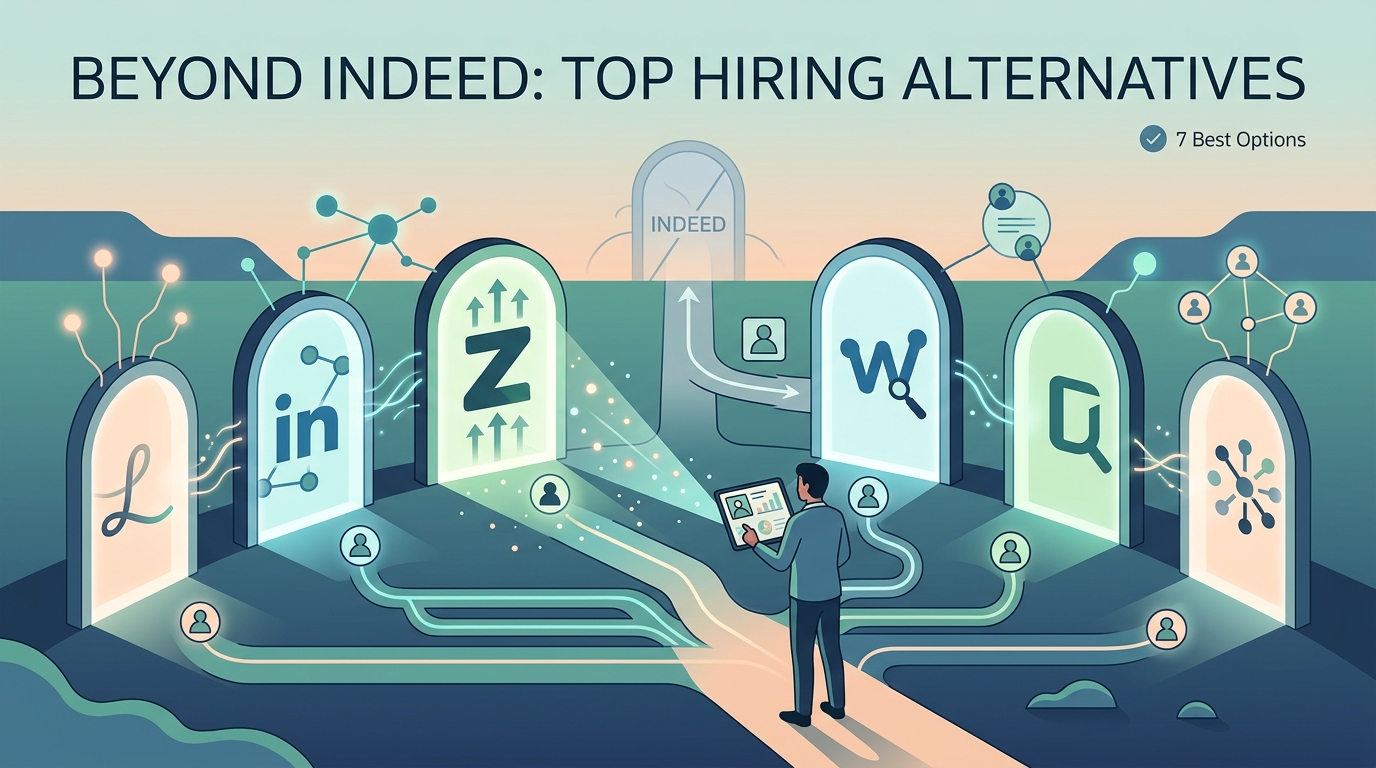
TL;DR: Indeed is the world’s largest job board, but it makes you wait for applicants and buries good candidates under paid ads and spam. The best Indeed alternative depends on how you want to hire — proactive AI sourcing (Lessie AI), professional-network reach (LinkedIn), aggregated job-board volume (ZipRecruiter), startup and tech talent (Wellfound), employer-brand and reviews (Glassdoor), broad volume hiring (Monster), or specialist tech roles (Dice). Lessie tops the list because it flips the model: instead of posting and praying, it finds and contacts the exact candidates you need.
For two decades, hiring meant one thing: post a job on Indeed and wait. The pitch was simple — the biggest audience of job seekers anywhere, a free posting option, and an apply button that fed your inbox. That model worked when applicants were plentiful and competition for talent was light. In 2026, that story has cracks. Recruiters report rising costs for sponsored posts, a flood of low-quality and AI-generated applications, and a frustrating sense that the best candidates — the ones already employed and not actively looking — never see the listing at all.
If you’re searching for an Indeed alternative right now, you’re not alone. The teams that win the talent war have stopped relying on inbound applicants and started sourcing proactively. This guide compares the seven best Indeed alternatives for 2026, with honest pros and cons for each, and shows where an AI sourcing agent fits as the strongest replacement for teams that want to find candidates rather than wait for them. Whether you need a free job board, a tech-specialist platform, or a way to reach passive talent, the right pick is below.
Why Look for an Indeed Alternative?
Indeed isn’t broken — it’s just a job board, and job boards only reach people who are actively applying. For most roles in 2026, that’s a shrinking and noisy pool. The same complaints surface again and again in recruiting communities:
- You only reach active job seekers. An estimated 70% of the workforce is passive — employed and open to the right offer, but not browsing job boards. Indeed structurally cannot reach them. The strongest candidate for your role is usually someone who never sees your post.
- Sponsored posts get expensive fast. Organic visibility on Indeed has declined for years. To get meaningful applicant volume you now pay per-click or per- application, and costs climb with role difficulty and location.
- Application quality has dropped. One-click apply and AI-written resumes mean a single posting can draw hundreds of loosely qualified applicants. Recruiters burn hours screening noise instead of talking to fit.
- It’s reactive, not strategic. Post and pray gives you whoever shows up. Proactive sourcing lets you target the exact skills, companies, and seniority you need — a fundamentally different and more reliable motion.
- Niche and technical roles thin out. For senior engineers, designers, or specialized operators, the people you want aren’t scrolling a general job board. They’re on GitHub, LinkedIn, in communities, or quietly employed elsewhere.
That gap — between waiting for applicants and actively finding the right people— is exactly where the best Indeed alternatives below earn their place. Some are better job boards. The strongest are a different motion entirely. For a deeper look at the proactive approach, see our guide to AI candidate sourcing.
Tired of posting and praying? Lessie searches 100+ live sources, scores the best-fit candidates, and drafts personalized outreach — so you reach the right people instead of waiting for whoever applies. 95% contact accuracy, 3x reply rates, free to start.
The 7 Best Indeed Alternatives for 2026
Below are the seven platforms most worth evaluating if you’re moving beyond Indeed this year. They’re ranked by overall fit for modern hiring — not by audience size alone. Lessie AI takes the top spot because it solves the core Indeed weakness — only reaching active applicants — by proactively sourcing and contacting the candidates you actually want.
Lessie AI
Best for proactive AI candidate sourcing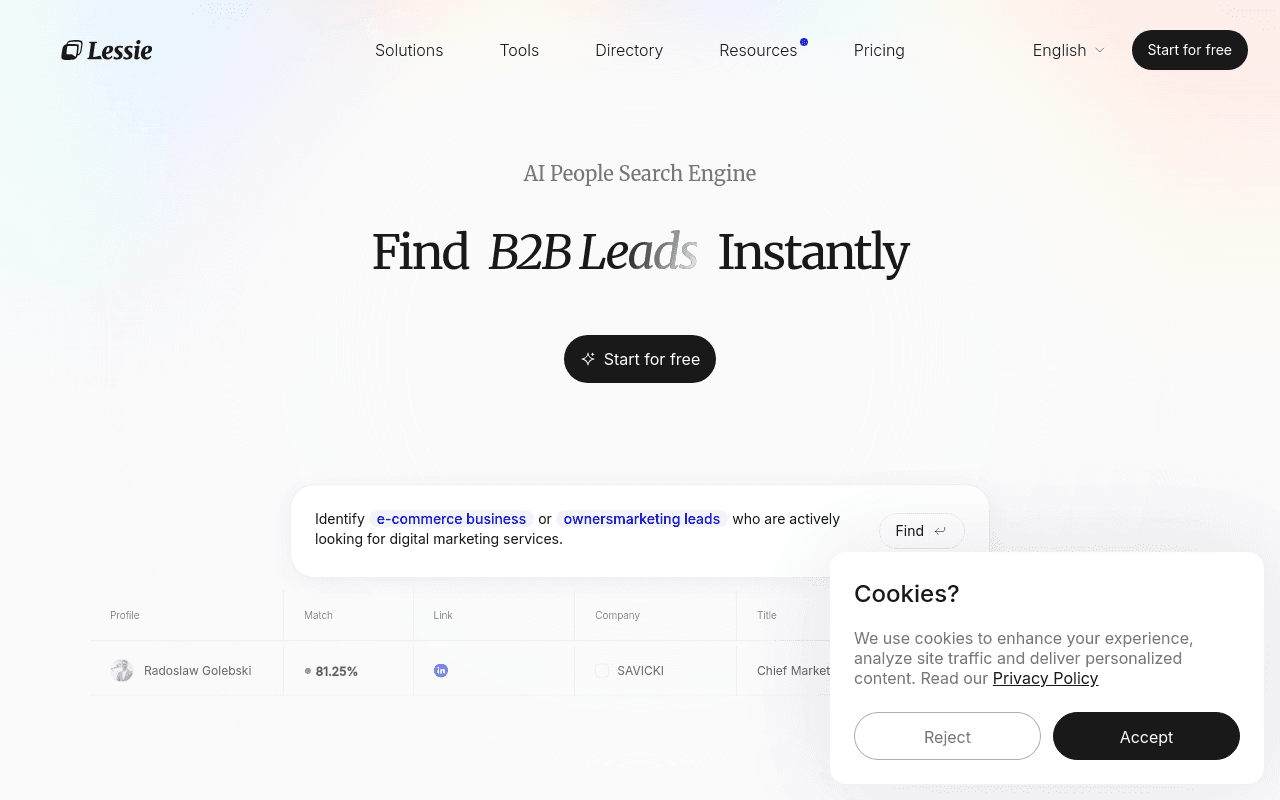
Lessie AI is the strongest Indeed alternative if your goal is to stop waiting for applicants and start finding the right people. It’s the world’s first People Search AI Agent — you describe the candidate you need in plain language, and Lessie searches across 100+ live data sources, scores each match, and reaches out for you. Where Indeed is a job board that surfaces whoever applies, Lessie is a proactive sourcing engine that surfaces whoever fits.
For recruiting, Lessie runs as Find Talent: it sources and contacts candidates across LinkedIn, GitHub, and the open web — including the roughly 70% of professionals who are passive and would never see an Indeed listing. That single structural difference is the whole point. You stop competing for the attention of active job seekers and start reaching the exact engineers, designers, or operators you want, wherever they are.
The numbers behind it matter: 50M+ profiles, 95% contact accuracy on verified emails, and AI-personalized outreach that drives roughly 3x higher reply rates than templated messages. Teams using Lessie report finding 300K+ candidates and cutting manual research time by 80% — because the agent handles the find-score-contact loop end to end instead of leaving you to screen an inbox of applicants.
Lessie also replaces the patchwork of point tools recruiters stitch together. It pairs naturally with an AI resume screener for inbound triage and a job description generator for the roles you do post — all within one workflow. See the full recruiting use case on the Find Talent page.
Pros: Proactive sourcing reaches passive candidates Indeed never sees, natural-language search across 100+ sources, 95% verified contact accuracy, AI outreach with 3x reply rates, free tier, far cheaper than enterprise sourcing suites. Cons: A newer brand than the legacy job boards, and it’s a sourcing agent rather than a place to post a job and collect inbound applications —so high-volume hourly roles may still want a job board alongside it.
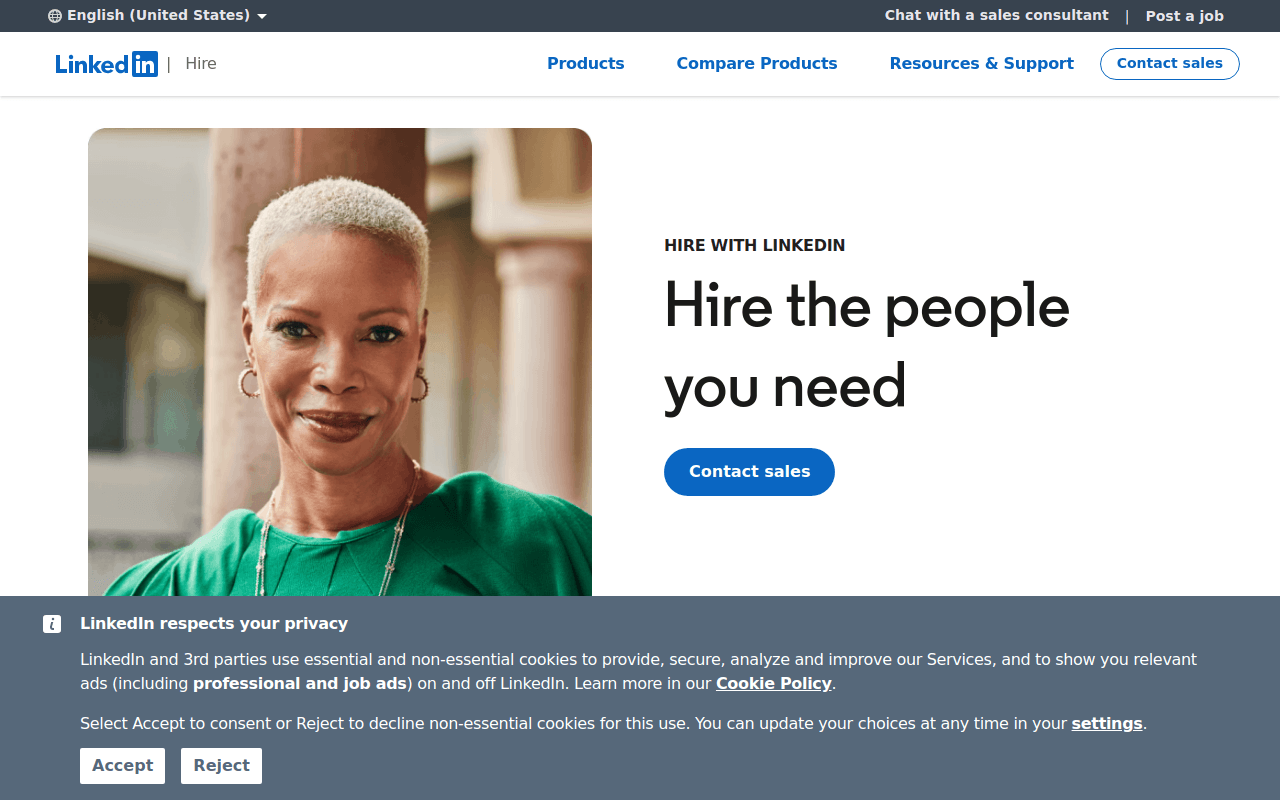
LinkedIn is the obvious Indeed alternative for professional roles. With 900M+ members keeping their own profiles current, it offers the freshest professional graph anywhere, plus tools to post jobs, run LinkedIn Recruiter searches, and message candidates via InMail. For white-collar and management hiring, it reaches both active and passive talent.
The catch is cost and clutter. Recruiter seats and job slots add up quickly, InMail volume is capped and expensive, and reply rates on cold InMails have fallen as inboxes fill with recruiter spam. It’s powerful but pricey, and you still do the manual searching yourself. If you’re weighing the dedicated sourcing tier, see our breakdown of LinkedIn Recruiter alternatives.
Pros: Largest professional network, self-updated profiles, strong filters, reaches passive candidates. Cons: Expensive seats and capped InMails, declining InMail reply rates, manual sourcing, weak for blue-collar or hourly roles.
ZipRecruiter
Best aggregated job-board volume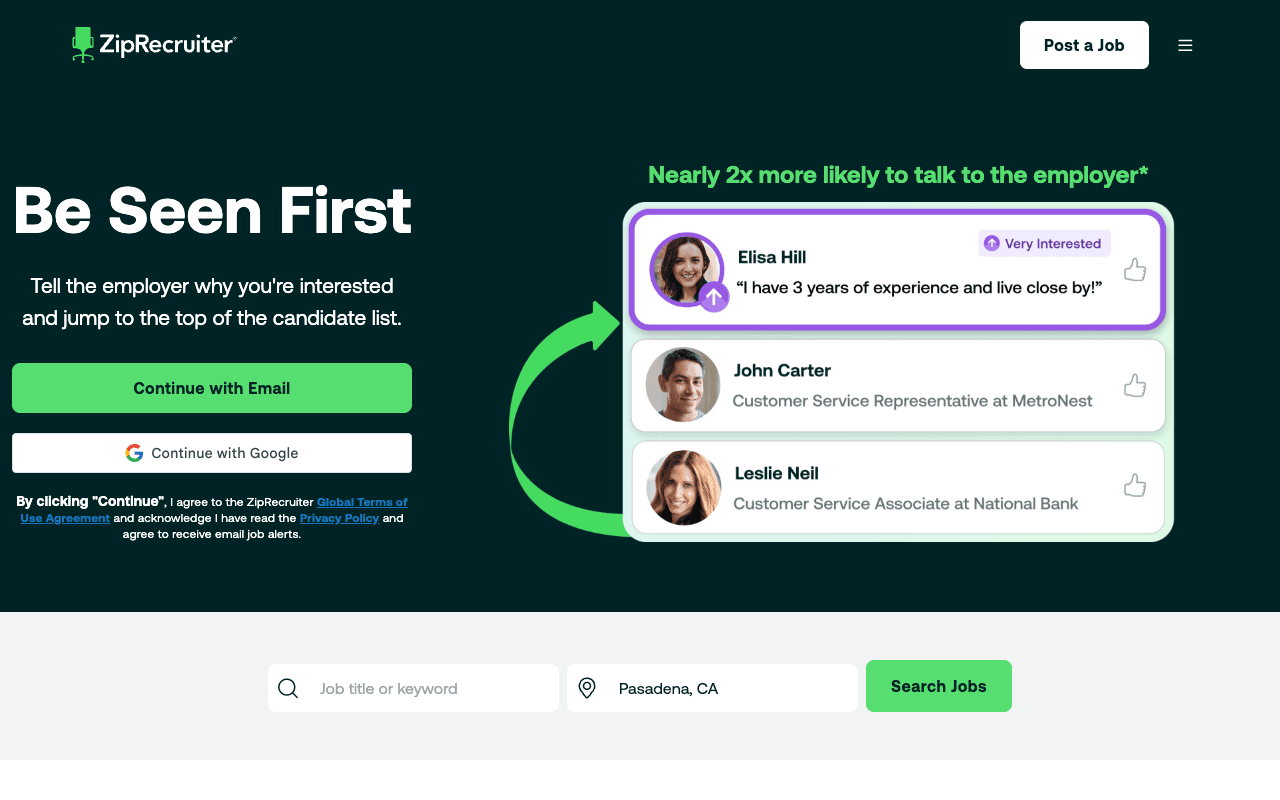
ZipRecruiter is the closest like-for-like Indeed alternative. Post once and it distributes your listing to 100+ job boards, then uses AI matching to invite likely candidates to apply. For employers who want applicant volume fast without managing multiple postings, it’s efficient.
But it’s still inbound by design — you’re reaching active job seekers, just across more sites. Pricing is quote-based and can be opaque, and the same application-quality problems that plague Indeed apply here too. It widens the funnel; it doesn’t change the motion.
Pros: One-click distribution to 100+ boards, AI candidate invitations, fast applicant volume, simple for small teams. Cons: Opaque quote-based pricing, still reactive/inbound only, application quality varies, limited passive reach.
Wellfound
Best for startup and tech talent
Wellfound (formerly AngelList Talent) is the go-to Indeed alternative for startups. Candidates on Wellfound expect equity, remote work, and early-stage roles, and free job posts make it accessible for small teams. For seed-to-Series-B companies hiring engineers, designers, and operators, the candidate pool is well-matched.
The trade-off is scope. Wellfound is narrow by design — it’s thin for enterprise, hourly, or non-tech roles, and the active community is smaller than the major boards. It’s a precision tool, not a volume play.
Pros: Free job posts, startup-native candidates, transparent salary/equity expectations, strong for remote tech roles. Cons: Narrow to startups/tech, smaller audience, weak for enterprise or non-technical hiring, still inbound.
Glassdoor
Best for employer brand and reviews
Glassdoor is the Indeed alternative for teams that know candidates research before they apply. Its core value is employer reviews, salary data, and brand storytelling — the signals that convince passive candidates a company is worth joining. You can post jobs too, and since Glassdoor and Indeed share a parent network, listings reach a wide audience.
But Glassdoor is brand-first, not sourcing-first. The job-board mechanics overlap heavily with Indeed, so on its own it doesn’t solve the passive-reach problem —it just makes you more attractive once a candidate finds you.
Pros: Strong employer-brand and review platform, salary transparency, wide job network, useful for candidate research. Cons: Overlaps with Indeed mechanics, reviews can be hard to manage, not a proactive sourcing tool, brand value > sourcing value.
Monster
Best legacy board for volume hiring
Monster is one of the original job boards and, now merged with CareerBuilder, still carries meaningful reach for high-volume and traditional roles. For employers filling many similar positions — retail, logistics, customer service — the slot-based plans and resume database can move volume.
That said, Monster has lost ground to Indeed and ZipRecruiter over the past decade. The candidate experience feels dated and, like every board on this list, it only reaches active applicants. It’s a fine supplement, rarely a primary strategy in 2026.
Pros: Long-standing reach, resume database access, CareerBuilder merger expands inventory, decent for volume roles. Cons: Declining relevance, dated experience, inbound-only, weaker for skilled or passive talent.
Dice
Best for specialist tech roles
Dice is the Indeed alternative built specifically for technology hiring. Its audience skews toward developers, engineers, data, and IT professionals, and its search and database tools are tuned for technical skills and certifications. For staffing firms and tech- heavy employers, the candidate pool is more relevant than a general board.
The limitation is breadth. Dice is tech-only, the active pool is smaller than the giants, and it’s another inbound channel — useful for active tech job seekers, but it won’t surface the senior engineer who’s happily employed and not looking.
Pros: Tech-specialist audience, skill- and certification-based search, relevant for IT/engineering staffing, tech recruiter database. Cons: Tech-only, smaller pool than major boards, inbound-only, weak for passive senior talent.
Indeed Alternatives Compared at a Glance
Use this table to shortlist fast. The key split isn’t price or audience size— it’s motion: most options are inbound job boards that reach active applicants, while Lessie is a proactive sourcing agent that reaches the passive candidates the boards never touch.
| Tool | Best for | Motion | Passive reach | Starting price |
|---|---|---|---|---|
| Lessie AI | Proactive AI sourcing | Find & contact | Yes (core strength) | Free; from $34.99/mo |
| Professional roles | Post + manual search | Partial | Quote-based | |
| ZipRecruiter | Aggregated volume | Inbound (multi-board) | Limited | ~$16/day per job |
| Wellfound | Startup & tech | Inbound | Limited | Free posts |
| Glassdoor | Employer brand | Inbound + branding | Limited | Free profile |
| Monster | Volume hiring | Inbound | Limited | Quote-based |
| Dice | Specialist tech | Inbound | Limited | Quote-based |
Every job board on this list waits for applicants. Lessie does the opposite —it searches 100+ live sources, scores best-fit candidates, and reaches out with personalized messages that get 3x more replies. Start free and source your first candidates in minutes.
How to Pick the Right Indeed Alternative
Choosing the right replacement isn’t about which platform has the biggest audience. It’s about matching the tool to four variables: the type of role, how much you can reach passive talent, your budget, and whether you want to source or post. Get those right and the list shortens fast.
Role type. For senior, technical, or hard-to-fill roles, the best candidates are passive — so proactive sourcing with Lessie or LinkedIn beats any job board. For high-volume hourly or entry-level roles where applicants are plentiful, ZipRecruiter, Monster, or Indeed itself still make sense. For startups, Wellfound; for pure tech, Dice.
Active vs passive. This is the decisive question. If you can fill the role with people actively applying, a job board works. If the people you actually want are employed and not looking, you need to go find them — which only a sourcing tool does. For the data-driven case behind proactive hiring, see our guide to data-driven recruiting.
Budget. Free options exist — Indeed’s free posts, Wellfound’s free posts, Glassdoor’s free profile, and Lessie’s free tier. Beyond free, job boards charge per click, per slot, or per quote, while Lessie starts at $34.99/month with transparent plans. Compare on the Lessie pricing page.
Source vs post. If your strategy is to post and wait, pick the board that best matches your role. If your strategy is to win the talent war by reaching the right people first, you want a sourcing agent. For a wider survey of the category, see our roundup of the best talent sourcing tools and the broader best AI recruiting tools.
How Lessie Solves What Indeed Can't
The core limitation of Indeed — and every job board on this list — is that it only connects you to people who are actively applying. Lessie removes that ceiling by sourcing proactively. Here’s what that looks like in practice:
- It reaches passive candidates. Describe your ideal hire in plain language and Lessie searches LinkedIn, GitHub, and the open web to surface people who fit — including the ~70% who are employed and would never see a job post. This is the heart of Find Talent.
- It scores and prioritizes. Instead of an inbox of unscreened applicants, Lessie ranks candidates by relevance and fit so you spend time on the best ones first — cutting manual research time by roughly 80%.
- It contacts for you. Lessie drafts personalized outreach from real signals in each candidate’s public footprint and runs follow-ups, driving about 3x higher reply rates than templated messages.
- It verifies contact details. Every email comes with 95% contact accuracy, so your outreach lands instead of bouncing. Pair it with contact finder tools for recruiters when you need to reach a specific person.
- It fits a modern stack. Lessie sits at the center of a lean recruiting toolkit alongside who is hiring right now for market signal and the broader category of talent intelligence platforms.
Indeed will always have a role for high-volume, applicant-rich hiring. But for the roles that actually decide whether your team wins — the senior, specialized, passive hires — the future of recruiting is proactive, and that’s exactly what Lessie is built for.