




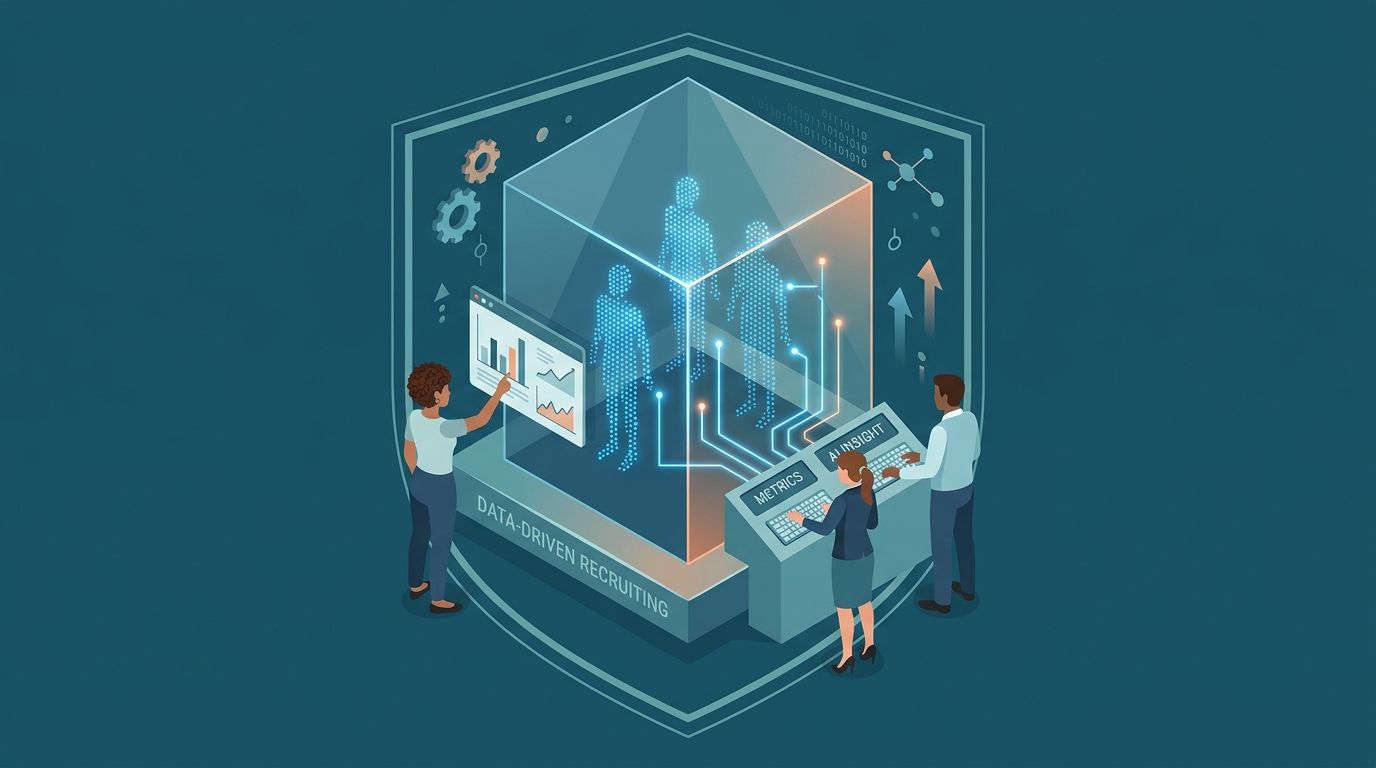
Data-driven recruiting is the practice of using metrics and analytics — not gut feel — to guide every hiring decision, from where you source to whom you extend an offer. The metrics that matter most are time-to-hire, quality of hire, source effectiveness, and pipeline conversion. To build a data-driven hiring process you define a clear ICP, instrument your funnel, source from measurable channels, score candidates against consistent criteria, and review the numbers every cycle. Modern AI sourcing tools make the data layer automatic instead of a spreadsheet chore.
Most hiring still runs on instinct: a recruiter feels a candidate is strong, a manager likes a resume, a job board feels like it works. Data-driven recruiting replaces those feelings with evidence. It treats hiring as a measurable funnel, so you know which sources produce hires, where candidates drop off, and whether the people you hire actually succeed.
The shift matters because hiring is expensive and slow when it is unmanaged. Teams that track the right recruiting metrics fill roles faster, spend less per hire, and — most importantly — hire better people. This guide explains what data-driven recruiting is, why it works, the metrics that matter, and a step-by-step process for building it, including the tools and AI that power the data layer.
What Is Data-Driven Recruiting?
Data-driven recruiting is a hiring approach that uses quantitative evidence — sourcing data, funnel metrics, and post-hire outcomes — to make and improve recruiting decisions. Instead of asking "does this candidate feel right?" you ask "what does the data say about candidates like this, and about the channel they came from?"
In practice it means three things. First, you collect structured data at every stage of the funnel. Second, you analyze that data to find what is working and what is leaking. Third, you act on it — reallocating budget to better sources, fixing slow stages, and tightening screening criteria. It is the same discipline marketing and sales adopted a decade ago, applied to talent.
The approach is not about drowning recruiters in dashboards. It is about answering three operational questions with evidence rather than opinion: where should we spend sourcing effort, who is most likely to succeed in the role, and what in our process is slowing us down. Decades of research, including the classic finding from Harvard Business Review on hiring , show that structured, evidence-based selection consistently outpredicts unstructured judgment. This approach simply operationalizes that finding.
Traditional recruiting reacts to an open req, posts a job, and screens whoever applies — success is judged by whether the seat gets filled.
Data-driven recruiting treats every req as a funnel with measurable inputs and outputs, and judges success by quality of hire and cost-efficiency, not just by closing the role.
Why Data-Driven Recruiting Matters
Data-driven recruiting matters because it directly lowers cost, raises hire quality, and removes bias from decisions. When you measure the funnel, you stop wasting money on channels that do not convert and stop losing finalists to a process that is too slow.
- Lower cost per hire — SHRM benchmarks put the average cost-per-hire near $4,700. Knowing which sources convert lets you cut spend on the ones that do not.
- Faster time-to-hire — funnel data shows exactly where days are lost, usually in sourcing and scheduling rather than in the interviews themselves.
- Better quality of hire — tracking post-hire performance and retention tells you whether your process actually selects good employees, which most teams never verify.
- Less bias, more fairness — structured, scored criteria reduce the influence of gut feel, making hiring more defensible and more equitable.
The payoff compounds. Each hiring cycle generates more data, which sharpens the next decision. For a fuller view of how sourcing fits the broader pipeline, see our guide to sourcing strategies in recruitment and the end-to-end recruitment process.
Data-driven recruiting needs a clean top of funnel. Lessie AI searches 100+ live sources in real time and returns matched candidates with verified contacts at 95% accuracy —so your metrics start with quality, not noise.
The Recruiting Metrics That Matter
The metrics that matter most are the ones that connect recruiting effort to business outcomes: time-to-hire, quality of hire, source effectiveness, and funnel conversion. Track too many and the signal drowns; these four cover speed, outcome, efficiency, and pipeline health.
| Metric | What it measures | Healthy benchmark |
|---|---|---|
| Time-to-hire | Days from a candidate entering the pipeline to accepting an offer | Top quartile under 30 days; average around 44 |
| Quality of hire | Performance, hiring-manager satisfaction, and first-year retention | Measured 6–12 months out, trending up |
| Source effectiveness | Which channels produce hires, not just applicants | Cost and conversion compared per channel |
| Pipeline conversion | Pass-through rate between each funnel stage | No single stage leaking more than expected |
| Offer acceptance rate | Accepted offers divided by offers extended | Above ~90%; lower signals slow or mispriced offers |
| Cost per hire | Total recruiting spend divided by hires made | Near $4,700 average; multiples higher for executives |
Pair a speed metric with an outcome metric so they balance each other. Optimize time-to-hire alone and you ship bad hires faster; optimize quality alone and the best candidates accept other offers while you deliberate. The point of the data is to improve both at once.
Two derived metrics are worth adding once the basics are stable. Source of hire tells you the percentage of hires that came from each channel — referrals, inbound, proactive sourcing, agencies — which is the single most useful input for budget decisions. Funnel velocity measures the average days spent in each stage, so you can see whether the delay sits in screening, scheduling, or decision-making. Together, source of hire and funnel velocity turn a vague "hiring is slow" complaint into a specific, fixable problem.
How to Build a Data-Driven Hiring Process
Building a data-driven hiring process means turning each recruiting stage into a measurable step with a defined input and output. You do not need expensive software to start — you need consistency. Follow these five steps in order.
- 1Define a precise ICP and scorecard
Start with the data target: the exact title, skills, seniority, and location of the ideal candidate, plus a written scorecard of must-haves versus nice-to-haves. This scorecard becomes your screening rubric and the baseline you measure every candidate against. Vague requirements produce unmeasurable pipelines.
- 2Instrument your funnel
Define every stage — sourced, contacted, replied, screened, interviewed, offered, hired — and capture the count at each one. Your applicant tracking system or a simple shared sheet is enough to begin. Without stage-by-stage counts you cannot see where the pipeline leaks.
- 3Source from measurable channels
Tag every candidate with the channel they came from so you can compare conversion later. Add proactive sourcing alongside inbound applicants — tools like Lessie AI search 100+ live sources and return matched candidates with verified contacts, giving you a clean, attributable top of funnel instead of an anonymous pile of resumes.
- 4Score candidates consistently
Run structured screens and interviews against the scorecard from step one, with the same questions and the same rating scale for every candidate. Consistent scoring turns subjective impressions into comparable data — and a free AI resume screener can rank inbound applicants against your criteria automatically.
- 5Review the data and iterate
After each cycle, read the funnel: which sources converted, where candidates dropped off, how long each stage took, and — months later — how new hires performed. Reallocate budget to the channels that produce hires, fix the slowest stages, and refine the scorecard. Data-driven recruiting is a loop, not a one-time setup.
The discipline scales down as well as up. A two-person startup running this loop in a spreadsheet still hires better than a large team guessing. What changes at scale is the tooling that collects and analyzes the data for you.
Tools and AI That Power Data-Driven Recruiting
The tools that power data-driven recruiting fall into three layers: systems that store candidate data, platforms that analyze talent signals, and AI agents that generate and enrich the data at the top of the funnel. Most teams already have the first; the second and third are where the leverage is in 2026.
- Applicant tracking systems (ATS) — the system of record for your funnel. They store stage counts and timestamps, which makes time-to-hire and conversion measurable.
- Talent intelligence platforms — aggregate market and candidate data to inform sourcing strategy. See our overview of talent intelligence platforms for how this layer works.
- AI sourcing agents — the newest and most impactful layer. They automate the data-heavy work of finding, scoring, and contacting candidates, which used to consume most of a recruiter's week.
Choosing across these layers is its own exercise. Our roundups of the best AI recruiting tools and best talent sourcing tools compare the leading options. If you are evaluating job-board-style platforms, our Indeed alternatives guide is a useful starting point.
Common Pitfalls in Data-Driven Recruiting
The biggest risk in data-driven recruiting is measuring the wrong things well. Teams that chase volume metrics — applications received, profiles viewed, emails sent — feel busy and productive while their actual hiring outcomes stay flat. Avoid these four common traps.
- Vanity metrics — number of applicants or messages sent looks good in a report but says nothing about quality. Track hires and quality of hire, not activity.
- Ignoring post-hire data — the most valuable signal arrives months after the offer. If you never connect a hire back to their performance and retention, you cannot tell whether your process actually selects good people.
- Dirty source data — if candidates enter the funnel untagged or with stale contact details, every downstream metric is unreliable. Garbage in, garbage out applies to recruiting analytics as much as anywhere.
- Optimizing one metric in isolation — cutting time-to-hire by rushing interviews lowers quality of hire; the two must be read together.
There is also a fairness dimension. As employment regulators increasingly scrutinize automated hiring, the EEOC guidance on algorithms in hiring makes clear that data and AI must be used to reduce, not amplify, bias. Consistent scorecards and audited criteria are how data-driven recruiting stays both effective and defensible.
A falling offer acceptance rate is the earliest warning that your data-driven process has drifted — usually it means compensation is out of band or the cycle has grown so slow that finalists sign elsewhere. Treat it as a leading indicator, not a lagging one.
How Lessie Powers the Data Layer
Lessie AI is the world's first People Search AI Agent, and it automates the most data-intensive part of recruiting: building and enriching the top of the funnel. Instead of writing Boolean strings across job boards, you describe the candidate in plain language — "senior data engineers in Berlin with Python and dbt, open to remote" — and the AI recruiting agent searches 100+ live sources, scores every match against your criteria, and returns profiles with verified emails at 95% accuracy.
Because every candidate arrives scored and attributable, your funnel data starts clean. From 50M+ profiles across LinkedIn, GitHub, and the open web, Lessie finds, scores, and reaches out automatically, drafting personalized messages that lift reply rates roughly 3x over template blasts — while cutting manual research time by about 80%. Your ATS stays the system of record; Lessie fills the part of the funnel that data-driven teams most need and most struggle to instrument. It is AI candidate sourcing with the measurement built in, and the free tier covers candidate search so you can test it on a live role before paying anything.
Replace hours of manual searching and spreadsheet tracking with one prompt. Lessie finds matched candidates, verifies their contacts, scores them against your criteria, and writes the first outreach email — the data-driven funnel, automated.