




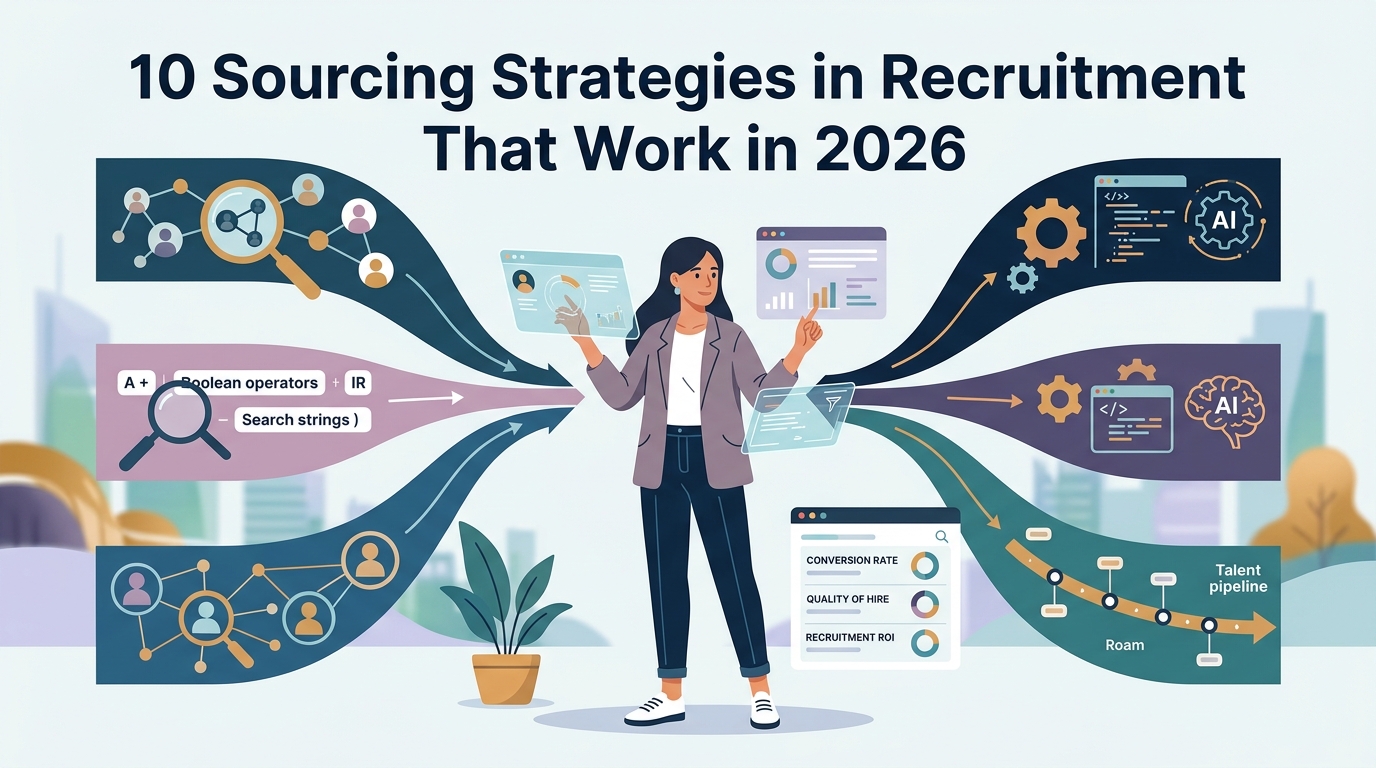
A sourcing strategy in recruitment is a deliberate plan for where and how you find candidates before they apply. The strongest teams combine search-based tactics (boolean and X-ray search, sourcing beyond LinkedIn, AI tools), relationship-based tactics (referrals, talent pipelines, silver medalists, passive outreach), and channel tactics (niche job boards, events, employer branding) — then track response rate and source-of-hire to double down on what works. This guide breaks down 10 strategies you can run this quarter.
A sourcing strategy in recruitment is a structured plan for proactively finding, engaging, and nurturing potential candidates — before they ever submit an application. It defines which channels you search, which profiles you prioritize, how you reach out, and how you measure results. In short: it turns sourcing from random LinkedIn scrolling into a repeatable system.
Why does this matter? Because the best candidates rarely apply. According to LinkedIn talent research, roughly 70% of the global workforce is passive talent — open to the right offer, but not browsing job boards. If your hiring plan starts and ends with posting a job, you are competing for the remaining 30% along with everyone else.
This article is a strategy playbook, not a software roundup — if you want tool-by-tool comparisons, see our guide to the best talent sourcing tools. Below are 10 candidate sourcing strategies grouped into three families, plus the metrics that tell you which ones deserve more budget.
Search-Based Sourcing Strategies: Find Candidates Where They Already Are
Search-based sourcing means actively querying the open web and professional platforms for people who match your role — instead of waiting for applications. It is the fastest way to build a longlist, and it rewards technique: a precise query beats an hour of manual scrolling every time.
1. Master boolean and X-ray search
Boolean search combines operators like AND, OR, quotes, and the minus sign to filter results with precision. X-ray search adds Google's site: operator to surface public profiles a platform's own search hides behind logins or caps. Start with one role, write three string variants (title synonyms, skills, location), and refine based on result quality. Keep a shared doc of strings that worked. Our Google X-ray search guide has copy-paste strings for LinkedIn and GitHub, and Google's search operators reference is the canonical syntax source.
2. Source beyond LinkedIn
LinkedIn is crowded: in-demand candidates receive dozens of recruiter messages a week. Sourcing where your talent actually spends time cuts that noise. Engineers ship code on GitHub and answer questions on Stack Overflow — the Stack Overflow Developer Survey shows how concentrated that community is. Designers showcase work on Behance and Dribbble. Data scientists compete on Kaggle. Niche Slack and Discord communities host specialists who have no public resume at all. A portfolio or commit history often tells you more than any profile headline.
3. Add an AI sourcing tool to your stack
AI sourcing tools replace manual query-building with natural language: describe the candidate (“senior backend engineers in Berlin with Go experience, open to fintech”) and the agent searches multiple sources, scores matches, and returns verified contact details. This compresses hours of boolean work into minutes and surfaces candidates who are invisible to keyword search. Treat AI as the engine of your search-based strategy — not a replacement for judgment. Our AI candidate sourcing guide covers workflows, prompts, and pitfalls in depth.
Lessie turns a plain-English description into a scored candidate list with verified emails — pulled from 100+ live sources, not a stale database. No boolean strings to maintain.
Relationship-Based Sourcing Strategies: Turn Your Network Into a Pipeline
Relationship-based sourcing converts people who already know your company — employees, past candidates, and warm contacts — into a steady stream of qualified talent. These strategies take longer to spin up than search, but they consistently produce the highest-quality hires at the lowest cost per hire.
4. Run a structured employee referral program
Referred candidates are typically faster to hire, better matched to culture, and more likely to stay — which is why referrals remain a top source of hire across industries. The key word is structured: a vague “send us your friends” email produces nothing. Define which roles are referral-eligible, make submitting a referral a two-minute task, pay bonuses promptly, and report back to referrers on outcomes. Re-launch the program each quarter with the current priority roles so it never goes stale.
5. Build a talent pipeline before you need it
A talent pipeline is a pre-vetted pool of candidates for roles you hire repeatedly or expect to open soon. Instead of starting from zero with every requisition, you nurture a warm bench: a quarterly check-in, a relevant article, an invite to a webinar. When the role opens, your first ten conversations are with people who already know you. Pipelines turn time-to-fill from months into weeks — especially for hard-to-fill engineering and leadership roles.
6. Re-engage silver medalists and past applicants
Silver medalists — candidates who reached your final round but were not chosen — are the most undervalued asset in your ATS. They were already screened, interviewed, and nearly hired. When a similar role opens, reach out personally and reference the previous process. The same applies to strong past applicants whose timing was off. A monthly ATS mining habit costs an hour and routinely produces interview-ready candidates at zero sourcing cost.
7. Personalize passive candidate outreach
Passive candidate sourcing only works if your message earns a reply. Generic “I came across your profile” notes get ignored. Reference something specific — a project they shipped, a talk they gave, a problem your team is solving that maps to their experience — and keep the first message under 100 words with one clear ask. Then follow up: most replies come from touch two or three, not touch one. Our library of LinkedIn InMail templates gives you proven openers to adapt.
Channel and Brand Strategies: Make Candidates Come to You
The third family of sourcing strategies in recruitment is about placement and reputation: showing up in the specific channels your candidates trust, and building an employer brand that does the persuading before you ever send a message. These tactics compound — each month of investment lowers the effort the other nine strategies require.
8. Go niche with job boards
Generic boards bury your role under thousands of listings. Niche job boards put it in front of a self-selected audience: think communities for remote workers, climate tech, developers, designers, or specific stacks and certifications. Applications from niche boards are fewer but dramatically better qualified, which saves screening time downstream. Test two or three boards per role family, track qualified-applicant rate per board, and cut the ones that underperform after two cycles.
9. Show up at events, meetups, and communities
Conferences, local meetups, hackathons, and online communities are where specialists build reputations — and where you can evaluate skills in context instead of from a resume. Sponsor or speak rather than just attend: a 15-minute talk generates inbound conversations all day. Afterward, connect within 48 hours while the context is fresh, and feed promising contacts into your talent pipeline (strategy 5) rather than pitching a role on first contact.
10. Invest in inbound employer branding
Employer branding is sourcing at scale: engineering blogs, candid team videos, salary transparency, and honest reviews pre-answer the questions every passive candidate has. When your outreach lands, the candidate googles you — what they find decides whether they reply. Start small: two authentic posts a month about real work, written by the team, beats a polished careers-page rebrand. Measure it through direct traffic to your careers page and the reply-rate lift on cold outreach.
Running multiple sourcing channels? Lessie consolidates search, scoring, and outreach in one agent — with 95% contact accuracy and 3x higher reply rates than manual prospecting.
How to Measure Sourcing Effectiveness
Measure sourcing with four numbers: response rate, source-of-hire, time-to-fill, and pipeline conversion. Together they tell you whether your messaging lands, which channels produce hires rather than just candidates, and where your funnel leaks. Review them monthly and reallocate effort — not all 10 strategies will earn their keep for every team.
- Response rate — replies divided by outreach sent, per channel and per template. Below 15% on cold outreach usually means weak personalization or poor targeting; fix the message before scaling the volume.
- Source-of-hire — which channel each hire actually came from. Track it at offer-accept, not application, and compare against the hours each channel consumes. This is the single best input for next quarter's sourcing mix.
- Time-to-fill — days from requisition to accepted offer. Pipeline and referral strategies should pull this down over time; if they do not, they are shelf-ware.
- Pipeline conversion — the pass-through rate from sourced candidate to screen to interview to offer. A channel that produces many contacts but few screens is a targeting problem, not a volume problem.
One caution: do not judge a relationship-based strategy on a 30-day window. Referral programs and talent pipelines look expensive in month one and unbeatable by month six. Give slow-compounding strategies at least two quarters before cutting them.
How Lessie Powers Your Sourcing Strategy
Most of the strategies above share one bottleneck: the hours it takes to find the right people and their contact details. Lessie, the People Search AI Agent, removes it. You describe the candidate in plain English; Lessie searches 100+ live sources — LinkedIn, GitHub, communities, company sites — scores every match, and returns verified emails with 95% accuracy.
- Replace boolean gymnastics — one natural-language prompt does the work of a dozen X-ray strings, and it does not break when a site changes its URL structure.
- Source beyond LinkedIn by default — strategy 2 happens automatically, because Lessie searches the platforms where engineers, designers, and specialists actually publish.
- Feed your pipeline and outreach — export scored lists to nurture, or let Lessie write personalized first-touch messages that earn 3x higher reply rates.
Teams using Lessie for talent sourcing cut manual research time by 80%+ — which means the strategic work in this guide (referrals, events, branding) finally gets the hours it deserves.