




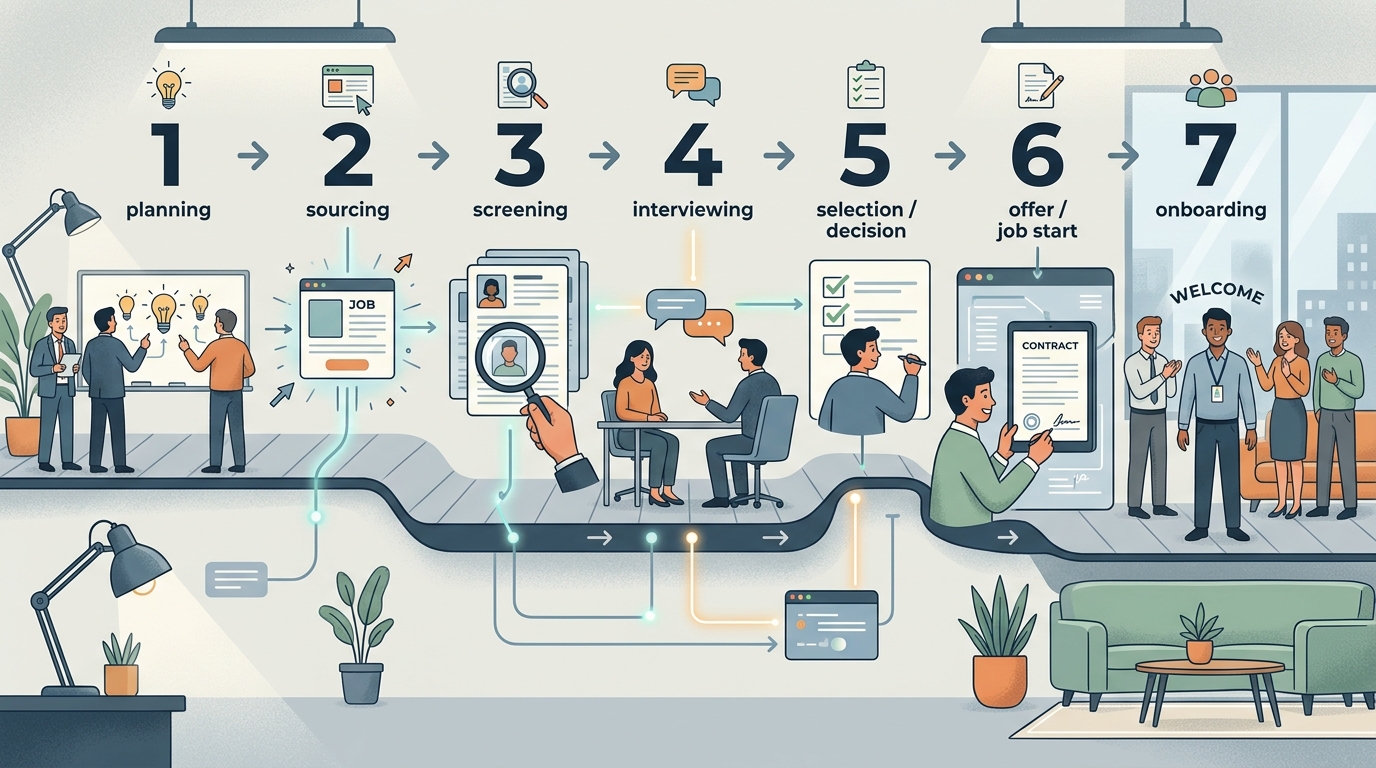
The recruitment process is the structured sequence an organization follows to identify a hiring need and fill it with the right person. It runs through seven steps: workforce planning, writing the job description, sourcing, screening, interviewing, the offer, and onboarding. Recruitment is reactive and role-specific; talent acquisition is the long-term strategy around it. The two metrics that tell you whether your process works are time-to-hire and quality of hire.
The recruitment process is the end-to-end series of steps a company takes to find, evaluate, and hire a new employee — from recognizing that a role needs to be filled to the new hire's first day. A well-defined process makes hiring repeatable, fair, and measurable instead of ad hoc.
Most organizations run some version of the same seven steps, whether they hire twice a year or twice a week. With the US Bureau of Labor Statistics JOLTS data consistently showing millions of open positions competing for candidates, the companies that win are the ones whose hiring moves fast without sacrificing rigor. This guide defines each step, separates recruitment from talent acquisition, and shows which metrics to track to improve it.
The 7 Steps of the Recruitment Process
A standard hiring pipeline moves through seven stages in order. Each stage produces a concrete output — an approved role, a job description, a candidate pipeline, a shortlist, an evaluation, a signed offer, and finally a productive employee.
- 1Workforce planning
Before any job ad goes live, the organization confirms the need: is this a new role, a backfill, or work that can be redistributed? Planning defines headcount, budget, level, and timing, and gets hiring-manager and finance approval. Skipping this step is the most common cause of roles being reopened, rescoped, or frozen mid-search — which wastes every later step.
- 2Job description
The role is translated into a written profile: responsibilities, must-have and nice-to-have skills, compensation range, and location or remote policy. A precise job description doubles as your screening rubric later. Tools like a free job description generator help teams produce a structured, inclusive draft in minutes instead of recycling an outdated posting.
- 3Sourcing
Sourcing is how candidates enter the pipeline: job boards, referrals, your careers page, and proactive outreach to passive candidates. Passive sourcing matters most for competitive roles — the strongest candidates are rarely applying anywhere. This is also the step where AI has changed recruiting most, with agents that search across platforms and return matched candidates with verified contact details.
- 4Screening
Applications and sourced profiles are narrowed to a shortlist. Typical filters include resume review against the job description, a short phone or async screen, and sometimes a skills assessment. The goal is to remove unqualified candidates quickly while keeping the bar consistent — structured criteria beat gut feel at this stage.
- 5Interviewing
Shortlisted candidates meet the hiring manager and team across one or more rounds: behavioral questions, role-specific exercises, and culture-add conversations. Structured interviews — same questions, defined scorecards —are far more predictive than improvised ones. An interview question generator keeps panels consistent across candidates and rounds.
- 6Offer
The chosen candidate receives a formal offer: compensation, equity or bonus, start date, and any contingencies like reference or background checks. Speed matters — strong candidates usually hold competing offers, and slow approval chains are a leading cause of declined offers. Track your offer acceptance rate; below roughly 90% signals mispriced or mistimed offers.
- 7Onboarding
Recruitment does not end at the signature. Onboarding covers paperwork, equipment, introductions, and a 30–90 day ramp plan. Strong onboarding directly improves early retention — and early attrition is the most expensive failure mode of the whole process, because it sends you back to step one with nothing to show for the spend.
Sourcing is the slowest step for most hiring teams. Lessie AI compresses it from weeks to minutes — describe who you need in plain language and get matched candidates from 100+ live sources with 95% contact accuracy.
Recruitment vs Talent Acquisition: What Is the Difference?
Recruitment is the tactical process of filling a specific open role. Talent acquisition is the ongoing strategy of building pipelines, employer brand, and workforce plans so future roles fill faster. Every talent acquisition function runs recruiting; not every recruitment effort is part of a talent acquisition strategy.
| Dimension | Recruitment | Talent Acquisition |
|---|---|---|
| Time horizon | Short-term: fill the open role now | Long-term: build pipelines for future needs |
| Trigger | A vacancy or approved headcount | Business strategy and workforce planning |
| Scope | The 7 steps above, role by role | Employer brand, talent pools, succession, analytics |
| Success metric | Time-to-hire, cost-per-hire | Quality of hire, pipeline coverage, retention |
In practice the line blurs: a recruiter who keeps silver-medalist candidates warm for the next opening is doing talent acquisition. If you are choosing software, the distinction matters — our comparison of the best talent acquisition software breaks down which platforms handle sourcing versus pipeline management.
How to Improve Your Recruitment Process
Improving your process starts with measuring it. Two metrics matter most: time-to-hire (speed) and quality of hire (outcome). Optimize speed alone and you ship bad hires faster; optimize quality alone and the best candidates accept other offers while you deliberate.
- Time-to-hire — days from a candidate entering the pipeline to accepting the offer. SHRM benchmarks put the average around 44 days; top quartile teams run under 30. The biggest gains usually come from the sourcing and scheduling steps, not from rushing interviews.
- Quality of hire — measured 6–12 months out via performance ratings, hiring-manager satisfaction, and first-year retention. As Harvard Business Review notes, most companies track cost and speed but never check whether their hiring process actually selects better employees.
- Cost-per-hire — SHRM estimates an average near $4,700 per hire, and several multiples of that for executive roles. Sourcing tools with flat pricing lower this fastest.
- Offer acceptance rate — accepted offers divided by offers extended. A falling rate usually means compensation drift or a process so slow that finalists already signed elsewhere.
Beyond metrics, three changes improve almost any recruiting process: write the screening rubric before sourcing begins, use structured interviews with shared scorecards, and add a proactive sourcing channel instead of waiting on applicants. Distributed teams should also adapt each step for remote — our guide on how to hire remote employees covers the async-screening and time-zone adjustments that matter.
How Lessie Streamlines Recruitment
Lessie AI is a People Search AI Agent that compresses the sourcing and outreach steps of the recruitment process. Instead of building Boolean strings across job boards, you describe the candidate in natural language — "senior backend engineers in Europe with Go experience, open to remote" — and the AI recruiting agent searches 100+ live sources, scores every match against your criteria, and returns profiles with verified emails at 95% accuracy.
It then drafts personalized outreach for each candidate and tracks replies, which lifts response rates about 3x compared to template blasts. Teams keep their ATS as the system of record; Lessie fills the top of the funnel that most applicant tracking systems leave empty. The free tier covers candidate search, so you can test it on a live role before paying anything.
Replace hours of manual LinkedIn and job-board searching with one prompt. Lessie finds matched candidates, verifies their contacts, and writes the first outreach email for you.