




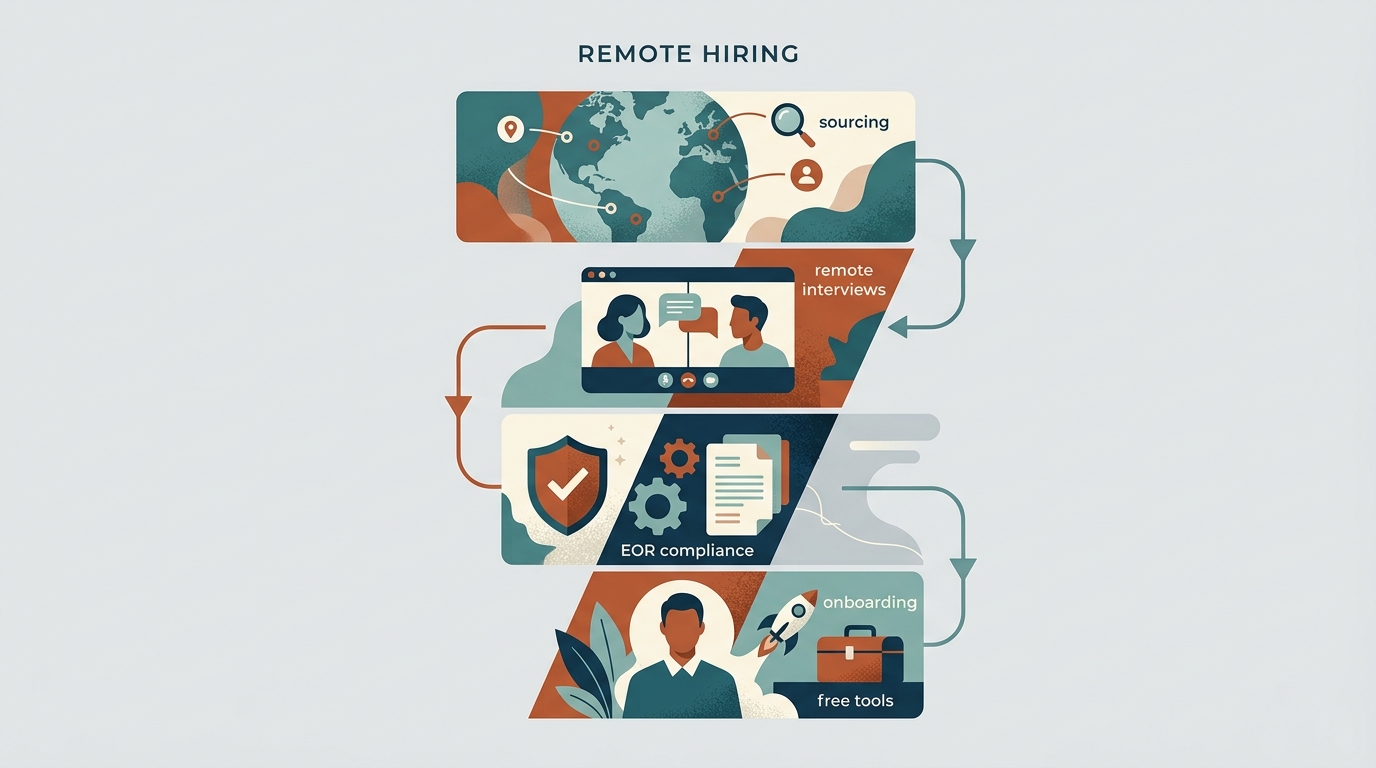
To hire remote employees, follow seven steps: define the role and your remote policy, write a remote-friendly job description, source candidates globally, screen and interview over video, sort out compliance (employee vs. contractor vs. EOR), make a location-aware offer, and onboard for async work. The biggest mistakes happen before the first interview — vague remote policies, local-only sourcing, and ignoring employment law in the candidate's country.
Figuring out how to hire remote employees breaks every assumption of local hiring. Where do you post a role that anyone on Earth can apply to? How do you screen someone you will never meet in person? Who handles payroll taxes when your best candidate lives in another country — or another continent?
The upside is worth the friction. Remote roles pull from a global talent pool instead of a 30-mile radius, and Buffer's State of Remote Work consistently finds that around 98% of remote workers want to keep working remotely for the rest of their careers. Offer remote, and you compete for people your local rivals never even see.
This guide walks through the full process of hiring remote employees: a seven-step workflow, the best sourcing channels, the legal and EOR questions that trip teams up, and the interview questions that actually predict remote performance.
Lessie AI turns a plain-English brief like "senior React developer, EU time zones, startup experience" into a scored candidate shortlist from 100+ data sources— verified emails included.
How to Hire Remote Employees in 7 Steps
The process to hire remote employees mirrors traditional hiring but adds three remote-specific layers: global sourcing, async-friendly screening, and cross-border compliance. Run the seven steps below in order — most failed remote hires trace back to skipping step 1 or step 5.
- 1Define the role and your remote policy
Before you write a word of the job ad, decide what "remote" means for this role: fully remote or hybrid, which time zones (or overlap hours) are required, whether you will hire in any country or a fixed list, and what equipment or stipend you provide. A vague policy creates mismatched expectations that surface only after the offer.
- 2Write a remote-friendly job description
State the time-zone window, salary range, and hiring countries up front— remote candidates filter on these three before reading anything else. Highlight async communication skills and self-management as requirements, not nice-to-haves. A free job description generator can draft a structured, bias-checked version in under a minute.
- 3Source candidates globally
Post on remote-specific job boards, but do not stop there — the strongest remote candidates are often not actively applying. Pair inbound posts with outbound sourcing across LinkedIn, GitHub, and niche communities. The next section covers where to find remote employees channel by channel.
- 4Screen and interview remotely
Use a short async screen first — a written questionnaire or a 5-minute video response — then 2–3 structured video interviews. How a candidate writes, schedules across time zones, and follows up is itself a work sample. Add a paid trial task for finalists when the role allows it.
- 5Check compliance: employee, contractor, or EOR
Hiring across state or country lines triggers payroll tax, benefits, and labor-law obligations where the candidate lives, not where you are. Decide between opening a local entity, engaging the person as a contractor, or using an employer of record (EOR). Get this wrong and misclassification penalties follow —details below.
- 6Make a competitive, location-aware offer
Pick a compensation philosophy before negotiations: global pay bands, local-market rates, or a hybrid with a single floor. Whatever you choose, publish the logic— remote candidates compare offers globally, and opaque pay is the fastest way to lose a finalist who has three other remote offers.
- 7Onboard for async success
Ship equipment and access before day one, assign an onboarding buddy, and document everything a new hire would normally absorb by sitting near the team. The first two weeks should mix scheduled face time (daily check-ins) with async material they can work through in their own time zone.
Where to Find Remote Employees
The best places to find remote employees are remote-specific job boards for inbound applicants and AI sourcing tools for outbound search. Inbound brings volume; outbound brings the senior, passive candidates who never visit a job board. Strong remote hiring pipelines run both at once.
- Remote job boards — We Work Remotely and FlexJobs reach audiences who have already opted into remote work, so every applicant has self-selected for your work model.
- LinkedIn and developer communities — filter by "open to remote" and go outbound. GitHub, Discord groups, and niche Slack communities surface specialists long before they update a resume.
- Employee referrals — your existing remote employees know other people who thrive remotely. Referred hires also ramp faster because they arrive with realistic expectations of distributed work.
- AI sourcing platforms — instead of paging through filters, describe the person you need and let an agent search. Our comparison of the best AI recruiting tools breaks down eight options by use case and price.
One more signal worth watching: which companies are actively recruiting in your space. A live view of who is hiring right now shows you the employers you are competing against for the same remote talent — useful for benchmarking titles, stacks, and posting velocity before you launch your own search.
A practical tip on time zones: source by overlap window, not by country. A role that requires four hours of overlap with New York opens up all of Latin America and much of Europe — a far larger pool than "US only" and a far easier collaboration setup than "anywhere." Write the overlap window into your search criteria and your job post, and both your sourcing and your screening get sharper.
Remote Hiring Legal Considerations: Contractors, EORs, and Compliance
The core legal rule when you hire remote employees: employment law follows the worker, not the company. If your hire lives in Germany, German labor law applies — regardless of where your company is incorporated. You have three compliant paths, each with a different cost and risk profile.
- Open a local entity — full control and lowest per-employee cost at scale, but setup takes months and only makes sense once you plan several hires in one country.
- Hire a contractor — fast and cheap, but only legal if the relationship genuinely is contracting. If you control their hours, tools, and core duties, most jurisdictions — including the IRS in the United States — will classify them as an employee, and misclassification brings back taxes and penalties.
- Use an employer of record (EOR) — the EOR legally employs the person in their country and handles payroll, taxes, and statutory benefits while they work for you day to day. Typical pricing runs roughly $400–$700 per employee per month — usually far cheaper than entity setup for the first few hires in a country.
Domestic remote hiring carries obligations too. In the United States, hiring remote employees in a new state usually means registering for payroll taxes there, carrying that state's workers' compensation coverage, and following its wage-and-hour and leave rules. Many teams discover this only at tax time — confirm the state requirements before the offer letter, not after.
Two more items for your checklist when hiring remote employees across borders: data protection (a hire in the EU brings GDPR obligations for the personal data they handle) and permanent establishment risk — a senior hire signing contracts from another country can create a taxable presence for your company there. When in doubt, a one-hour consult with an employment lawyer is cheaper than any of these mistakes.
Stop juggling five sourcing tabs. Lessie AI finds and ranks remote candidates across 100+ live sources with 95% contact accuracy, so you spend your time interviewing— not searching.
Interview Questions for Remote Candidates
The best interview questions for remote candidates test self-management, written communication, and async judgment — the three skills that separate strong remote performers from strong office performers. Skills questions stay the same; add a dedicated remote-readiness round with questions like these.
- "Walk me through how you structure a typical remote workday." Listen for deliberate routines, not improvisation.
- "Tell me about a time a project went sideways because of a communication gap. What did you change?" Remote veterans always have a real answer.
- "You are blocked and the person who can unblock you is asleep. What do you do?" Tests async judgment and initiative.
- "How do you make your work visible to a distributed team?" Look for written updates, demos, and documentation habits.
- "Have you worked across time zones before? What broke, and how did you fix it?" Surfaces real distributed-team experience versus office habits on a laptop.
- "What does your home working setup look like?" Practical, and it surfaces equipment needs before day one.
Run interviews over video, keep the same question set for every candidate so scores are comparable, and include at least one written exercise — most remote collaboration is written. If you want a structured set tailored to your role in seconds, the free interview question generator builds role-specific questions with evaluation criteria.
For finalists, a short paid trial project beats another interview round. Two to four hours of real, scoped work shows you how the candidate communicates progress, asks questions async, and delivers without supervision — exactly the behaviors a remote role depends on. Pay for the time regardless of outcome; it keeps the process fair and your employer brand intact.
How Lessie Helps You Hire Remotely
Lessie AI is a People Search AI Agent: describe the remote candidate you need in plain English, and it handles the search-to-contact workflow that normally eats a sourcer's week. For remote hiring specifically, that solves the hardest problem — finding qualified people across a global pool too large to browse manually.
- Natural-language sourcing — "backend engineer, fintech experience, UTC±2, open to remote" becomes a scored shortlist. No boolean strings, no filter grids.
- 100+ live data sources — Lessie searches LinkedIn, GitHub, company sites, and niche communities simultaneously, so global candidates surface no matter where they are visible.
- Verified contacts at 95% accuracy — every shortlisted candidate comes with a verified email, so outreach starts immediately.
- AI-personalized outreach — Lessie drafts individual messages and tracks replies, delivering up to 3x higher response rates than template blasts.
Teams use it alongside the steps above: write the role with the free generators, source with Lessie's AI recruiting agent, and spend the time you saved on interviews and onboarding — the parts of remote hiring that still need a human.