




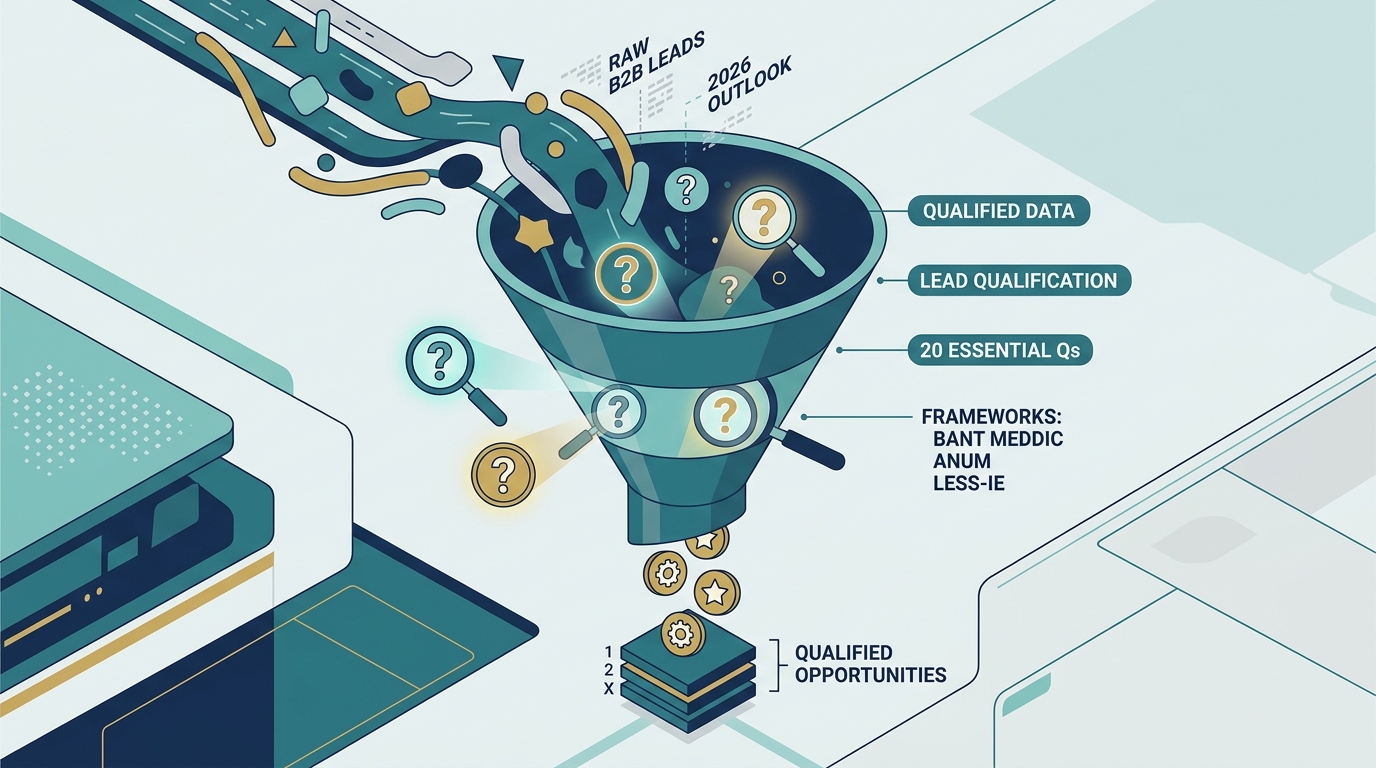
The right lead qualification questions map to the three things every B2B rep needs to know in the first call: (1) is there a real pain or trigger driving this conversation, (2) does the prospect have budget authority, and (3) what is the timeline. The 20 questions below are organized by the four canonical frameworks— BANT, MEDDIC, ANUM, GPCTBA/C&I — and ranked by which surface real information vs. polite filler. Pre-qualify before the call (Lessie surfaces funding, tech stack, recent hires on every contact) and the conversation gets shorter and higher-conversion.
Most lead qualification questions in B2B sales training are recycled from BANT and MEDDIC playbooks written for enterprise software in the 1990s. The questions still work, but the calling environment changed. Reps now have 8–12 minutes to qualify before a prospect drops off, AI summarization makes filler questions obvious, and the best teams pre-qualify before the call so the conversation starts at the third or fourth question, not the first.
This guide covers the 20 lead qualification questions that actually surface budget, urgency, authority, and need in 2026. We organize by framework (BANT, MEDDIC, ANUM, GPCTBA/C&I), explain why each question works, and show how to pre-qualify before the call using Lessie — which cuts qualification time in half by surfacing funding stage, tech stack, and decision-makers automatically.
The 4 Lead Qualification Frameworks That Drive These Questions
Before the questions, the frameworks. Knowing where each question comes from helps you adapt the wording to your motion.
BANT (Budget, Authority, Need, Timeline). IBM's classic. Still the most-taught framework. Strong on budget and timeline; weak on diagnosing real pain. Best for transactional and short-sales-cycle B2B.
MEDDIC (Metrics, Economic buyer, Decision criteria, Decision process, Identify pain, Champion). PTC's enterprise sales playbook. Strong on complex deals where you need to map the buying committee. Best for $50k+ ACV deals.
ANUM (Authority, Need, Urgency, Money). A reordered BANT prioritizing authority and need over budget. Useful when budget is fungible (most B2B SaaS) and timing is the bottleneck.
GPCTBA/C&I (Goals, Plans, Challenges, Timeline, Budget, Authority, Consequences, Implications). HubSpot's inbound-sales framework. Strong on consultative selling; weak when prospects are price-shopping at the bottom of the funnel.
The 20 Best Lead Qualification Questions for 2026
Numbered for reference. Use 4–6 of these per discovery call, not all 20. The questions are ordered so each answer informs the next.
Pain & Need (BANT N, MEDDIC IP, GPCTBA Challenges):
- What problem are you trying to solve right now? Open-ended on purpose. Surfaces the actual trigger.
- What have you tried so far? Reveals competitive landscape and prior spend. If they have not tried anything, urgency is low.
- What happens if you do nothing for 6 months? Tests pain severity. Strong answer = high urgency. Vague answer = low urgency.
- How are you measuring success on this? MEDDIC Metrics. If they cannot articulate a number, the deal will stall at procurement.
Budget & Money (BANT B, ANUM M):
- Is there a budget already allocated, or do you need to make a business case? Far more useful than "what is your budget" (which gets a deflection).
- What did you spend on this category last year? Concrete reference point. If zero, this is a new initiative and timing slows.
- What is the cost of the problem today? Reframes price into ROI conversation. Critical for complex deals.
Authority & Decision Process (BANT A, MEDDIC EB+DP, ANUM A):
- Who else needs to be involved in this decision? Surfaces the buying committee without sounding accusatory.
- What does the approval process look like for something at this price point? Identifies legal, procurement, IT review steps that kill momentum.
- Who would own this internally if you moved forward? Identifies the champion vs. evaluator.
- How does your team typically buy software like this? Reveals trust patterns — are they consensus buyers, exec-driven, or RFP-driven?
Timeline & Urgency (BANT T, ANUM U, GPCTBA T):
- When do you need this in place? The most-asked timeline question. Push past "ASAP" with a follow-up.
- What is driving that timeline? Surfaces real triggers (board meeting, fiscal year end, competitive pressure) vs. polite filler.
- What would make you delay this past Q3? Inverse question. Reveals actual risks to the timeline.
Champion & Buying Process (MEDDIC C, GPCTBA C&I):
- Have you championed a tool / vendor here before? Strong predictor of deal velocity. Champions who have won before win again.
- What objections do you expect from your team? Pre-handles objections and reveals stakeholder dynamics.
- What would "great" look like 6 months after rollout? Reframes the conversation around outcomes, not features. Strong qualifier of fit.
Disqualification (sometimes the best question):
- Is this a real priority this quarter, or something you are exploring? Direct. Disqualifies polite shoppers in one question.
- If we had a perfect solution at the right price, what would prevent you from moving forward? Surfaces hidden blockers (legal, IT, exec sponsor).
- Why are we having this conversation now? The most underrated qualification question. Forces the prospect to articulate the trigger out loud.
Half of these questions can be pre-answered before the call. Lessie surfaces funding stage, recent leadership hires, tech stack, and decision-maker org chart from 100+ live sources, so SDRs walk into discovery with budget and authority context already mapped.
How to Pre-Qualify Leads Before the Discovery Call
The best lead qualification questions are the ones you do not have to ask because the answer is already on the screen. Modern AI-native prospecting platforms surface qualification context automatically.
Funding and budget signals. A Series B announcement two months ago is a stronger budget qualifier than any question. Lessie surfaces funding rounds, revenue proxies, and headcount growth on every contact.
Authority signals. Role title alone is not authority. Recent promotion, leadership hire announcements, and reporting structure (visible from LinkedIn + company sites) reveal real decision dynamics. Lessie maps these for the contacts it returns.
Need / pain signals. Job postings (especially for adjacent roles), product launches, hiring spikes, layoffs, and tech stack changes all signal real pain. Lessie pulls these signals from live sources.
Timing / urgency signals. Funding rounds (90–120 day budget deployment window after close), fiscal year ends, CRO transitions, M&A announcements. Trigger-based outbound built on these signals converts 3–5x base outbound because the timing is real.
For a team running 100 discovery calls a month, pre-qualifying cuts call-time in half and lifts the meeting-to-opportunity conversion meaningfully. The qualification questions become diagnostic, not exploratory.
Common Lead Qualification Mistakes
Five patterns that turn qualification into theater.
Asking budget too early. Question #5 ("is there budget allocated") works because it is not "what is your budget." The latter gets you deflection or a number designed to test you.
Treating qualification as a checklist. Reading 20 questions off a script kills the conversation. Use 4–6 questions, listen, and follow the information.
Skipping disqualification. Questions #18–20 (the disqualification questions) feel uncomfortable but save weeks of stalled deals. A polite shopper disqualified in 5 minutes is more valuable than a stalled MQL.
Confusing "interested" with "qualified." A prospect who likes your demo is not qualified. They are interested. Qualification requires budget + authority + timeline.
Not documenting the answers in CRM. Qualification information that does not make it into CRM has to be re-asked at the next call. AE-handoff failure mode #1.
FAQ: Lead Qualification Questions
For more on building qualified pipeline, see our B2B lead generation strategies guide and the best B2B sales prospecting tools ranking. The original Gartner sales-technology research is the canonical source for B2B sales process benchmarks.