




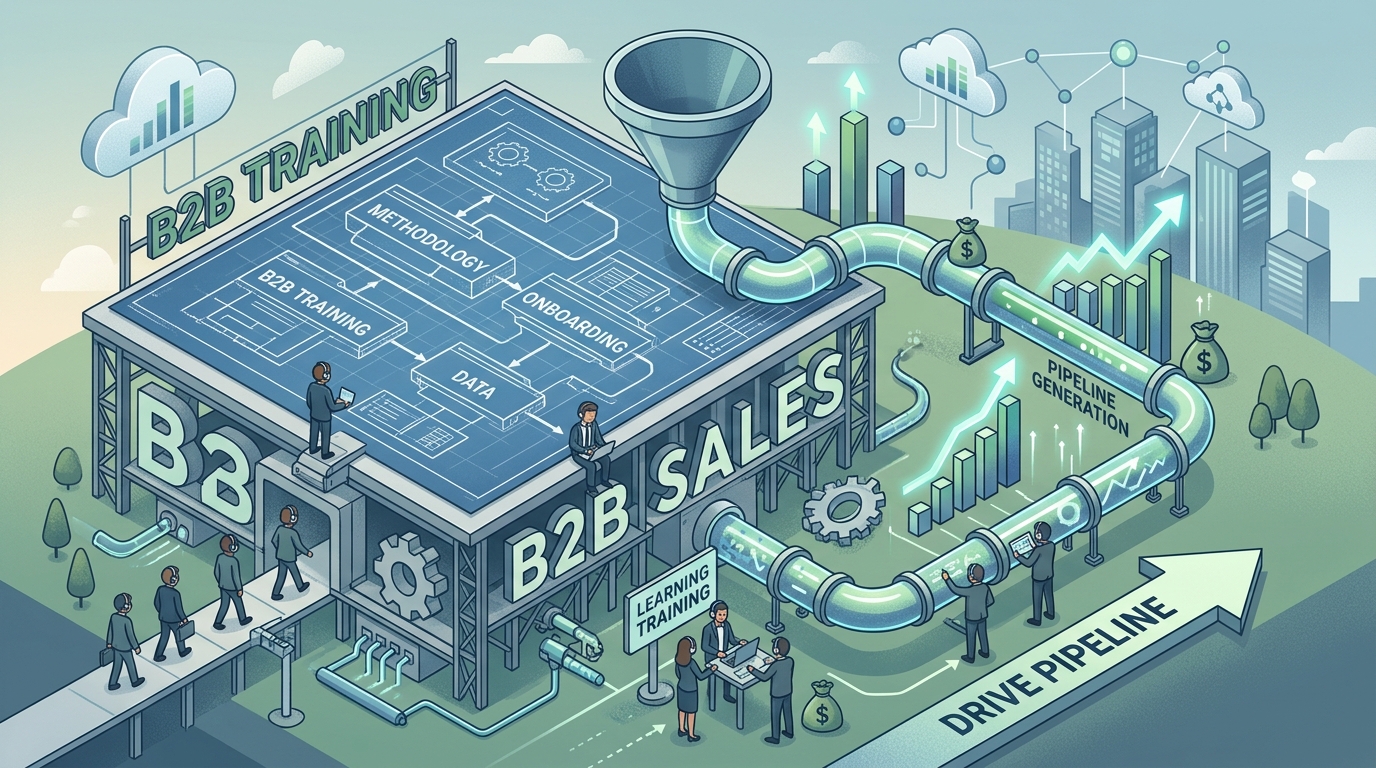
TL;DR: B2B sales training is the structured process of teaching reps the skills, product knowledge, and methodology they need to move complex deals from first touch to closed-won. A modern B2B sales training program blends onboarding, ongoing coaching, a shared methodology, and role-plays on real accounts. It works only when you measure it — ramp time, quota attainment, win rate — and reinforce it. The single biggest reason training fails to translate into pipeline is bad targeting data, so pairing your program with live prospecting is what makes the skills actually pay off.
Most sales leaders can name their best rep, but far fewer can explain, repeatably, what makes that rep good — and even fewer can teach it to the next ten hires. That gap is what B2B sales training is meant to close: taking the instincts of your top performers and turning them into a system anyone can learn. Done well, it shortens ramp time, lifts quota attainment, and makes your pipeline predictable instead of hero-dependent.
The problem is that most training is a one-week onboarding blitz followed by silence. Reps forget roughly half of it within weeks, revert to whatever worked before, and the investment evaporates. This guide walks through what a real B2B sales training program looks like: the skills and modules to cover, the methodologies worth teaching, how to onboard new reps, how to measure whether any of it is working, and why better data on your sales leads is what finally makes the training stick.
What Is B2B Sales Training?
B2B sales training is the structured development of the skills, knowledge, and behaviors reps need to sell to other businesses. Unlike B2C selling, B2B deals involve longer cycles, multiple stakeholders, higher price points, and technical evaluation — so the training has to cover far more than a pitch. It spans product fluency, discovery, objection handling, negotiation, and the mechanics of working a buying committee.
It is also not a one-time event. Effective B2B sales training is a continuous program: structured onboarding for new hires, then ongoing coaching, deal reviews, and skill refreshers for the whole team. The goal is to make excellence repeatable rather than tied to a handful of naturally gifted reps who happened to figure it out on their own.
The stakes are high because ramp is expensive. A new B2B rep commonly takes three to six months to reach full productivity, and every week shaved off that ramp is revenue pulled forward. Good training does two things at once: it gets new reps producing faster, and it lifts the ceiling for reps who have already ramped. Both show up directly in pipeline.
Building a Modern B2B Sales Training Program for Teams
A modern B2B sales training program is a system with four moving parts, not a slide deck. Those parts are onboarding, a shared methodology, ongoing reinforcement, and measurement. Skip any one and the program leaks: onboarding without reinforcement fades, methodology without measurement drifts, and reinforcement without a shared framework just spreads bad habits faster.
Start by defining what “good” looks like at each stage of your funnel. Reverse-engineer your top performers: how they run discovery, how they multithread, how they handle the pricing conversation. Turn those observed behaviors into a written playbook so training has a concrete target rather than vague encouragement to “sell better.”
Then blend the formats. Live workshops build foundational skills, but the retention comes from application: call reviews, deal clinics, and role-plays against realistic buyer objections. The best programs run on a cadence — a weekly coaching rhythm and a monthly skills theme — so learning is spaced out instead of crammed. Spaced reinforcement is the difference between a team that remembers the framework and one that forgot it by the second quarter.
Training lands faster when reps rehearse on live, in-market accounts instead of a spreadsheet from last year. Lessie searches 100+ sources on every query and returns verified decision-makers, so new hires practice discovery and outreach on real buyers from day one.
Core Skills and Modules to Cover
A complete B2B sales training curriculum covers the full deal lifecycle, not just the pitch. The modules below map to where reps most often lose deals — shallow discovery, weak multithreading, and clumsy negotiation. Prioritize the ones your win-loss data says are hurting you most, then round out the rest over the first two quarters.
- Product and market fluency — what you sell, who it is for, and the business outcomes it drives, framed in the buyer’s language rather than feature lists.
- Prospecting and targeting — building an ideal-customer list, finding the right contacts, and personalizing outreach that earns a first reply. This is where automated prospecting removes hours of manual list-building.
- Discovery and qualification — asking questions that surface real pain, budget, and decision process instead of a feature checklist.
- Demo and value framing — tying capabilities to the specific problems the buyer named in discovery.
- Objection handling and negotiation — defending price, managing procurement, and protecting margin without discounting reflexively.
- Multithreading the buying committee — identifying the economic buyer, champion, and blockers, and reaching each with the right message.
Underpinning all of it is data literacy. Reps who understand how to read sales intelligence — firmographics, technographics, and buying signals — run sharper discovery and waste less time on accounts that were never going to buy. Training the skill without training the data behind it leaves reps polished but pointed at the wrong companies.
Sales Methodologies Worth Teaching
A sales methodology gives your team a shared language for how deals move, so coaching and forecasting become consistent. The right choice depends on your deal complexity and cycle length — a transactional SMB motion needs a lighter framework than a six-figure enterprise sale. Pick one, teach it deeply, and reinforce it everywhere rather than mixing three half-taught frameworks.
| Methodology | Best for | Core idea |
|---|---|---|
| MEDDIC / MEDDPICC | Complex enterprise deals | Rigorous qualification of metrics, buyer, and decision process |
| SPIN Selling | Consultative discovery | Situation, Problem, Implication, and Need-payoff questions |
| Challenger | Disrupting the status quo | Teach, tailor, and take control of the buyer conversation |
| Solution / Consultative | Outcome-driven mid-market | Diagnose the problem before prescribing the product |
Whatever framework you choose, the point is consistency. When every rep qualifies with the same criteria, your pipeline reviews stop being guesswork and your forecast tightens. A shared methodology also makes training portable: a new hire who learns MEDDIC in onboarding can be coached against it in every deal review for the rest of their tenure.
Resist the urge to over-engineer. A methodology reps actually use beats a more sophisticated one they quietly ignore. Teach it with real deals from your own pipeline, not textbook examples, so the framework feels like a tool rather than a compliance exercise.
Onboarding and Ramping New Reps
Onboarding is the highest-leverage moment in any B2B sales training program because it sets the ramp curve for a rep’s entire tenure. A strong 30-60-90 plan front-loads product and market knowledge, then shifts quickly to supervised selling — reps should be running real discovery calls, with coaching, well before day 90. The fastest-ramping teams treat onboarding as apprenticeship, not lecture.
Structure it in phases. The first month is knowledge: product, ICP, messaging, tools, and the methodology. The second month is application: shadowing, role-plays, and first live calls under supervision. The third is ownership: the rep works their own pipeline with a coach reviewing calls and deals. Clear milestones at each phase tell you whether a hire is on track or needs intervention before quota pressure hits.
Role clarity matters here too. If your team splits inbound and outbound motions, new hires need to know which one they are ramping into — the skills and metrics differ sharply. Our guide to SDR vs BDR breaks down how those roles diverge and why training one like the other quietly sets reps up to miss. Onboard to the motion the rep will actually run.
New reps learn faster when their practice reps produce real meetings. Instead of role-playing against fictional buyers, have them source and message a small set of live, in-market accounts during onboarding — the feedback is immediate, and the pipeline is real.
Measuring B2B Sales Training Effectiveness
If you cannot measure your training, you cannot improve it — and you cannot defend the budget. The metrics that matter fall into two buckets: leading indicators that show learning is happening, and lagging indicators that show it reached revenue. Track both, because activity that never converts is just motion, and revenue without leading signals is luck you cannot repeat.
Leading indicators include ramp time to first deal, methodology adoption in call reviews, activity quality (not just volume), and assessment scores after each module. These tell you early whether a cohort is absorbing the training, long before quota data comes in. A rep whose discovery scores are climbing week over week is on a good trajectory even if the first close is still weeks out.
Lagging indicators are where the money shows up: quota attainment, win rate, average deal size, sales-cycle length, and new-hire time-to-productivity. Compare cohorts before and after a program change to isolate the impact. If win rate climbs and ramp time drops after you overhaul discovery training, that is a defensible return on the investment —the kind of evidence that keeps the enablement budget funded.
One caution: bad data can make good training look ineffective. If reps are working stale or inaccurate contact lists, their perfectly executed outreach still bounces, and the metrics blame the training instead of the list. Always control for data quality before concluding a module failed.
How Better Data and Prospecting Make Training Stick
The best-trained rep in the world still misses quota if they are pointed at the wrong accounts with the wrong contact information. Skills only convert when they are applied to real, reachable, in-market buyers — which is exactly where most training quietly breaks down. The bottleneck is rarely the rep’s technique; it is the quality of the data feeding their pipeline.
This is where modern prospecting closes the loop on training. Instead of querying one static database, an agentic search engine scans 100+ live sources on every query — LinkedIn, company sites, funding data, news, podcasts — and returns verified decision-makers with emails checked at search time. Reps apply their freshly trained discovery and messaging to accounts that actually fit, and the skills finally show up as pipeline.
A few things change when data quality catches up to training:
- Practice becomes real. New hires rehearse discovery and outreach on live B2B lead generation targets instead of made-up personas, so the feedback loop is immediate.
- Personalization gets trained in. With real signals in front of them —hiring, funding, tech stack — reps learn to write from context, and teams see roughly 3x reply rates over templated sequences.
- Ramp compresses. The list-building step that eats a new rep’s first weeks collapses into a search, so more of onboarding goes to selling.
For teams that want to push it further, an AI BDR can run sourcing, enrichment, and first-touch outreach on autopilot, freeing human reps to work the replies that matter — which is where all that training actually pays off. The point is not to replace trained reps but to make sure their skills land on the right buyers, consistently, week after week.
Great training deserves great targets. Lessie turns a plain-English description of your ideal customer into a fit-scored list of accounts and verified decision-makers, pulled live from 100+ sources — so your newly trained reps spend their hours selling, not list-building.