




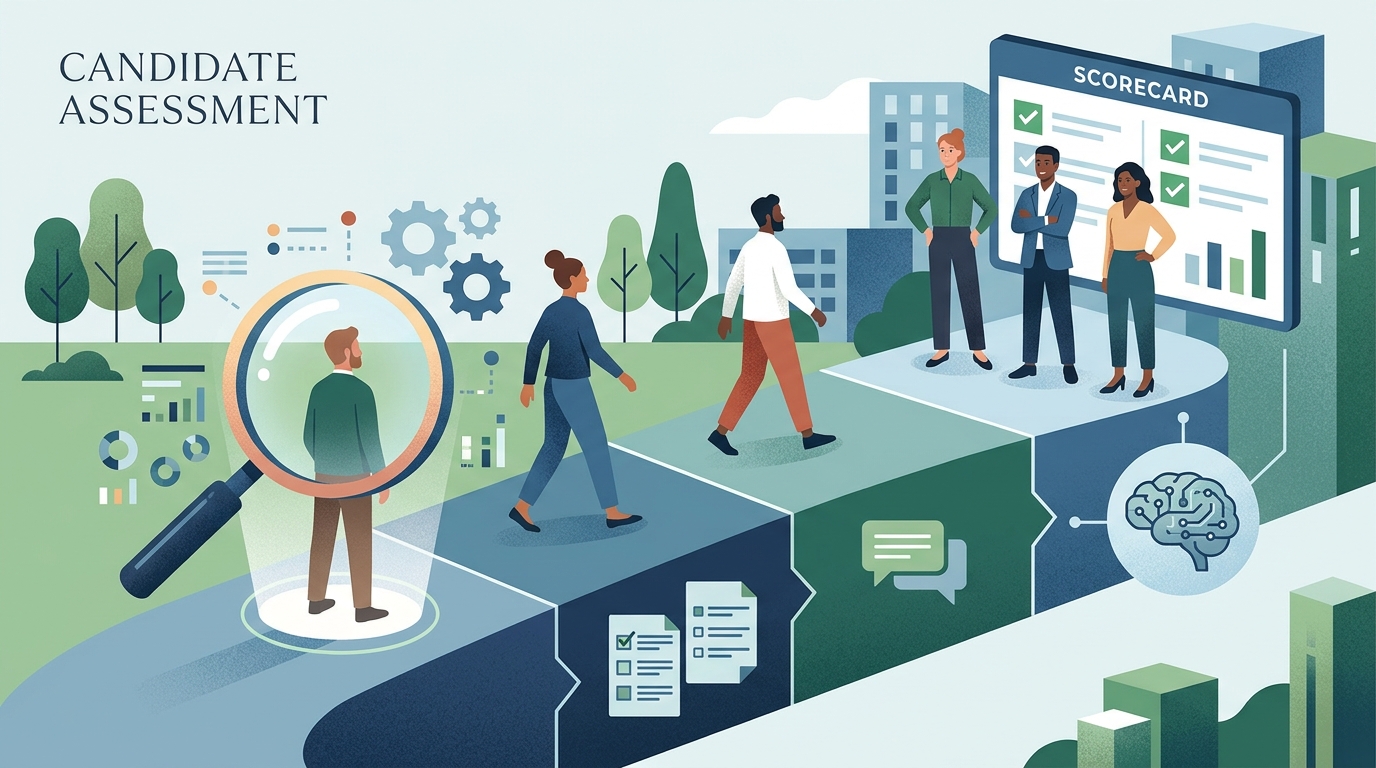
TL;DR: Candidate assessment is the structured process of evaluating whether someone can actually do the job — using skills tests, structured interviews, work samples, and cognitive or personality measures instead of gut feel. The strongest process combines two or three complementary methods, scores every candidate against the same role-specific scorecard, and is designed to reduce bias. Good assessment starts earlier than most teams think: the quality of your evaluation is capped by the quality of the candidates you sourced in the first place.
Most hiring mistakes are not interview mistakes — they are candidate assessment mistakes. A resume tells you what someone claims to have done. A single unstructured chat tells you whether you liked them. Neither reliably predicts performance. Yet many teams still make five-figure hiring decisions on exactly that basis, then wonder why a third of new hires struggle in the first year.
A real candidate assessment process replaces that guesswork with evidence. It defines what success in the role looks like, chooses methods that measure those specific things, and applies the same yardstick to everyone. Done well, it raises quality of hire, shortens time-to-decision, and gives you a defensible, fairer basis for saying yes or no.
This guide covers what candidate assessment is, the main assessment types and when to use each, how to build a fair and bias-reduced evaluation process, how scorecards turn opinions into decisions, the tool categories to know, and where AI-powered sourcing fits at the very top of the funnel — long before the first test is ever sent.
What Is Candidate Assessment?
Candidate assessment is the systematic evaluation of a job applicant against the specific requirements of a role, using structured, comparable methods rather than intuition. Instead of asking “do I like this person,” a candidate assessment asks “can this person do the work, and how do they compare to everyone else in the pipeline on the same criteria.”
The distinction that matters is structured versus unstructured. An unstructured process improvises different questions for each candidate, weighs them differently, and leans on the interviewer’s memory. A structured candidate assessment fixes the criteria in advance, uses the same methods and questions for every applicant, and records scores as it goes. Decades of hiring research consistently show structured methods predict on-the-job performance far better than unstructured interviews alone.
Assessment also sits inside a larger hiring flow. You define the role, source and attract candidates, screen them, assess the shortlist in depth, and then decide. Screening is a light filter — does this person clear the basics. Assessment is the deep evaluation of the few who pass. Getting the two confused leads teams to over-test everyone or under-evaluate the finalists, both of which waste time and money.
The Main Types of Candidate Assessments
There are four core candidate assessment types — skills tests, structured interviews, work samples, and cognitive or personality measures — and the best processes combine two or three rather than relying on any single one. Each measures a different dimension of fit, so stacking complementary methods gives you a fuller, more reliable picture than doubling down on one.
- Skills tests. Direct measures of a specific competency — a coding challenge, a spreadsheet task, a writing prompt, a language test. They answer “can they do this exact thing” with the least ambiguity, which is why skills-based candidate assessment is the fastest-growing category. Keep them tightly scoped to skills the role actually uses.
- Structured interviews. The same predefined questions, asked of every candidate, scored against a rubric. Behavioral versions probe past actions (“tell me about a time…”); situational versions probe judgment (“what would you do if…”). Structure is what converts an interview from a vibe check into a genuine assessment.
- Work samples and job simulations. A miniature version of the real work— a take-home project, a live pair-programming session, a mock sales call, a portfolio review. Work samples are among the most predictive assessment methods because they test performance directly, not a proxy for it. Guard against making them so long that strong candidates drop out.
- Cognitive and personality measures. Standardized assessments of reasoning, problem-solving, or work-style traits. Cognitive tests predict general ability across many roles; personality inventories describe how someone tends to work, not whether they are“good” or “bad.” Use validated instruments and treat trait results as context, never as a pass/fail gate.
The right mix depends on the role. A senior engineer might get a scoped work sample plus a structured system-design interview. A support hire might get a written skills test plus a situational interview. Match the method to the competency you most need to verify, and resist the urge to bolt on tests that do not map to real job requirements — every extra step costs candidate goodwill and completion rate.
| Assessment type | What it measures | Best for | Watch out for |
|---|---|---|---|
| Skills test | A specific, job-relevant competency | Technical, functional, and language skills | Testing skills the role never uses |
| Structured interview | Judgment, experience, communication | Almost every role, as the backbone | Drifting back into unstructured chat |
| Work sample | Actual performance on real tasks | Roles with tangible output | Over-long, unpaid, high-dropout tasks |
| Cognitive / personality | Reasoning ability and work style | High-volume or fast-ramp roles | Using traits as a pass/fail gate |
A great assessment process still fails if the pipeline is thin. Lessie searches 100+ live sources per query and returns qualified candidates with verified contact details, so you have enough strong people to actually assess. Start free, no credit card required.
How to Build a Fair, Bias-Reduced Assessment Process
You build a fair candidate assessment process by fixing the criteria before you meet anyone, using the same methods for every applicant, and separating scoring from discussion. Bias thrives on improvisation and vague standards; structure and consistency are the most practical defenses against it, and they also make your process easier to defend if a decision is ever challenged.
Start from a job-specific success profile. List the four to six competencies that actually determine performance in this role, in plain language. Everything downstream— which assessments you run, what your scorecard measures — should trace back to this list. Vague criteria like “culture fit” are where bias hides, so replace them with observable behaviors you can score.
Standardize the method for every candidate. Same questions, same tasks, same order, same evaluators where possible. When two applicants get a different experience, you can no longer compare their results — you are measuring the process, not the people. This consistency is the single highest-leverage move you can make when evaluating candidates.
Score independently, then discuss. Have each interviewer submit scores before the group talks. This prevents the loudest or most senior voice from anchoring everyone, and it surfaces genuine disagreement instead of burying it under groupthink. Only after independent scores are in should the panel reconcile differences.
Widen the top of the funnel. The fairest scoring in the world cannot fix a homogeneous shortlist. A structured process paired with broad, intentional sourcing is what actually moves outcomes, which is why skills-based hiring and diverse pipelines belong in any serious conversation about bias-reduced assessment. Assessment can only choose from the candidates you brought in.
When you score, force each rating to point at something the candidate actually said or did:“4 — shipped a caching fix in the work sample that cut load time,” not “4— seemed sharp.” Evidence-anchored scores are harder to bias, easier to calibrate across interviewers, and far more useful when the panel reconciles disagreements.
Scorecards: Turning Assessment Into Decisions
A scorecard is a simple grid that turns a candidate assessment into a comparable decision: the competencies you defined down one side, a rating scale across the top, and space for evidence. It is the connective tissue between “we evaluated them” and “here is why we are hiring or passing,” and it is what makes a structured process auditable months later.
Build the scorecard directly from the success profile. Each competency gets its own row and a consistent scale — a 1-to-4 scale is popular because it removes the safe middle option and forces a real call. Attach a short definition to each level so a “3” means the same thing to every interviewer, and require a line of evidence for each score so ratings stay tied to what actually happened in the assessment.
Assign each interviewer the competencies they are best placed to judge, rather than having everyone grade everything shallowly. The engineer scores the work sample, the hiring manager scores role judgment, a cross-functional partner scores collaboration. This division keeps each score deep and reduces the redundancy that makes panels tired and sloppy.
Finally, decide how you will combine scores before you see them. Will you average, or require a minimum bar on the two must-have competencies? Setting the decision rule up front stops the group from quietly moving the goalposts to justify a candidate they already like —one of the most common ways a structured process silently reverts to gut feel.
Candidate Assessment Tools and Software
Candidate assessment tools fall into a handful of categories, and most teams end up combining a few rather than buying one platform that claims to do everything. Knowing the categories lets you shop against your actual gap instead of a feature list, and to slot each tool cleanly beside the systems you already run.
- Skills and coding assessment platforms. Deliver and auto-grade technical or functional tests at scale, with anti-cheating controls and question banks. Strong when you hire the same skill repeatedly and want consistent, comparable results.
- Structured-interview and scorecard tools. Often built into your applicant tracking system (ATS), these store interview kits, collect independent scores, and keep an audit trail. This is where fair, structured assessment actually lives day to day.
- Cognitive and personality assessment providers. Validated psychometric tests delivered as standardized modules. Choose vendors that publish validity evidence, and use results as one input among several, not a gate.
- Video and work-sample tools. Asynchronous video responses and structured take-home or live-simulation environments that make performance easy to review and compare.
Two practical rules cut through the noise. First, tools should feed clean data back into your resume database and ATS rather than living in a silo that forces double entry. Second, no assessment tool solves an empty pipeline — the best-integrated scorecard in the world is worthless if too few qualified people ever reach it. For a broader look at the surrounding stack, see our guide to the best recruiting software.
Where Sourcing Fits: Assessment Starts Before the First Test
The most overlooked truth about candidate assessment is that its ceiling is set upstream: you can only assess the people you managed to find. A brilliant, bias-reduced scorecard applied to a weak or narrow shortlist still produces a weak hire. So the real starting point of assessment is sourcing — getting enough of the right candidates into the funnel to make evaluation meaningful.
Traditional sourcing has a structural blind spot. Databases and job boards only surface people who already applied or who optimized a profile for keyword search. The strongest candidate for a role often has a great portfolio, a conference talk, or an active GitHub — but never uploaded a resume where a filter would catch them. Assess only the applicants who found you, and you never even get the chance to evaluate the best fit.
Lessie is an agentic search engine built to close that gap. Instead of filtering one static database, it queries 100+ live sources per search —company sites, GitHub, portfolios, publications, and social platforms — then verifies contact details at the moment of search rather than serving a stale cache. That gives your assessment process a wider, fresher, more representative pool to actually work from.
It slots in cleanly before evaluation and beside your existing stack. Your ATS and scorecards stay the system of record for assessment; Lessie feeds the top of the funnel with qualified, contactable candidates — the kind of candidate sourcing automation that removes the manual list-building tax before the first structured interview or skills test is ever sent. Get sourcing right, and every downstream assessment gets easier, fairer, and more decisive.
Stop assessing only the people who happened to apply. Lessie searches the live web to surface qualified candidates your job boards and database miss, verifies their contact details, and hands you a stronger shortlist to assess — all in one workflow. Start on the free tier, no credit card required.
Candidate assessment, in the end, is not a single test — it is a deliberate system: role-specific criteria, complementary assessment methods, consistent scorecards, and a pipeline wide enough to make the whole thing matter. Get those pieces right and hiring stops being a gamble and starts being a decision you can explain. For more on the surrounding workflow, explore the Lessie blog.