




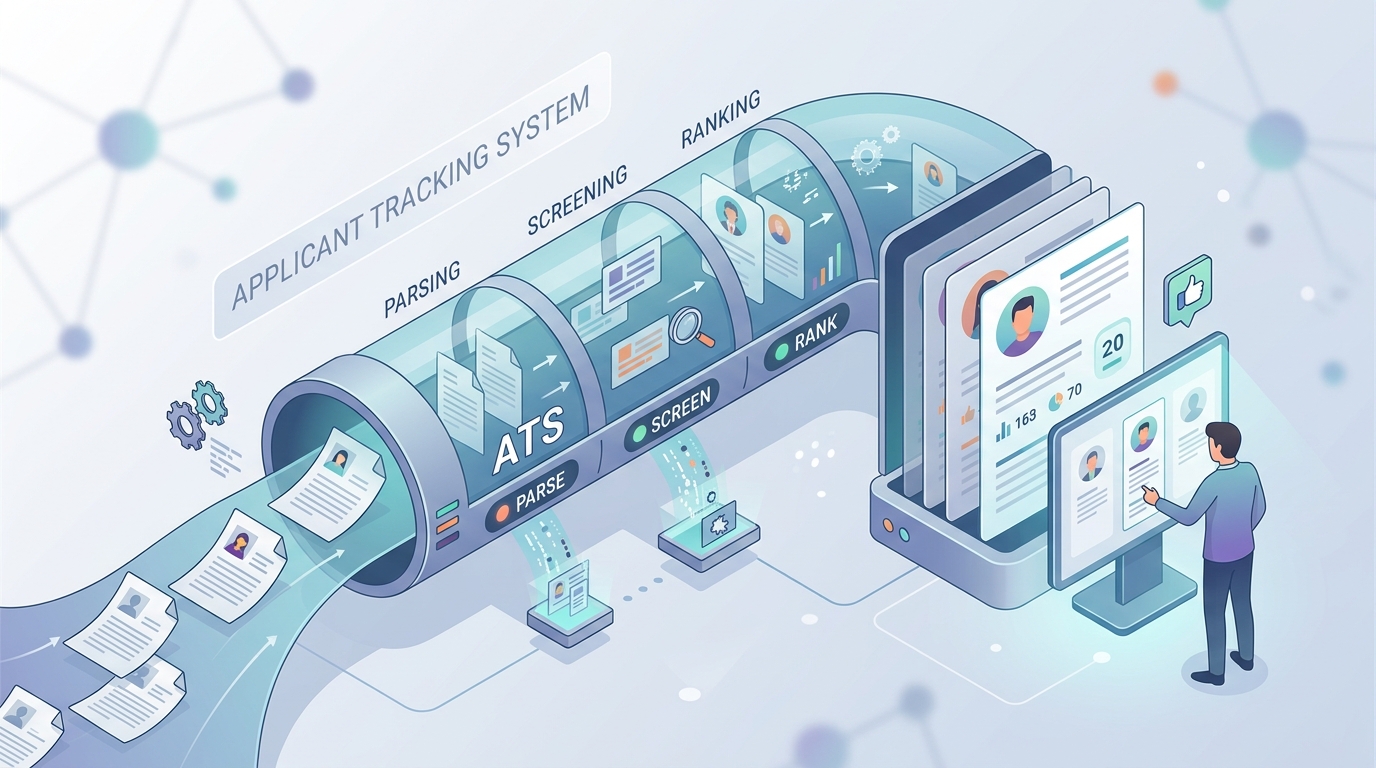
An applicant tracking system (ATS) is software that collects, parses, and organizes job applications so recruiters can screen and manage candidates from one dashboard. It reads every resume into structured data, screens candidates against the job's requirements, ranks the strongest matches, and tracks each person through your hiring pipeline. This guide covers what an ATS is, how it works, what it can and cannot do, how to choose one in 2026, and why pairing an ATS with an AI recruiting agent like Lessie closes the biggest gap: finding people who never applied in the first place.
If you have ever posted a job online and watched 200 resumes land in your inbox within a day, you already know why an applicant tracking system exists. An ATS is the software layer that catches every application, reads the resume, and sorts candidates before a recruiter opens a single file. For growing teams, understanding what an ATS is — and just as importantly, what it is not — is the first step toward hiring faster without hiring worse.
This guide breaks down exactly what an ATS does: how it parses resumes, screens applicants, and ranks candidates inside a hiring pipeline. We will also cover how to choose an ATS that fits your team, and why even the best applicant tracking system only manages people who already applied — it has no way to go find the ones who did not.
Whether you are hiring your first employee or scaling a full recruiting team, the right ATS becomes the backbone of every requisition, interview, and offer. Let's start with the basics.
What Is an ATS, Exactly?
An ATS (applicant tracking system) is software that stores job postings, collects resumes, and helps recruiters filter, rank, and move candidates through defined hiring stages. Instead of managing applications in email threads and spreadsheets, recruiters work from one dashboard that tracks every candidate from application to offer.
Most applicant tracking systems share a common feature set: they distribute a single job posting to multiple job boards at once, store every resume in a searchable database, let hiring teams leave shared feedback and scorecards, schedule interviews automatically, and generate hiring-funnel reports. Small startups and Fortune 500 companies alike run on some version of this same core workflow — only the scale and the integrations differ.
Recruiters are not the only people who touch an ATS day to day. Hiring managers use it to review shortlists and leave feedback, HR teams pull it for compliance audits, and executives check dashboards for time-to-fill metrics. A five-person startup and a 5,000-person company can run the exact same ATS category — the difference is usually seat count, workflow complexity, and how many integrations get turned on.
How Does an ATS Work? Parsing, Screening, Ranking, and Pipeline Management
Every ATS follows a similar sequence: it parses each resume into structured data, screens candidates against the job's must-have criteria, ranks the survivors by fit, and then tracks each person through pipeline stages. The exact scoring logic varies by vendor, but these four steps are universal to how an applicant tracking system works.
- Parsing — the ATS extracts name, contact details, skills, work history, and education from PDF or Word files and converts them into searchable fields.
- Screening — parsed data is checked against keywords, required skills, years of experience, and location; non-matches are flagged or auto-rejected.
- Ranking — remaining candidates are scored, often by keyword-match percentage or weighted criteria, and sorted into a shortlist.
- Pipeline management — recruiters move candidates through stages (applied, screened, interviewing, offer, hired), leave notes, and trigger automated emails.
Parsing is the step that causes the most friction. It is not perfect — inconsistent resume formats, tables, and scanned images can all get misread, which is exactly why qualified candidates sometimes get filtered out before a human ever sees their name.
None of these four steps happen in isolation. A resume that parses cleanly but lacks the right keywords still gets screened out. One that matches every keyword but arrives in a messy, unparseable format never even reaches the screening stage. Understanding the full sequence — not just one step — is what separates candidates who make it to an interview from those who quietly disappear from the pipeline.
You now know how an ATS filters resumes — but it only works with people who already applied. Lessie's AI recruiting agent searches 100+ live sources to surface qualified candidates before your competitors even post the job, then hands you verified emails at 95%+ accuracy.
What an ATS Can Do (and What It Cannot)
A modern ATS can post jobs to multiple boards, parse and store resumes, screen and rank applicants, schedule interviews, and generate hiring reports. What it cannot do is go out and find candidates who never saw your job posting — an applicant tracking system only manages the pool of people who already applied.
What an ATS can do:
- Distribute one job posting to LinkedIn, Indeed, Google Jobs, and other boards at once
- Parse resumes into structured, searchable candidate profiles
- Screen and rank applicants against job requirements
- Track every candidate through custom pipeline stages
- Generate compliance and hiring-funnel reports
What an ATS cannot do:
- Search for candidates who have not applied (passive candidates)
- Guarantee a qualified pipeline if the posting attracts low-quality applicants
- Replace human judgment on soft skills, culture fit, or nuanced experience
- Verify contact information beyond what a candidate typed into the form
These limits matter because a lot of recruiting frustration comes from expecting an ATS to do something it was never built for. Teams that rely on an ATS as their only sourcing tool tend to see the same pattern: the same active job-seekers apply everywhere, while the strongest people — often already employed and not actively looking — never show up in the applicant pool at all.
That last gap — no way to reach people who never applied — is the single biggest limitation of any applicant tracking system, and it is the reason active sourcing has become a separate discipline from ATS management.
How to Choose an ATS: A Practical Checklist
Choosing an ATS comes down to five criteria: price, integrations, language support, data-privacy compliance, and reporting depth. Get these five right and the rest — interface, onboarding speed — usually falls into place.
- Price — compare monthly per-seat cost against a flat platform fee, and watch for hidden charges on job-board postings or candidate-volume caps.
- Integrations — confirm it connects to your HRIS, calendar, Slack, and the job boards you already use.
- Language support — for teams hiring in Brazil, a fully localized Portuguese interface and support team (not just a translated menu) matters for adoption.
- Data-privacy compliance — candidate resumes and contact details are personal data under Brazil's LGPD; confirm the ATS supports consent flows, retention controls, and deletion requests.
- Reporting depth — look for time-to-hire, source-of-hire, and pipeline-conversion reports that actually inform decisions, not just vanity dashboards.
Implementation time is worth asking about too. A lean ATS can go live in days; enterprise systems with custom workflows and multiple approval layers can take months. Ask any vendor for a realistic timeline based on your team size, not their best-case demo scenario.
In Brazil, popular ATS options include Gupy, Solides, and Recrutei, each with different strengths across price, integrations, and reporting depth — evaluate them against the five criteria above rather than by brand recognition alone.
Once you have narrowed your shortlist, compare it against a purpose-built recruitment and selection platform to see how it closes the sourcing gap most ATS tools leave wide open.
ATS Plus Active Sourcing: Where AI Comes In
An ATS is a management tool for candidates who already applied — it has no way to reach the qualified people who have not. That is where an AI recruiting agent like Lessie comes in: instead of waiting for applications to trickle in, it searches LinkedIn, GitHub, company sites, and 100+ other live sources to find and verify passive candidates automatically.
Lessie's AI recruiting agent follows a simple four-step workflow: define the ideal candidate profile in plain language, discover matches across 100+ data sources, score each candidate by fit, and reach out with AI-personalized messages. Teams using Lessie have sourced 300K+ candidates this way, with contact accuracy above 95%. Once Lessie surfaces a passive candidate, you export them straight into your existing ATS pipeline — the two tools work together, not against each other.
Consider a typical scenario: a recruiter posts an open role and the ATS collects 150 applications in a week. Screening and ranking narrow that to 20 qualified people— but none of them have the specific niche skill the role actually needs. That is exactly the moment active sourcing earns its keep, surfacing the additional candidates who were never going to apply on their own.
Stop waiting for your best candidates to apply. Lessie searches 100+ live sources — LinkedIn, GitHub, company sites — and delivers verified contacts at 95%+ accuracy, so your ATS pipeline never runs dry.
How to Make Your Resume Pass the ATS
Most rejections happen at the parsing and screening stage, not because a candidate lacks qualifications, but because the ATS could not read the resume correctly. A resume built for humans first and ATS parsing second often loses to a plainer one that a parser can actually read.
- Use standard section headers (Experience, Education, Skills) so parsers recognize them
- Mirror the exact keywords and phrasing from the job description (skills, tools, job title)
- Save as a .docx file or a text-selectable PDF — never an image-based PDF
- Skip tables, columns, text boxes, and headers/footers — parsers often scramble them
- Spell out acronyms at least once ("Search Engine Optimization (SEO)")
None of this means gaming the system with invisible white-text keyword stuffing — most modern parsers flag or ignore hidden text, and a recruiter who reviews a shortlist manually will notice a resume that reads like a keyword list instead of a career history.
Not sure if your resume will actually pass? Run it through Lessie's free ATS resume scorer to check keyword match and formatting issues before you hit submit.
For the recruiter side of this process, see our guide on how to screen resumes efficiently, and for building a pipeline beyond single job posts, check out our guide to building a talent pool.