




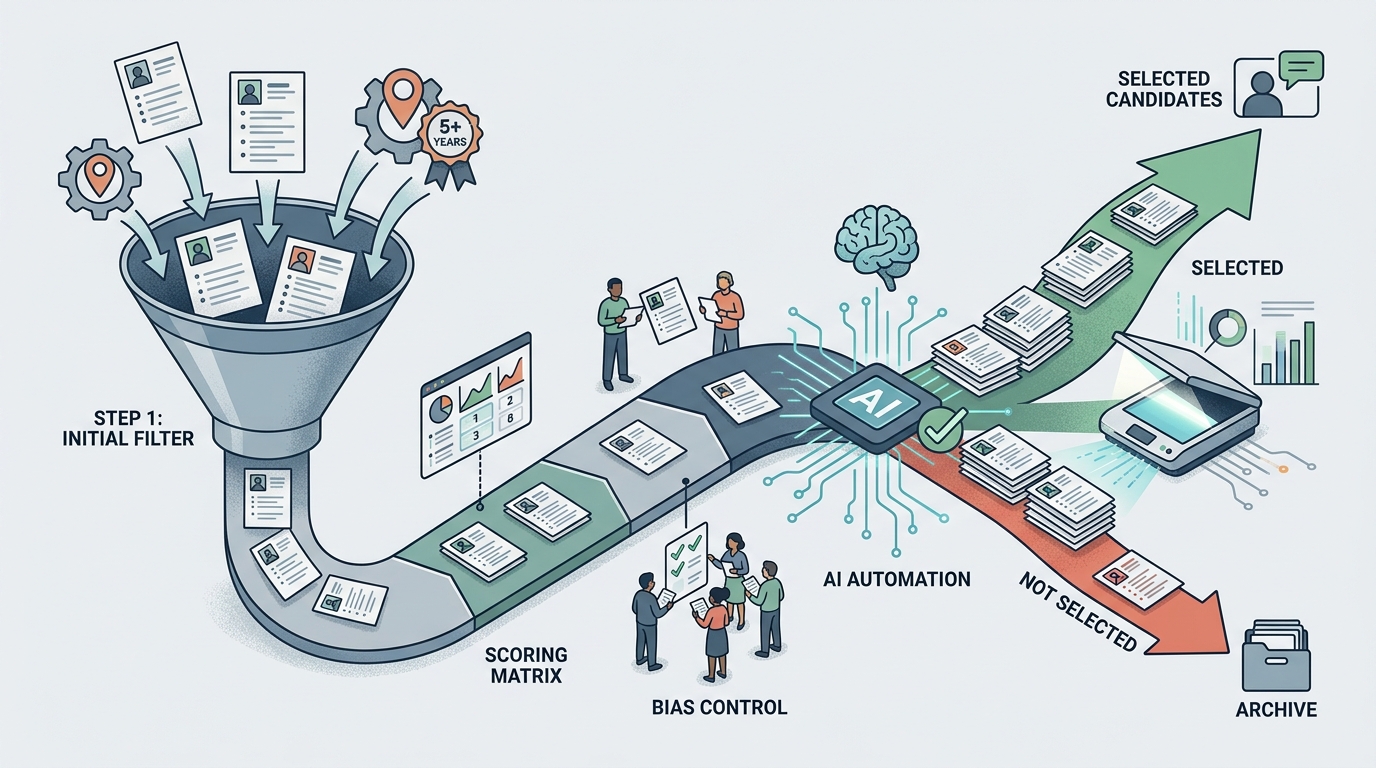
Resume screening is the process of checking every application against a job's must-have and nice-to-have requirements before anyone is invited to interview. Done well, it follows six steps: define objective criteria, pre-screen against a minimum bar, score every resume on the same matrix, control for bias, calibrate the shortlist with the hiring manager, and track your metrics. This guide walks through each step, then shows how an AI resume screener like Lessie can run the repetitive middle steps automatically.
Post one open role and a few hundred resumes can land in the inbox within days. Most recruiters and hiring managers do not have time to read every one closely, so screening becomes a fast, high-stakes triage: who gets seen by a human, and who never makes it past the first pass.
The volume problem is real. A large share of applicants for any given role do not meet the core requirements at all, and recruiters commonly report spending well under a minute scanning each resume before deciding whether it deserves a second look. That pace is fast enough to miss good candidates and slow enough to bury a hiring manager in low-quality applications.
This guide explains how to screen resumes properly: a repeatable, six-step process any recruiter or hiring manager can run without special tools. Partway through, we will show where an AI resume screener naturally takes over the most repetitive parts of the process, so resume screening stops eating your week.
What Is Resume Screening (and Why Getting It Wrong Is Expensive)
Resume screening is the step in hiring where every application gets checked against a job's requirements before anyone talks to a human. It happens before phone screens and interviews, and its only job is to separate candidates worth your team's time from those who are not a fit.
Getting resume screening wrong is costly in both directions. Screen too loosely and hiring managers waste hours interviewing candidates who were never qualified. Screen too fast or too rigidly and you reject strong candidates whose resumes do not use your exact keywords — a career-changer, a self-taught engineer, someone whose old title does not match. Both failure modes show up later as a slow time-to-hire, a high interview-to-offer ratio, or a role that stays open for months while good applicants get filtered out unseen.
The fix is not working faster on the same ad hoc process — it is making the process itself consistent. A team that screens resumes the same way every time, with written criteria instead of a gut read, spends less total time per hire and ends up with a shortlist that actually reflects the job, not whoever skimmed the pile last.
How to Screen Resumes in 6 Steps
A consistent resume screening process protects you from two things: missing good candidates and burning hours on unqualified ones. The six steps below work whether you are screening ten resumes or ten thousand, and each one maps to a decision you would otherwise make inconsistently, resume by resume.
- 1Define objective screening criteria
Before you open a single resume, write down what the job actually requires. Split the list into must-haves (a required certification, a minimum number of years, a specific tool) and nice-to-haves (a bonus skill, a preferred industry background). Must-haves become your pass/fail bar; nice-to-haves break ties later. Skipping this step is the single biggest reason screening feels subjective.
- 2Pre-screen against a minimum bar
Run every resume against your must-have list first, whether manually or with an ATS keyword filter. This step is deliberately blunt — its job is to remove the clearly unqualified applications (wrong location, no required license, far short on experience) so you spend your limited attention on resumes that could actually work.
- 3Build a scoring matrix
Turn your criteria into a simple point system: for example, 0–3 points for years of relevant experience, 0–2 for a required certification, 0–2 for a specific tool or language, 0–3 for demonstrated impact in past roles. Score every remaining resume the same way, so a candidate's rank reflects the job's requirements, not how the reviewer felt that afternoon.
- 4Control for bias
Treat names, photos, and school prestige with caution — none of them reliably predict job performance. Where possible, screen with names and dates hidden, keep the same criteria and order for every resume, and have more than one person score the top candidates independently before comparing notes.
- 5Calibrate the shortlist with the hiring manager
Before you schedule interviews, sit down with the hiring manager and walk through your top-scored resumes together. This step catches criteria that looked right on paper but do not match what the team actually needs, and it aligns everyone on what "qualified" means before candidates are in the room.
- 6Track feedback and metrics
Log how long screening takes per role (time-to-screen), what share of screened candidates pass the first interview, and which criteria actually predicted a good hire. Feed that back into step one for your next opening — resume screening improves the same way any repeated process does: with data from the last round.
Steps two through four are the most repetitive —and the easiest to automate. Lessie's free AI resume screener reads a resume against your job description and returns a 0–100 match score, an Advance / Maybe / Reject verdict, strengths, gaps, and the missing keywords in seconds.
Manual Resume Screening vs. Automated Screening
Manual resume screening and automated screening solve the same problem at different speeds and different levels of consistency. A human reviewer brings judgment an algorithm cannot always match; a well-built AI screener brings a scoring matrix it applies identically to the first resume and the four-hundredth.
Manual screening scales roughly linearly with headcount: twice the applicants tends to mean roughly twice the hours, and those hours usually come from whoever is already busiest — the hiring manager or a senior recruiter. It also drifts. Reviewer fatigue is real, and the criteria applied to resume ten rarely match the criteria applied to resume two hundred on a long day.
Automated resume screening applies the same scoring matrix to every resume regardless of volume or time of day, which fixes the drift problem directly. What it does not replace is judgment on borderline cases — the career-changer with transferable skills, the resume that undersells a strong candidate. The strongest setup pairs both: let automation handle the volume and consistency, and keep a human reviewing the shortlist and the edge cases.
How to Automate Resume Screening With AI
AI resume screening works by reading a candidate's resume and a job description together, then scoring the match the same way a scoring matrix would — except it does it in seconds, for every applicant, without fatigue or drift. That frees a recruiter's time for the shortlist instead of the full inbox.
Lessie's AI resume screener is built for exactly this. Paste in a resume and a job description and it returns a 0–100 match score, a clear Advance, Maybe, or Reject verdict, a list of strengths and gaps, and the specific keywords a resume is missing — the same information step three of the manual process produces, generated instantly and consistently for every candidate.
Screening only helps once candidates are already in front of you. Lessie's resume database takes a different approach from a traditional database of old uploads: it builds live candidate profiles from 100+ sources across the web, with 95%+ verified contact details, searchable in plain English instead of Boolean filters — so the pool you are screening is fresher to begin with.
Screening also does not have to be the end of the workflow. Lessie's recruiting tools go a step further than filtering applicants who came to you — the same AI agent can proactively search LinkedIn, GitHub, and other live sources for people who match your must-have criteria but never applied at all.
Strong candidates you screen but do not hire for this role do not have to disappear. Our guide on building a talent pool covers how to keep those resumes warm and searchable for the next opening instead of starting from zero every time you hire.
Candidates preparing an application can run the same logic in reverse: Lessie's free resume scorer shows job seekers how their resume is likely to score before they hit submit.
You do not have to choose between speed and consistency. Lessie screens every resume against your exact criteria, then helps you find qualified candidates who never applied — all from one AI agent, free to start.
Resume Screening and Data Privacy: What to Keep in Mind
Automating resume screening means handling personal data at scale, which comes with real compliance obligations. Regulations like Brazil's LGPD and Europe's GDPR require a clear retention period for candidate data, a legitimate basis for using it, and transparency about any automated decision that affects a candidate.
In practice, this means three things. Set and honor a retention period — delete resumes for closed roles instead of keeping them indefinitely "just in case." Audit your scoring criteria periodically to confirm they are not acting as proxies for protected characteristics like age, gender, or background. And be ready to explain, in plain language, how a candidate was scored if they ask — transparent criteria are both a compliance safeguard and a better candidate experience.
None of this is a reason to avoid automating resume screening — it is a reason to pick tools that make the process auditable in the first place. A defined scoring matrix, a documented retention rule, and a screener that can show its reasoning are easier to defend to a regulator, and to a candidate, than a manual process nobody wrote down.