




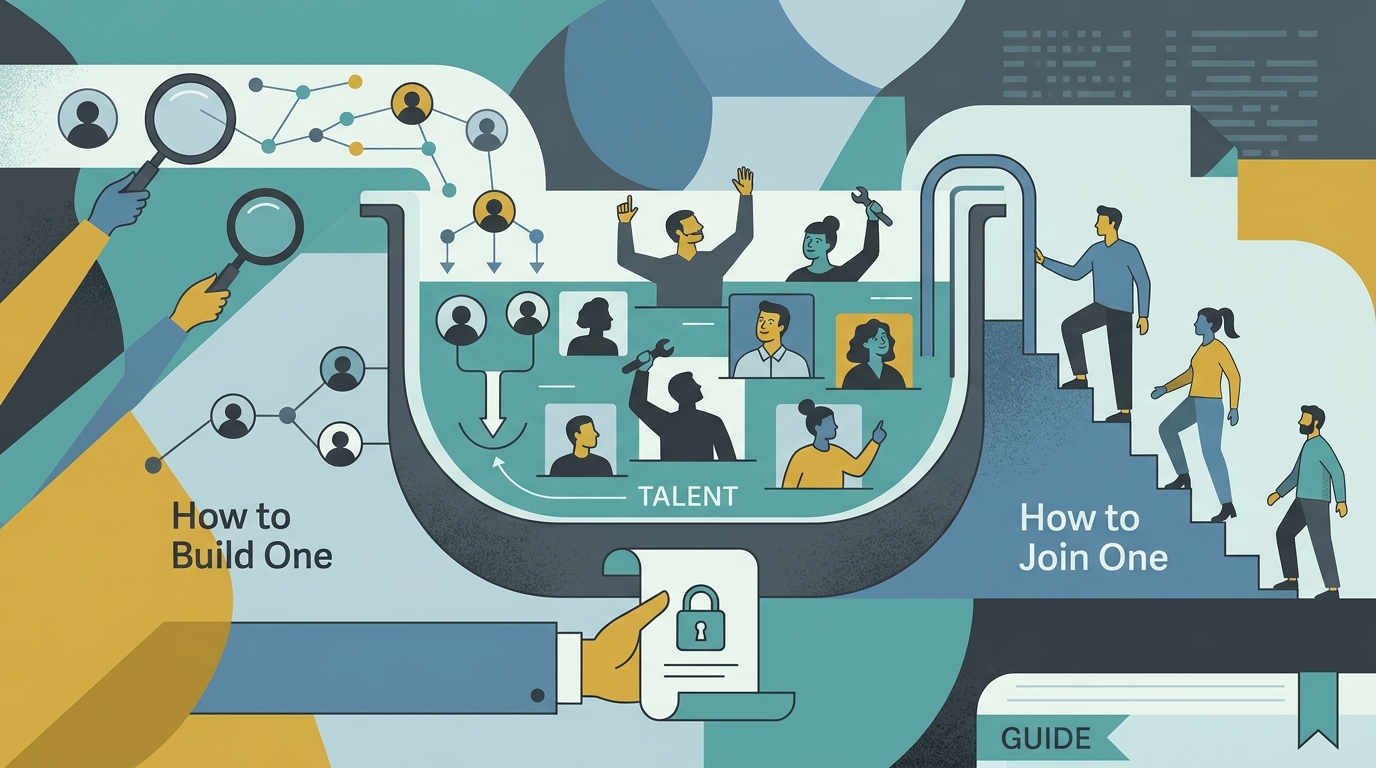
A talent pool is a database of qualified candidates and past applicants a company keeps warm, so recruiters can search it the moment a role opens instead of starting sourcing from zero. This guide covers both sides: if you are in HR, skip to how to build a talent pool in five steps below. If you are a candidate, jump to what it actually means when a company tells you your resume will stay in its talent pool.
Most hiring teams start every search the same way: post the job, wait for applications, screen from scratch. A talent pool changes that. It is a living database of people you have already sourced, interviewed, or who applied before — organized so you can search it the instant a new role opens instead of starting over.
This guide is built for two audiences. HR and recruiting teams get a five-step framework for building a talent pool that stays useful instead of going stale. Candidates get a straight answer to the question that shows up in every rejection email: what does it actually mean when a company says your resume will stay in its talent pool?
What Is a Talent Pool?
A talent pool is a searchable database of candidates a company has already sourced, interviewed, or received applications from, kept organized so recruiters can revisit them for future roles. Unlike a one-time job posting, a talent pool is meant to be reused — the same profile can be the right fit for three different openings over two years.
A useful talent pool record usually tracks more than just a name and a resume file:
- Contact info and current status — email, phone, and whether the person is still open to opportunities.
- Role and skill tags — the job family, seniority, and core skills a recruiter would search for.
- Source — referral, past applicant, event contact, or AI-sourced profile.
- Last-contact date — so nobody reaches out twice, or lets a strong candidate go cold by accident.
- Notes from the last conversation — compensation expectations, location preferences, or why they were not hired last time.
A talent pool is not the same thing as a resume database or an applicant tracking system (ATS). The ATS tracks candidates through one specific hiring pipeline; the resume database stores every resume that ever came in. The talent pool is a curated subset of both — people worth reaching out to again, tagged by skill, role, and readiness to move.
The distinction matters because most companies confuse the three and end up with one giant, unsearchable inbox. A real talent pool separates “everyone who ever applied” from “people we would actually hire if the timing were right” — which is the entire point of building one in the first place.
In practice, a talent pool usually holds four kinds of people: strong runner-up candidates who lost out on timing rather than fit, employee referrals not yet tied to an open role, alumni who left on good terms and might come back, and warm leads sourced proactively before a role even exists. All four groups belong in one searchable talent pool instead of scattered across old email threads.
A talent pool also goes by other names depending on the company — talent pipeline, candidate pool, or sometimes just a “silver medalists” list for near-miss candidates. The core idea stays the same regardless of the label: a searchable group of people worth another look before you start sourcing from scratch.
How a Talent Pool Works (and Why It Is Worth Building)
A talent pool runs on four stages: sourcing candidates in, organizing what you have, nurturing the relationship so people stay warm, and hiring by pulling from the pool the moment a role opens. Skip any one stage and the talent pool turns into a graveyard of stale resumes nobody searches.
Sourcing means adding people continuously — not just when you are actively hiring. Strong candidates who did not get an offer, referrals, event contacts, and AI-sourced profiles all belong in the same pool, tagged by role and skill so they surface later.
Organizing turns a folder of resumes into a searchable talent pool. Every profile needs consistent tags — role, seniority, location, skills, last-contact date — or recruiters end up scrolling instead of searching once a req opens.
Nurturing is the step most companies skip, and it is why most talent pools go cold within a year. A quarterly check-in, a relevant job alert, or a short update keeps candidates warm without feeling like spam.
The payoff for building a talent pool is real: faster time-to-hire because you are searching warm candidates instead of cold-starting, lower cost-per-hire because you are not paying for a fresh sourcing campaign every time, and a pipeline that is already partly built before the req even opens.
Consider a company that opens three similar sales roles a year. Without a talent pool, each opening starts a fresh multi-week search. With one, the recruiter runs a single search against candidates already tagged for that job family — some rejected months earlier for timing reasons, not fit — and can often get a shortlist together in a day instead of two weeks.
A few signs your talent pool needs attention:
- No one has searched it in the last quarter.
- Most profiles are more than two years old with no update.
- Nobody on the team owns keeping it current.
- Recruiters default to a brand-new search instead of checking the pool first.
Someone has to own the talent pool, or it decays by default. In larger teams that is usually a recruiting operations or sourcing specialist; in smaller companies it is often whoever runs hiring part-time. Either way, ownership means running periodic searches, updating tags, and retiring contacts who have gone unresponsive or taken another role.
Building a talent pool by hand means exporting spreadsheets from your ATS and hoping the tags stay consistent. Lessie searches 100+ live sources to source, tag, and refresh your talent pool automatically — so recruiters search one place instead of five.
For HR: How to Build a Talent Pool in 5 Steps
Here is the five-step framework we use with recruiting teams building a talent pool that actually gets searched, not just filled.
- 1Define your talent profile and job families
Start with the roles you hire for repeatedly, not every job you have ever posted. Group them into job families — “backend engineers” or “enterprise AEs,” for example — and define what a strong fit looks like before you add a single resume to the talent pool.
- 2Aggregate candidates from every source
Pull in past candidates who almost got an offer, employee referrals, event and conference contacts, and profiles found through AI-powered candidate sourcing. A talent pool built from one channel only stays small; the useful ones pull from all of them continuously.
- 3Organize and tag everything so it is searchable
A pile of PDFs is not a talent pool. Move candidates into a searchable resume database, tagged by role, skill, seniority, and last-contact date, so a recruiter can filter to “senior product designers, contacted in the last 6 months” in seconds instead of hours.
- 4Nurture the relationship so the pool stays warm
A talent pool nobody talks to for two years is not a talent pool — it is a stale mailing list. Send a quarterly update, share a relevant opening, or just check in. This is also a good moment for a quick pass of screening resumes efficiently so the highest-fit candidates stay visible instead of buried.
- 5Track metrics and refresh regularly
Set a review cadence: how many roles were filled from the talent pool last quarter, how stale is the average profile, and who has gone unresponsive for over a year. Archive or re-verify contacts on that schedule so the pool stays a source of hires, not a graveyard.
Most teams get steps one and two right, then stall on nurturing and metrics. Put one person on point for keeping the talent pool current — even part-time — and it stops being a graveyard of old resumes and starts being the first place anyone checks before opening a req.
Data Privacy and Best Practices for Talent Pools
A talent pool holds personal data on people who are not your employees, which means privacy rules apply even though no one signed an offer letter. The practices that matter most: get clear consent to keep a resume on file, set a retention limit instead of storing profiles forever, and honor deletion requests quickly.
Consent should be explicit, not implied. A line in your application form or a follow-up email stating that a resume may be kept in the talent pool for future roles, with a way to opt out, covers most regional privacy requirements — GDPR in the EU, CCPA in California, LGPD in Brazil.
A basic, compliant consent notice for a talent pool should cover:
- Purpose — that the resume may be considered for future roles, not just the one applied for.
- Retention period — how long the profile stays active before it is reviewed or removed.
- Right to deletion — a clear way to request removal from the talent pool at any time.
- Contact point — who to reach out to with privacy questions or requests.
Set a retention window — 12 to 24 months is common — and either re-confirm interest or delete the profile when it expires. Build a simple way for candidates to request removal from the talent pool, and honor it within a defined number of days. Treating this as a compliance afterthought is the fastest way to turn a trust-building tool into a liability.
Multinational teams building one shared talent pool across regions should default to the strictest applicable rule. If a single database serves recruiters in the EU, the US, and Brazil, applying GDPR-level consent and retention practices to every profile is simpler than tracking three separate policies for one talent pool.
Keep a simple log of consent given and requests handled — who asked to be removed from the talent pool, when, and how quickly it happened. If a regulator or a candidate ever asks, a documented process is the difference between a quick answer and a scramble.
If your resume needs to work inside an ATS and a recruiter's talent pool search at the same time, formatting matters more than most candidates realize. Lessie's free resume scorer checks ATS compatibility in under a minute.
For Candidates: What Does “Your Resume Will Stay in Our Talent Pool” Mean?
When a company says your resume will stay in its talent pool, it usually means exactly what it sounds like: you were not the right fit for this specific role, but someone thought you were strong enough to keep on file for the next one. It is not automatically a rejection in disguise, and it is not automatically a promise either.
Whether that talent pool actually gets revisited depends entirely on whether the company treats it as a working database or a dumping ground. Teams that tag and search their talent pool regularly do reach back out — sometimes months later, for a role that never existed when you first applied. Teams that only pay attention to active openings rarely do.
You can improve your odds either way. Keep your resume current, follow up once every few months instead of going silent, and make sure your resume is actually readable by the software doing the filtering. A resume that reads perfectly well to a human but confuses the parsing software gets buried in the talent pool no matter how strong the candidate is.
Check your resume with a free resume scorer before you apply anywhere, so the same document that lands you in the talent pool is also readable when a recruiter searches for you later.
A short, polite check-in every few months is not pushy — it is exactly what keeps you visible in a talent pool full of people who never follow up again. Mention one specific update: a new certification, a completed project, or a role you would be interested in if it opened.
Three things are worth doing once you know you are in a company's talent pool:
- Update your resume every few months, even with small changes — a stale profile looks abandoned.
- Follow the company's careers page or LinkedIn so you notice new roles before they are widely posted.
- Reply if someone from the team checks in — silence reads as no longer interested.