




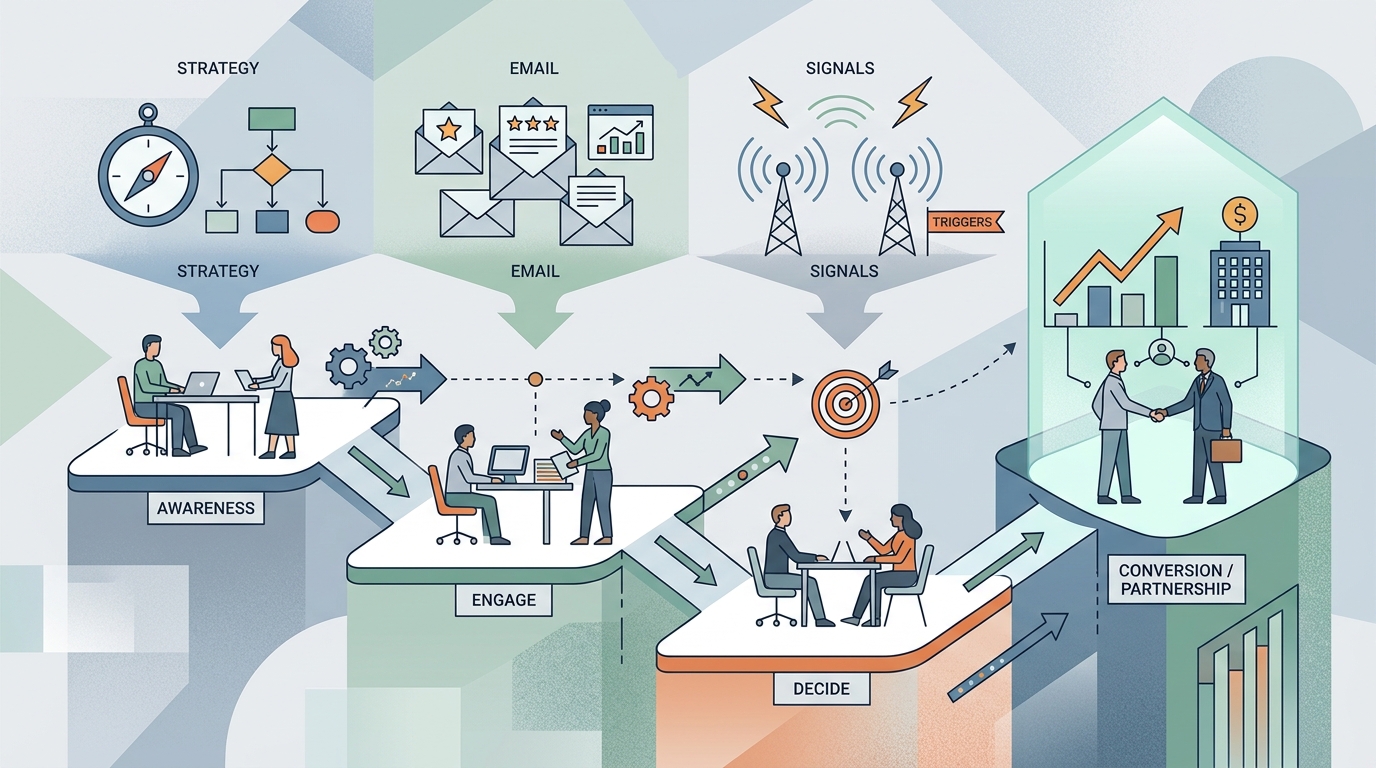
TL;DR: B2B lead nurturing is the structured work of staying valuable to a lead between first interest and buying readiness—a gap that runs months in most B2B categories. Effective nurturing segments by stage, sends education before persuasion, and—the biggest upgrade available today—triggers touches on buyer signals instead of calendar intervals. This guide covers the strategy, the email craft, the signal-triggered model, and the numbers that tell you it is working.
Most leads are not ready to buy on the day you meet them—and almost all revenue attribution eventually admits it. The interested-but-not-now lead is the largest population in every B2B pipeline, and what happens to them is decided by nurturing: done badly, it is a weekly newsletter nobody opens; done well, it is the reason a buyer who went quiet in March signs in September with your name already decided.
What Is B2B Lead Nurturing?
B2B lead nurturing is the deliberate sequence of relevant touches—email, content, conversation—that keeps a not-yet-ready lead moving toward a purchase decision. It sits after the first connection and before the sales cycle proper: the lead knows you exist and has a real problem, but timing, budget, or internal priority is not there yet.
The economics justify the patience. A nurtured lead costs a fraction of a newly acquired one, converts at meaningfully higher rates, and—because trust compounds—tends to buy more with less discounting. The failure mode is treating nurturing as scheduled broadcasting; the fix is treating it as signal-aware relationship maintenance, where what you send and when is driven by what the buyer is doing.
How Do You Build a Lead Nurturing Strategy?
A working lead nurturing strategy answers three questions per lead: where are they in the journey, what do they need to move one stage, and what event tells you they moved? Build it in four parts.
- Segment by stage and problem. A lead who downloaded a beginner guide and one who compared your pricing page live in different worlds. At minimum, separate problem-aware (educate), solution-aware (differentiate), and decision-stage (de-risk)—then segment by the specific problem that brought them in.
- Map content to stage. Education before persuasion: how-to content and benchmarks early, comparison and case material in the middle, security reviews and ROI math late. Sending decision-stage content to problem-aware leads is the fastest unsubscribe available.
- Define stage-change triggers. Decide which behaviors and events promote a lead—a pricing-page return, a demo-video completion, a job change, a funding round—so the sequence responds to movement instead of assuming it.
- Plan the handoff. Nurturing ends when readiness signals fire. Write down which combination—engagement spike plus a structural event, say—moves the lead to a human conversation, so marketing and sales stop debating it lead by lead.
How Do You Write Lead Nurturing Emails?
Nurturing emails earn attention by being independently useful—each one should be worth opening even if the reader never buys. Three rules keep a sequence out of the promotional graveyard.
Lead with value, close with optionality. The body delivers something genuinely helpful—an insight, a benchmark, a template—and the call-to-action stays light: "worth a look?" not "book now." Pressure converts ready buyers only; value converts ready buyers and keeps unready ones reading.
Write to the stage, reference the reality. Generic nurturing reads as automation; stage-plus-signal nurturing reads as attention. "Since you were comparing onboarding tools last month, this churn benchmark may be useful" is a different species from "Thought you might enjoy our latest blog post."
Craft the conversation, not just the blast. When a nurtured lead replies, the multi-turn exchange that follows is where the deal is actually made—the AI reply generator drafts context-matched responses that keep momentum, and the follow-up email generator builds the progressive sequences for leads who go quiet mid-conversation. For the first-touch craft that feeds nurturing its leads, see our cold email guide.
What Is Signal-Triggered Nurturing?
Signal-triggered nurturing replaces "day 14: send email 3" with "event fired: respond to it." Time-based sequences assume all leads mature at the same rate; signals let each lead set their own pace—and buying windows rarely consult your drip schedule.
- Engagement signals—a return visit to pricing, a webinar attended, a proposal re-opened—mean interest is warming; respond with the next-stage touch now, not on schedule.
- Structural signals—your champion changed jobs, the account raised a round, a hiring surge started—mean circumstances changed. These are the events that reopen stalled conversations, and they come from watching the market, not your marketing automation.
- Silence signals—engagement stopping abruptly—mean pause or re-segment. Continuing to broadcast at a lead who checked out converts nothing and burns the list.
The conversational layer matters here too: signal-triggered touches produce replies, and replies need multi-turn handling—the province of conversational marketing, where the goal is a dialogue that qualifies and advances rather than another broadcast. Nurturing that ends at the send is only half-built.
Which Metrics Tell You Nurturing Works?
Measure movement, not activity. Opens and clicks are inputs; the numbers that justify the program are stage progression and what nurtured leads do at the bottom of the funnel.
- Stage-progression rate—the share of leads moving up a stage per quarter. The single best health metric; a flat number means your content map is wrong.
- Reply and conversation rate—broadcasts get opens; nurturing that works gets answers. Rising reply rates predict pipeline two quarters out.
- Nurtured-vs-fresh conversion—compare close rate and deal size for nurtured leads against newly acquired ones. This gap is the program's ROI argument.
- Re-engagement yield—how many stalled leads each signal type reopens. This tells you which signals to watch harder and which touches to retire.