




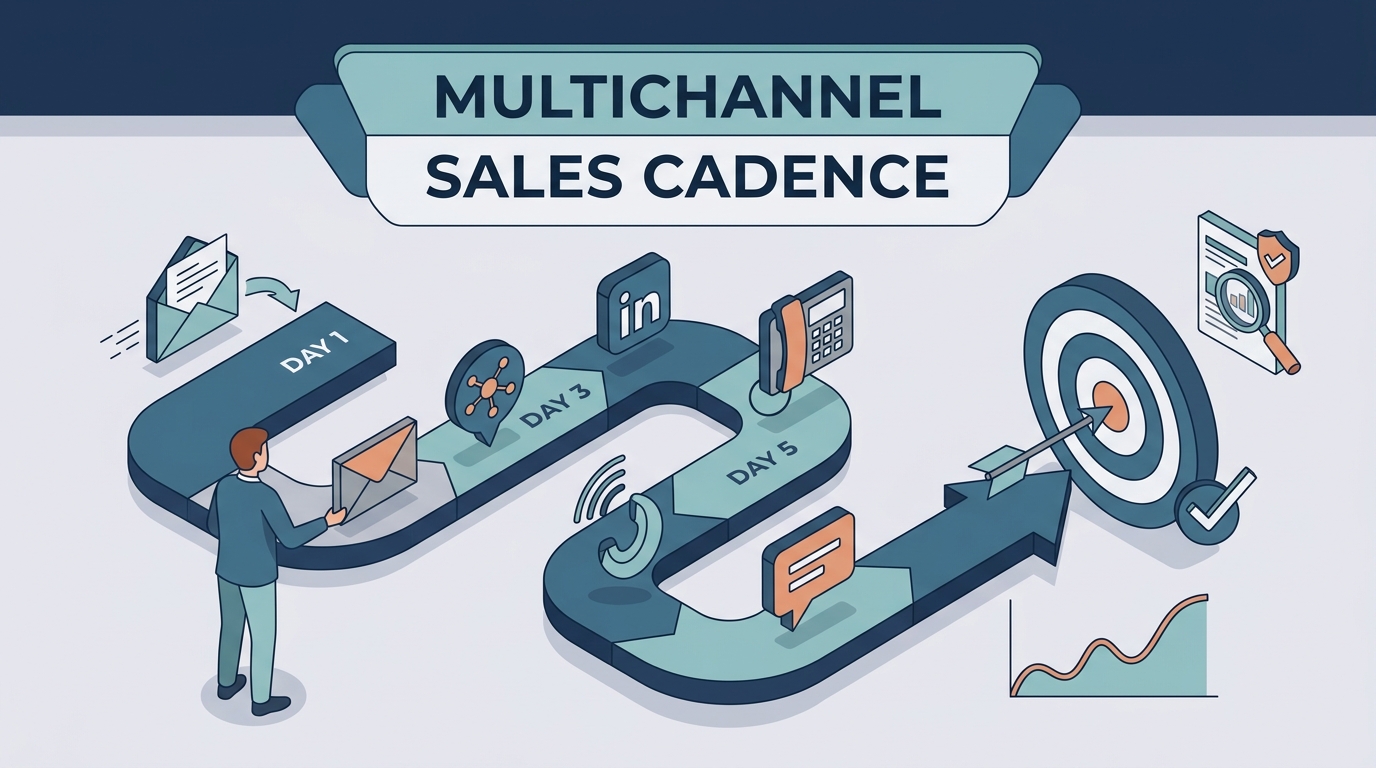
TL;DR: A sales cadence is a structured, repeatable schedule of outreach touches — email, phone, LinkedIn, and sometimes video or SMS —spread across a fixed window, usually 8–12 touches over 14–21 days. An effective cadence mixes channels, spaces touches deliberately, and gives each message a reason to exist. The two things that make or break it are consistency and data: a rep who follows the schedule beats one who improvises, and a cadence built on verified contacts converts far better than one firing into dead inboxes.
Most outbound doesn’t fail because the pitch is weak. It fails because the follow-up falls apart. A rep sends one email, hears nothing, and moves on — even though the overwhelming majority of replies come after the first touch. A disciplined sales cadence fixes that by turning follow-up from a matter of willpower into a system that runs the same way for every prospect, every time.
This guide covers what a sales cadence is, how it differs from a sequence and a workflow, the anatomy of a multi-channel cadence that actually books meetings, a day-by-day template you can copy, the email/call/LinkedIn mix, the mistakes that quietly wreck results, and how verified contact data turns a good cadence into a converting one. If you are still building the target list those touches will run against, start with your sales leads and B2B lead generation foundation first.
What Is a Sales Cadence?
A sales cadence is a predefined sequence of outreach touchpoints, scheduled across specific days and channels, that a rep follows to engage a prospect from first contact to a booked meeting or a clear no. It is the difference between “I’ll follow up when I remember” and “touch 4 is a LinkedIn message on day 6.” The cadence defines how many times you reach out, on which channels, and how far apart.
The value is compounding. Any single email has a modest reply rate, but a well-timed series of relevant touches across multiple channels stacks those small odds until a real conversation surfaces. Prospects are busy, not hostile — most non-replies are timing and inbox noise, not rejection. A cadence gives you enough at-bats, spread over enough days and channels, to catch them at a moment when the message lands.
A cadence is also what makes outbound coachable and repeatable. When every rep runs the same structure, you can measure which step drives replies, which channel underperforms, and where prospects drop off — then improve the whole team’s numbers by fixing the cadence, not by hoping individuals try harder.
Sales Cadence vs Sequence vs Workflow
These three terms get used interchangeably, but the distinction is useful. A cadence is the rhythm and plan of human-driven outreach — the schedule of touches a rep works through. A sequence usually refers to the automated implementation of that cadence inside a sales-engagement tool, where emails send and tasks surface on a timer. A workflow is broader still: the full set of rules and branches that route a prospect through your system based on their behavior.
In everyday use, “sales cadence” and “sales sequence” are close enough to be synonyms, and plenty of teams say cadence when they mean the automated sequence and vice versa. What matters more than the label is the substance: how many touches, across which channels, over how many days, and with what message on each. Get those four decisions right and the tooling is just plumbing.
Anatomy of an Effective Multi-Channel Sales Cadence
An effective cadence has four levers: number of touches, channel mix, timing between touches, and total duration. Tune all four together — a cadence with the right number of touches crammed into two days feels like harassment, and the perfect channel mix spread too thin over two months loses all momentum.
Number of touches. Most high-performing cadences run 8 to 12 touches. Fewer than 6 and you give up before the odds compound; more than about 14 and you are usually just annoying someone who was never going to buy. The sweet spot gives a genuinely interested prospect several chances to notice you without becoming a nuisance to everyone else.
Channel mix. A multi-channel sales cadence beats an email-only one because different people respond on different channels, and seeing your name in more than one place builds familiarity. The workhorses are email, phone, and LinkedIn, with video and SMS as situational add-ons. A cadence that blends all three of the core channels reaches prospects who ignore cold email but answer a well-timed LinkedIn prospecting message.
Timing and spacing. Front-load a little, then widen the gaps. Early touches can sit one to two days apart to build momentum; later touches stretch to three or four days so you stay persistent without crowding the prospect. Vary the time of day and day of week too — a prospect who never opens a Tuesday-morning email might answer a Thursday afternoon.
Duration. Most cadences run their course in 14 to 21 days. That is long enough to catch someone returning from travel or a busy sprint, but short enough that a rep can carry a healthy volume of prospects through it at once. When it ends without a reply, move the prospect to a longer-interval nurture rather than deleting them — timing changes.
A cadence is only as good as the list it runs against. Lessie searches 100+ live sources on every query and returns decision-makers with emails verified at search time — so your touches land in real inboxes instead of bouncing before touch two.
A Sample 14-Day Sales Cadence, Step by Step
Here is a concrete, multi-channel cadence template you can adapt. It runs 9 touches across email, phone, and LinkedIn over 14 days. Treat it as a starting skeleton — adjust the spacing and channel weight to your market, then let the data tell you what to change.
- 1Day 1 — Opening email
Lead with the prospect, not your product. Reference a specific trigger — a recent hire, funding round, launch, or post — and tie it to one problem you solve. Keep it under 90 words with a single, low-friction ask. This first touch sets the tone for the whole cadence.
- 2Day 2 — LinkedIn connection
Send a connection request with a short, non-salesy note, or simply engage with a recent post. This warms the name so your later emails feel less cold. Do not pitch here — the goal is recognition, so touch 4 lands on someone who has already seen your face once.
- 3Day 4 — Follow-up email
Reply in the same thread as day 1 with a new angle — a customer result, a relevant stat, or a different pain point. Never send a bare “just bumping this to the top of your inbox.” Every follow-up must add a reason to reply.
- 4Day 5 — Phone call + voicemail
Call in the late morning or late afternoon. If it goes to voicemail, leave a 15-second message that names the reason you called and points back to your email. Multi-channel touches reinforce each other — the voicemail makes the next email feel familiar.
- 5Day 7 — LinkedIn message
Now that you are connected, send a brief direct message. Keep it conversational and tied to their world, not your quota. LinkedIn often outperforms email at this stage because it feels more personal and less like a mass send.
- 6Day 9 — Value email
Give something with no ask attached — a relevant guide, a benchmark, a teardown of a problem their peers face. This “give” touch resets goodwill and often pulls replies from prospects who ignored the earlier direct asks.
- 7Day 11 — Second call
Try a different time of day than your first call. Persistence on the phone separates reps who hit quota from reps who send and pray. If you connect, you have a conversation; if not, the attempt still reinforces the cadence.
- 8Day 13 — Short nudge email
A two-line email acknowledging you have reached out a few times, with a clear, easy-to-answer question. Directness at this stage frequently earns a reply, even if it is a polite “not now” you can use to time your next attempt.
- 9Day 14 — Break-up email
Close the loop gracefully: “I’ll stop reaching out, but if this becomes relevant, here is how to find me.” Break-up emails are famously effective —the implied scarcity nudges fence-sitters to respond before you disappear.
Getting the Email, Call, and LinkedIn Mix Right
The right channel mix depends on your buyer, but the principle is constant: no single channel carries a cold prospect on its own. Email scales, phone breaks through, and LinkedIn builds familiarity — used together they compound. A cadence weighted only toward email leaves replies on the table from people who never open cold mail but will take a call or answer a DM.
Email is your volume channel and the backbone of most cadences. It is asynchronous, easy to personalize at scale, and the natural home for value-add touches. Keep messages short, thread your follow-ups, and make every send earn its place. This is also where automated prospecting tools do the most work, drafting personalized first touches from real signals instead of merge fields.
Phone is your breakthrough channel. Connect rates are low, but a live conversation moves a deal further than any email, and even unanswered calls plus voicemails lift the response rate of the surrounding touches. Reps who skip the phone entirely almost always underperform on the same cadence.
LinkedIn is your familiarity channel. A connection request, a thoughtful comment, or a short message makes your name recognizable so later touches feel warmer. It is the softest of the three and the easiest to overuse — keep it human and low-pressure. For outbound-heavy teams, understanding how prospecting roles split the work is worth a read; see our guide to SDR vs BDR for how the motion gets staffed.
Common Sales Cadence Mistakes to Avoid
Most cadences underperform for a handful of predictable reasons. Fixing these matters more than adding another clever subject line, because they quietly cap the ceiling on everything else you do.
- Giving up too early. Stopping after two or three touches forfeits the majority of replies, which arrive later in the sequence. Persistence is the whole point of a cadence.
- Single-channel dependence. An email-only cadence ignores everyone who responds on the phone or LinkedIn. Multi-channel is not optional if you want the full reply rate.
- Empty follow-ups. “Just bumping this” and “circling back”add no value and train prospects to ignore you. Every touch needs a fresh reason to exist.
- Same message, different day. Repeating one pitch across nine touches is lazy and obvious. Vary the angle, the channel, and the ask so the cadence feels like a person, not a robot.
- Bad data underneath. The most disciplined cadence in the world converts nothing if the emails bounce and the phone numbers are wrong. Stale contact data is the silent killer of outbound.
That last mistake is the one teams overlook most, because it hides behind “the cadence isn’t working.” If a quarter of your emails bounce and your direct dials ring the wrong desk, no amount of copywriting saves the numbers. Cadence quality and data quality are two halves of the same result.
Great cadences run on fresh data. Lessie assembles target accounts and decision-makers from 100+ live sources with contacts verified at search time — so your carefully sequenced touches actually reach the people you meant to reach.
How Verified Contact Data Makes Cadences Convert
A sales cadence is a delivery system, and it can only be as good as the addresses it delivers to. When contact data is stale, the best-designed cadence leaks value at every step: emails bounce, calls hit dead lines, and the prospect you spent a week sequencing never actually saw a single touch. Verified, current data is what turns cadence effort into cadence results.
This is where an agentic search engine changes the economics. Instead of exporting a static list from one database and hoping it is still accurate, Lessie scans 100+ live sources on every query — LinkedIn, company sites, funding data, news, podcasts — and returns decision-makers with emails checked at search time, not cached from months ago. Your cadence runs against people who exist, at addresses that work.
It also feeds the personalization that makes each touch land. Because Lessie surfaces the real signals behind a contact — recent role changes, hiring, launches — the first email and the LinkedIn note can reference something true instead of a generic opener, which is a large part of the roughly 3x reply-rate lift teams see over templated sends. Strong B2B lead generation and the cadence that works it are one loop, not two separate jobs.
For teams that want the whole motion handled, an AI BDR can run sourcing, enrichment, and first-touch outreach on autopilot — building the list, keeping the data fresh, and executing the early cadence steps so human reps step in on the replies that matter. The cadence stays disciplined because software, not memory, drives the schedule.