




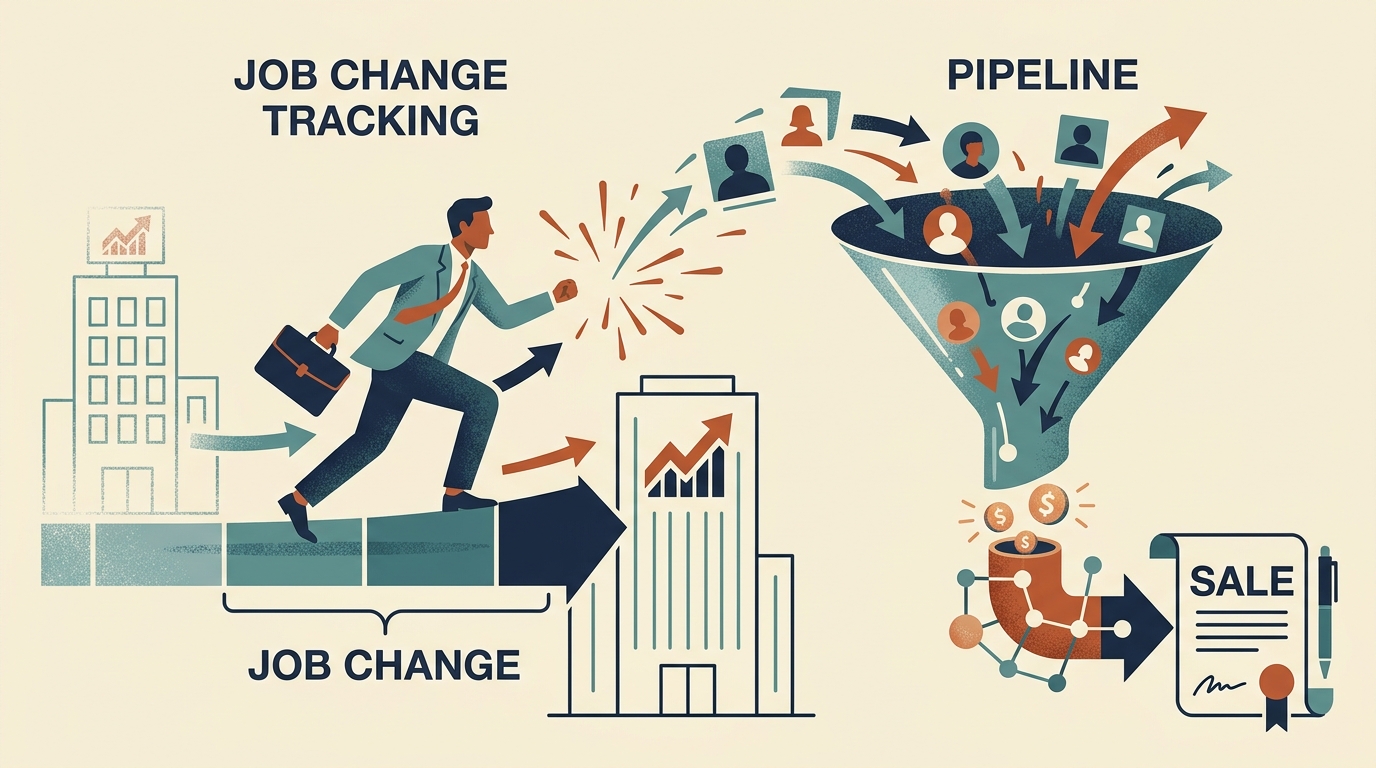
TL;DR: Job change tracking is the practice of monitoring when decision-makers, champions, and past users of your product move into new roles—and treating each move as a sales trigger. A new leader inherits problems, controls fresh budget, and carries preferences from their last stack, which makes the months right after a move one of the most reliable buying windows in B2B. This guide covers why job changes convert, which moves to track, how to track them, and what to say when one happens.
Ask any seasoned rep where their easiest deals came from and a familiar story appears: someone who loved the product at one company showed up at another—with a mandate and a budget. The frustrating part is that most teams meet that story by accident. Job change tracking turns it into a system, so the moves that matter reach you while the opportunity is still open instead of surfacing a quarter later in a lost-deal review.
What Is Job Change Tracking?
Job change tracking is the systematic monitoring of role changes among the people who matter to your pipeline—buyers at target accounts, champions inside existing customers, and past users of your product—so that each relevant move triggers a timely, personal touch. It is a people-level discipline: where most account monitoring watches companies, job change tracking watches humans as they carry needs and preferences from one employer to the next.
The practice sits inside a broader family of buying signals, alongside funding events and expansion news. What makes the job change special is its precision. A funding round tells you a company has money; a job change tells you which person now owns a problem, and often hints at what they will do about it. Signal-first teams treat it as a first-class trigger rather than trivia for the CRM.
It also runs in two directions. Inbound moves—a new VP arriving at a target account—create openings. Outbound moves—your champion leaving a customer—create risk on the account they left and opportunity at the one they joined. A complete program watches both.
Why Is a Job Change Such a Strong Buying Signal?
A job change is a strong buying signal because it resets three things at once: ownership, budget, and loyalty. The person who defended the incumbent tool may be gone; the person who replaced them owes it nothing. Few other events concentrate that much change into a single, publicly observable moment.
- New leaders are expected to change things. An incoming executive is hired to produce results the last one did not. Evaluating tools, processes, and vendors is part of the job description—your outreach lands while that review is actually happening.
- They carry preferences with them. People rebuy what worked. A leader who used your product successfully is dramatically easier to win at their new company—the trust was built on someone else's payroll.
- Authority is at its peak. Early-tenure leaders get latitude that fades as quarters pass. The purchase that sails through in month two can stall in month twelve.
- The signal is public and fresh. Role changes surface on professional profiles and announcements almost immediately, unlike budget decisions that stay private until a deal closes.
None of this guarantees a deal, of course. A job change is an opening, not an order form—the value is in the timing it gives you relative to competitors who are still asleep.
Which Job Changes Should You Track?
Track the moves that map to revenue: champions and users leaving accounts you already know, and relevant decision-makers arriving at accounts you want. Tracking everyone is noise; tracking these four groups is pipeline.
- Champions leaving a customer. Two triggers in one. The account they left needs a save plan before renewal—your internal advocate is gone. The company they joined is now your warmest prospect list of one.
- Past users landing anywhere new. Anyone who actively used and liked your product is a warm door at their next employer, whatever their new title is. These are the people behind "the rep who closed a deal with one email."
- New decision-makers at target accounts. A fresh VP of Sales, Marketing, or Engineering at an account on your list is a re-qualification event: the stack they inherited is under review whether the incumbent vendor knows it or not.
- Promotions into buying power. Moves inside a company count too. The manager who could only recommend last quarter may sign this quarter—and they already know the problems firsthand.
Prioritize by relationship first (past users and champions convert best), then by account fit. A relevant title arriving at a perfect-fit account belongs in this week's queue, not this month's.
How Do You Track Job Changes at Scale?
You track job changes either manually—watching profiles and announcements yourself—or automatically, with tools that monitor moves against a defined list of people and accounts. Manual works at friendship scale; automation is what makes it a channel.
The manual floor. Follow your champions and key buyers on LinkedIn, watch the new-role announcements in your feed, and keep CRM contacts honest when emails start bouncing. A bounced email from a known contact is itself a job-change alert—crude, but free. The limit is obvious: feeds surface a fraction of moves, and nobody checks five hundred profiles weekly.
The automated layer. Signal tools watch the people you care about and alert you when a role changes—the approach behind people on the move monitoring. The best setups combine a person-level watchlist (champions, users, named buyers) with a pattern-level one (any new revenue leader at accounts matching your profile), so you catch both the moves you predicted and the ones you could not have.
Job changes also compound with company-level signals. A new sales leader plus a surge of SDR job postings is a far louder signal than either alone—leadership plus headcount usually means new tooling. Layering the two is exactly what predictive hiring approaches do for recruiting, and the same logic applies to selling: stacked signals beat single ones.
What Do You Say When a Job Change Happens?
Say something specific, early, and low-pressure. The job change gives you a legitimate, human reason to write—wasting it on a generic pitch throws away the one advantage the signal gave you.
- The congratulations opener (new buyer at a target). Congratulate the move, name one challenge people in that seat usually face in their first months, and offer a resource rather than a meeting. You are opening a relationship at the exact moment they are mapping their options—not closing a deal in one message.
- The reunion note (past user or champion). Reference the shared history plainly: what their old team used the product for and one thing that has improved since. Familiarity does the selling; keep it short.
- The save play (champion left a customer). This one is internal first: flag the account, find the remaining users, and build a new champion before renewal—ideally before procurement notices the seat went quiet.
Timing beats polish in all three. A decent message in week two of a new role outperforms a perfect one in month six, because the week-two message arrives while the stack review is still open. Job changes sit alongside funding rounds and expansion news in the wider family of sales triggers—and of all of them, this is the one where speed matters most.
How Lessie Automates Job Change Tracking
Lessie is a People Search AI Agent that automates job change tracking by monitoring role-change signals across 100+ live sources and matching them to the people and accounts you actually care about. Instead of maintaining spreadsheets of former champions, you describe the pattern in plain English and let the agent watch.
A query like "VPs of RevOps who started a new role at B2B SaaS companies in the last 60 days" returns the people behind that pattern with verified contact details at 95%+ accuracy. Point the same logic at a company instead of a person—paste a domain into the Hiring Signal Scanner—and you see whether leadership moves come with the hiring surge that usually signals new budget.
The output is ranked and reasoned: who moved, why the move matters for your product, and a drafted opener tied to the specific change. Your team spends its time on the conversation, not on discovering that it should have happened last month.