




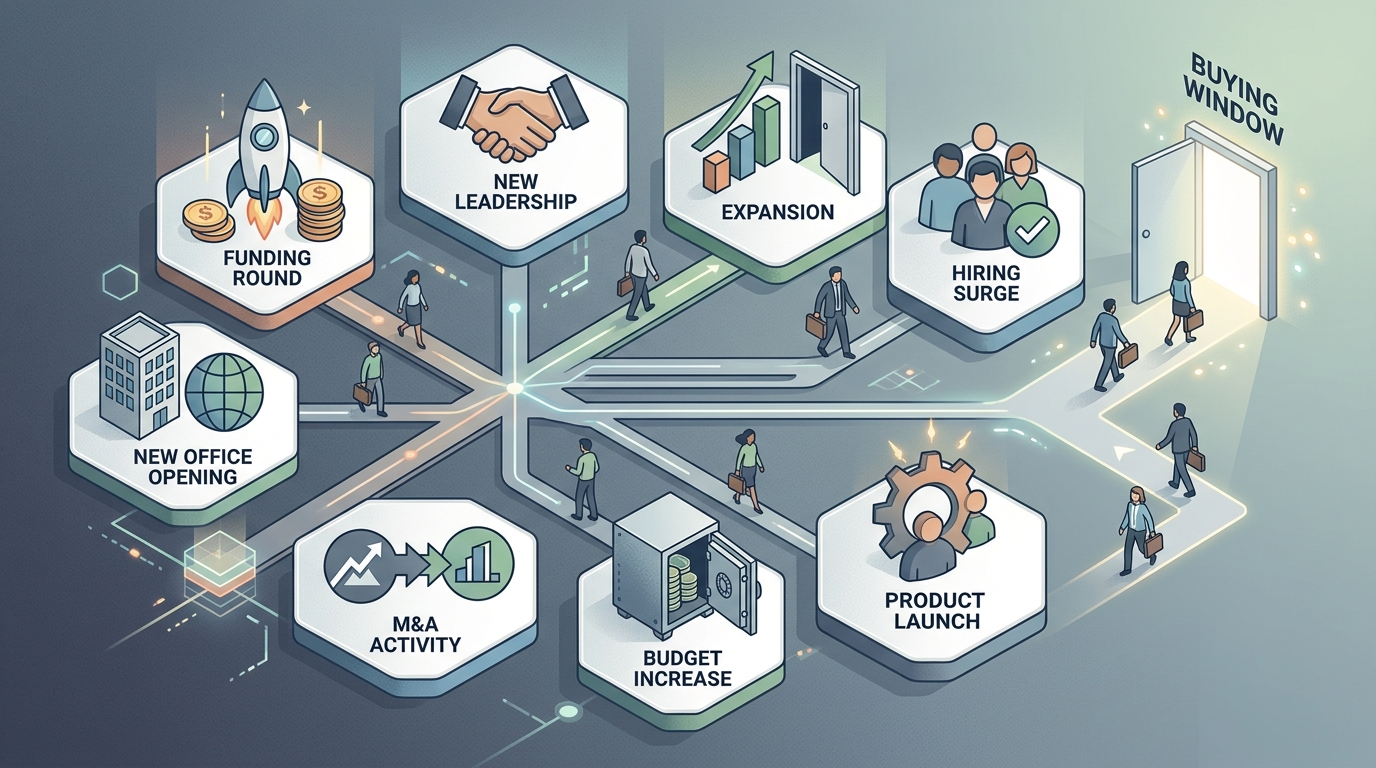
TL;DR: Sales triggers are datable events—a funding round, a leadership change, a hiring surge—that mark the moment an account becomes more likely to buy. They matter because outreach anchored to a trigger arrives with a built-in reason and lands inside a real buying window, instead of interrupting an account that has no current need. This guide is the working list: the eight trigger events that reliably open windows, why each works, how to spot it, and the angle to lead with.
Two identical companies can sit in the same territory for a year—same size, same industry, same fit—and only one of them will buy this quarter. The difference is rarely visible in firmographics. It is an event: something happened at one of them that turned a dormant need into a funded project. Sales triggers are how you find out which one, and when.
What Are Sales Triggers?
A sales trigger is an observable, datable event at a company or in a person's career that signals a change in their likelihood to buy. The event creates or exposes a need—new money to spend, a new leader with a mandate, a new scale problem—and because it is observable, it tells you not just who might buy but when the conversation became worth starting.
Triggers are the event layer of the broader signal families covered in buying signals: where research behavior builds gradually, a trigger has a timestamp. That makes triggers the natural backbone of signal-based selling—each event starts a clock, and the value of your outreach decays as that clock runs.
One distinction before the list: a trigger opens a window, it does not close a deal. The event earns you a relevant conversation at the right moment—what happens next still depends on fit and execution.
Company Money and Momentum Triggers
The first four triggers are about resources and growth: events that hand a company money or momentum it did not have last quarter. These are the loudest and most widely watched triggers, so speed differentiates.
- 1. Funding rounds. Why it works: new capital comes with explicit growth targets, and hitting them almost always means buying tools and services within months. How to spot it: funding announcements, investor updates, and coverage in startup press—widely public, which means the window is competitive. The angle: tie your message to what the raise is for ("scaling the GTM team"), not to the money itself.
- 2. Mergers and acquisitions. Why it works: integration forces decisions—two stacks must become one, duplicated vendors get reviewed, and new leadership arrives with the deal. How to spot it: deal announcements and the follow-on reorg news over the next two quarters. The angle: speak to the integration pain directly; neutrality ("whichever stack wins") reads as practical.
- 3. Expansion moves. Why it works: a new office, market entry, or localization push creates first-time needs—the playbook that worked at home has gaps abroad. How to spot it: expansion announcements, location changes on hiring posts, new-region job listings. The angle: lead with the specific gap that expansion creates for your category.
- 4. Product launches. Why it works: a launch changes a company's scale profile overnight—more traffic, more customers, more support volume—and stresses whatever the old stack barely handled. How to spot it:launch posts, changelogs, press coverage. The angle: congratulate, then name the scale problem launches typically create in your domain.
People and Pressure Triggers
The next four triggers are quieter: changes in people, technology, and circumstance that shift what a company needs. They are less crowded than funding news—fewer competitors watch them, which makes them disproportionately valuable.
- 5. Leadership changes. Why it works: incoming executives review the stack they inherited, control early-tenure budget, and are expected to make changes.How to spot it: announcement posts and title updates—and because this trigger rewards person-level tracking, it has its own playbook in our guide to job change tracking. The angle: a congratulations note plus one genuinely useful observation about the seat they just took.
- 6. Hiring surges. Why it works: job postings are budget made visible—five SDR openings mean an outbound push is funded, and every new team needs tooling sized to it. How to spot it: careers pages and posting velocity; the Hiring Signal Scanner reads a company's whole posting pattern from its domain in seconds. The angle: name the team being built and the problem that team will hit in their first quarter.
- 7. Technology changes. Why it works: adopting or dropping a tool reveals both direction and gaps—a switch to a new CRM opens integration needs; a contract ending opens a replacement review. How to spot it: tech-stack shifts on careers posts, integration pages, and public case studies. The angle: position alongside what they just adopted, or against what they just left.
- 8. Negative events. Why it works: an outage, a breach, a public pricing backlash—pain compresses evaluation timelines more than any growth event.How to spot it: status pages, community complaints, press. The angle:careful and helpful, never gleeful—offer the fix, skip the commentary on the failure.
Triggers also stack. Funding plus a new sales leader plus SDR postings is not three mild signals—it is one loud one: a funded outbound motion being built right now. When multiple triggers fire on one account inside a quarter, move it to the top of the list—pasting the domain into the Buying Signal Checker shows every trigger currently live on that account in one view.
How Do You Spot Sales Triggers Before Competitors?
You spot triggers early by watching sources continuously rather than checking them occasionally—the gap between those two is where competitors get there first. Three practices separate teams that catch windows from teams that read about them.
Define which triggers matter for you. Not all eight deserve equal watch. Match triggers to your product's actual buying reasons: if deals follow headcount growth, weight hiring; if they follow scale problems, weight launches and funding. Two or three trigger types watched well beat eight watched badly.
Automate the watching. Manual checking—news alerts, careers-page visits, feed scrolling—works for a dozen accounts and collapses beyond that. Signal tools watch event sources continuously and fire alerts scoped to your market, which converts triggers from a research task into an inbox.
Verify before you write. A trigger is a hypothesis about need, not proof of it. Thirty seconds of checking—is the event real, is this the right person, does the implied need match what you sell—separates trigger-based outreach from spray with a timestamp. Our guide to how to identify buying signals covers that qualification method; this article is the event dictionary it plugs into.
How Lessie Turns Triggers Into Conversations
Lessie is a People Search AI Agent that watches trigger events across 100+ live sources and turns them into ranked, contactable opportunities. You describe the market in plain English—"B2B software companies that raised a round or changed sales leadership in the last 90 days"—and the agent returns the accounts where those triggers fired, each with a verified decision-maker contact at 95%+ accuracy.
Every result carries its reasoning: which trigger fired, when, and why it maps to your offer, plus an opener drafted around that specific event. The watching, cross-referencing, and first-draft work that makes trigger selling labor-intensive happens inside the search—your team just takes the conversations while the windows are open.