




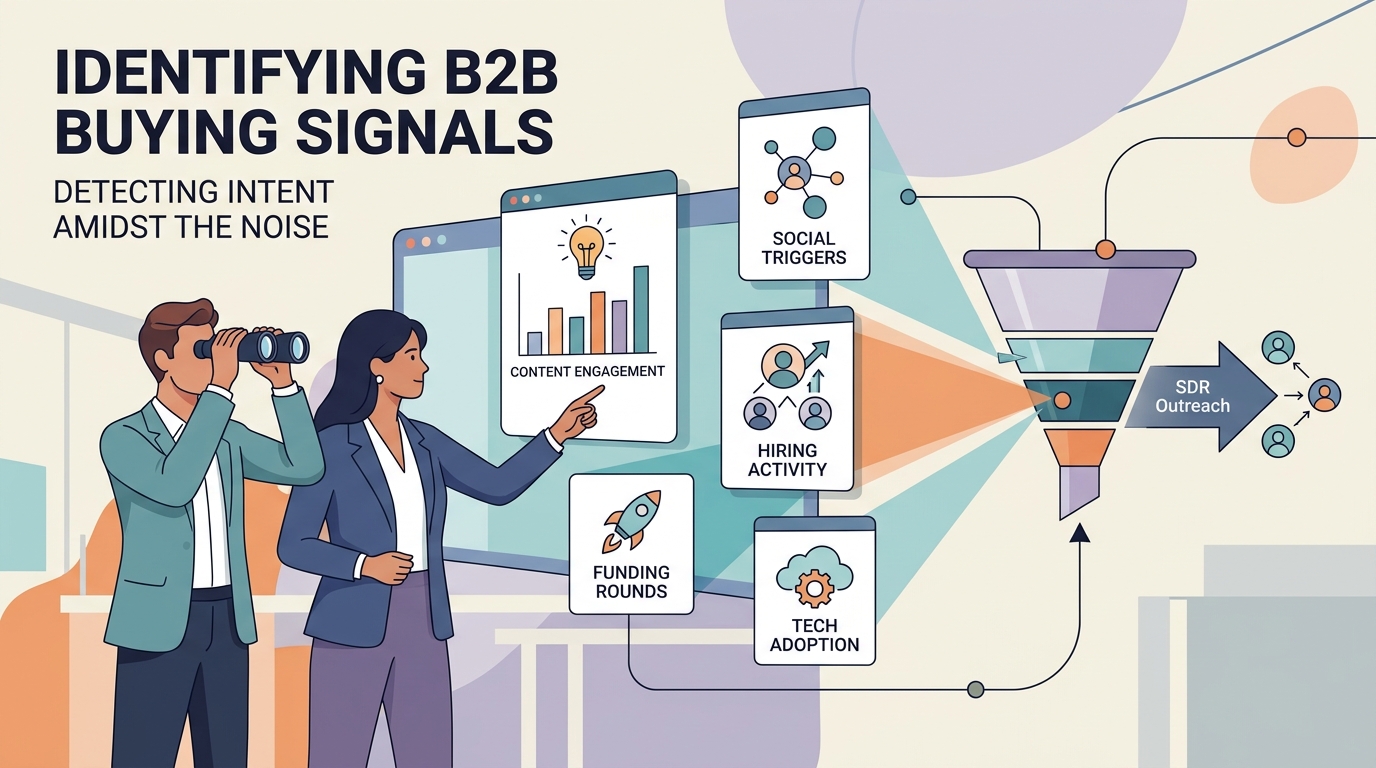
TL;DR: To identify buying signals, you need to watch five categories of activity—content engagement, social activity, hiring, funding and growth, and technographic shifts—and know what each one implies about how close an account is to buying. This guide breaks down exactly how to detect each type of B2B buying signal, what it means when you see it, and a five-step process for turning a raw signal into a timely, relevant conversation before a competitor gets there first.
Most revenue teams have more data than they know what to do with, but very little of it tells them when to reach out. Learning to identify buying signals is how you fix that: instead of guessing which accounts might be ready, you watch for the specific, observable events that show a company is actively moving toward a purchase. A pricing page visited three times in a week, a new VP of RevOps hired last month, a funding round closed last quarter—each one is a clue, and stacked together they tell you exactly who to call first.
What Are B2B Buying Signals, and Why Do They Matter?
B2B buying signals are observable, real-world events that show a company is more likely than usual to purchase a product like yours right now. They matter because they replace guesswork with evidence: instead of ranking accounts purely by firmographic fit — industry, size, region — you rank them by what people at the company are actually doing, which is a far stronger predictor of near-term buying readiness than fit alone.
The practice sits close to, but is not identical to, tracking intent signals — often called buyer intent signals. Intent signals are usually narrower—behavioral data about active research, like content consumption or repeat page visits. This broader category is the umbrella: it includes intent-style research behavior, but also structural changes at a company—a funding round, a hiring spree, a new tool added to the stack—that predict a buying window opening even before anyone starts actively researching. Treat intent as one important category inside the larger buying-signal picture, not a synonym for it. According to Gartner, B2B buyers now spend only a small fraction of their total purchase journey meeting with any single sales rep—which is exactly why catching signals before a prospect ever contacts you matters more than it used to.
Five categories cover the vast majority of what matters:
- Content engagement signals—what people at an account are reading, downloading, and revisiting.
- Social signals—what people at an account are posting, engaging with, and changing on LinkedIn and other professional networks.
- Hiring and headcount signals—what roles a company is actively trying to fill.
- Funding and growth signals—capital events and expansion moves that free up budget.
- Technographic signals—the tools a company adopts, drops, or is visibly missing.
The rest of this guide walks through how to actually catch each one, then how to turn a caught signal into a conversation. For the fuller picture of how these categories fit into a live target-account workflow, see our guide to B2B buying signals; for the event-by-event dictionary—what each trigger means and the angle to lead with—see sales triggers.
One more distinction worth making before the categories: a buying signal is not the same thing as a lead. A lead is a person who raised their hand—filled out a form, booked a demo, replied to an email. A buying signal is evidence that a company is moving toward a purchase—a rising level of purchase intent—whether or not anyone has raised their hand yet. Most of the value here comes from that gap: you get to the conversation before the prospect has done anything as explicit as filling out a form, which is exactly the window a slower competitor will still be waiting on.
How Do You Identify Content Engagement Signals?
You identify content engagement signals by tracking what named accounts do on your own site and content library—webinar attendance, resource downloads, pricing-page visits, and repeat visits—because each one is a direct, first-party sign that someone is actively evaluating a purchase. This is usually the highest-confidence signal category because you control the data collection yourself.
Webinar and event attendance. When someone from a target account registers for and actually attends a webinar, especially one tied to a specific pain point or use case, they are telling you which problem they are trying to solve right now. Track not just registration but attendance and questions asked—a live question during Q&A is a stronger signal than a passive sign-up that never shows up.
Whitepaper and resource downloads. A downloaded comparison guide, ROI calculator, or implementation checklist means someone is far enough along to want structured detail, not just a blog post. Weight downloads that require a work email and a specific job title more heavily than anonymous gated-content downloads, since they carry more identity confidence.
Pricing-page visits. A visit to your pricing page is one of the single clearest buying signals available, especially when it happens more than once. Someone checking pricing has usually moved past general research into budget conversations internally. Track repeat visits within a short window—two or three visits in a week outweighs a single visit spread over a month.
Repeat site visits generally. Beyond pricing, a pattern of returning visits to the same set of pages—a comparison page, a specific feature page, a case study in your vertical—shows sustained rather than one-off interest. A single visit is curiosity; three visits in ten days is momentum.
The common thread across all four: recency and frequency matter more than the raw count. A visit today is worth far more than the same visit two months ago, and a cluster of visits from multiple people at one account is stronger than the same number of visits spread across a quarter. Research from HubSpot on buyer behavior consistently shows that most of a purchase decision now happens before a prospect ever talks to a rep—which is exactly why first-party content signals carry so much weight.
How Do You Identify Social and Hiring Signals?
You identify social signals by watching what people at a target account post, engage with, and change on LinkedIn, and you identify hiring signals by watching which roles a company is actively trying to fill—both reveal buyer intent long before anyone visits your website. Together they catch the buyers your content-engagement tracking will always miss: the ones who have not come to you yet.
LinkedIn engagement. When a decision-maker likes, comments on, or shares posts about a specific pain point—or engages with a competitor's content—they are telling you what is on their mind in public. Comments are a stronger signal than likes because they require enough investment in the topic to write something. LinkedIn's own Sales Solutions research has repeatedly found that reps who engage consistently around these signals build more pipeline than reps who treat the platform as a static directory.
Job changes. A new hire into a senior role, especially one who previously used a tool like yours at a former company, is one of the most reliable signals in B2B sales. New leaders re-evaluate their stack in the first 90 days on the job far more often than tenured ones do, which makes a job change one of the highest-leverage signals to watch—our guide to job change tracking turns it into a full playbook.
Company follows. An account starting to follow your company page, or several employees following in a short window, often precedes an active evaluation by weeks. It is a quiet signal on its own, but combined with anything else on this list it adds real confidence that something is starting to move.
Posts about pain points. Employees publicly describing a problem — "our outbound reply rates are on the floor" or "we're drowning in manual data entry" — are effectively raising their hand in public. These posts are rare, but they are extremely high-intent when you catch them.
Job postings that imply a need. A job posting is a buying signal in disguise: a company hiring its first "Head of RevOps" or opening a wave of SDR roles is telling you, months in advance, what tools that new team will need. Read the requirements section closely—postings that explicitly list a category of tool ( "experience with sales intelligence platforms") are a near-direct buying signal, not just an inference.
Team expansion in a relevant function. Beyond individual postings, watch headcount growth in the function you sell into. A sales team growing from ten to twenty-five reps needs more of everything that supports a rep—from prospecting tools to enablement content—and that need shows up as a hiring signal well before it ever shows up as a formal request for proposal.
How Do You Identify Funding, Growth, and Technographic Signals?
You identify funding and growth signals by tracking capital events and public expansion news, and you identify technographic signals by tracking which tools a company adopts, drops, or is visibly missing—both point to a buying window opening even before anyone at the account starts actively researching a solution.
Funding rounds. A new round of funding is one of the most dependable signals because it does two things at once: it confirms budget exists, and it usually comes with pressure to grow fast, which means new tools get approved faster than usual. The first 90 days after a round closes is typically the highest-velocity buying window a company will have all year.
Expansion announcements. A new office, a new market, or a new product line all mean new operational needs. Expansion into a new geography, for instance, often means a company needs new sales, compliance, or hiring tooling adapted to that market—a clear and specific reason to reach out.
New leadership hires. A new CRO, VP of Sales, or Head of Marketing almost always re-evaluates the existing stack. Leadership changes are one of the highest-converting buying signals sales and recruiting teams both watch, because a new leader has both the mandate and the incentive to make visible changes early in their tenure.
Tech-stack adoption. When a company adopts a new tool that is complementary to yours, that adoption is itself a buying signal—it tells you they just solved one problem and may now have budget or attention for the adjacent one. Our guide to technographic data covers how to track these adoption events at scale instead of checking one domain at a time.
Tech-stack gaps. The inverse also matters: a company that has clearly invested in adjacent categories but is visibly missing a tool in yours has an open gap. Public stack-lookup tools make this visibility free to check, and a gap you can point to directly makes for a sharp, specific opening line instead of a generic pitch.
As with content and social signals, recency does the heavy lifting. A funding round from eighteen months ago has already been spent; one from six weeks ago is still actively shaping budget conversations happening right now. The Salesforce State of Sales research series has tracked a steady rise in teams using signals like these—rather than static lists—to decide who gets called first.
How Do You Turn a Buying Signal Into a Conversation?
You turn a buying signal into a conversation by detecting it quickly, qualifying whether it is strong enough to act on, finding the right person to contact, personalizing your outreach around the specific signal, and timing the send while the signal is still fresh. Skipping any one of these steps is why most teams that collect signals still fail to convert them into meetings.
- 1Detect the signalSet up tracking across the five categories above—your own site analytics for content engagement, LinkedIn monitoring for social activity, job boards for hiring, a funding database for growth events, and a stack-lookup tool for technographic changes. The goal is one place to see everything, not five dashboards nobody checks daily.
- 2Qualify and score itNot every signal deserves outreach. Weigh each one by recency (how long ago it happened), strength (how directly it implies a need), and whether it is stacked with another signal at the same account. An account showing two or three simultaneous buying signals is a far better bet than one with a single weak signal.
- 3Find the right contactA signal at the company level is not useful until you have a name. Identify who owns the decision tied to the signal—the hiring manager for a new role, the economic buyer for a funding-driven expansion—and get a verified way to reach them.
- 4Personalize the outreachReference the specific signal you caught, not a generic observation about growth. "I saw you just opened a Head of RevOps role" reads as relevant; "I noticed your company is growing" reads as a template. Specificity is what earns a reply.
- 5Time the sendMost signals have a shelf life measured in days or weeks, not months. Send while the signal is still fresh—the same day for a hot content signal, within a couple of weeks for a hiring or funding signal—before a faster competitor gets there first.
How Does Lessie Automate Buying Signal Detection and Outreach?
Lessie automates buying signal detection by continuously reading content engagement, social activity, hiring, funding, and technographic changes across 100+ live sources, then ranking accounts by how strong and current their combined signals are and pairing each one with a verified contact—so the entire five-step workflow above runs without you manually checking separate tools.
You describe who you are targeting in plain English—for example, "Series B fintech companies that just hired a Head of RevOps"—and the agent searches live sources for exactly that combination of signals, rather than starting from a static list that goes stale the day it is built. Because the underlying buyer intent data is pulled from many sources rather than a single feed, it catches buying signals a single-vendor tool would miss.
The output is not just a list of accounts. Each one comes with the specific reason it made the list, a verified contact at the right role, and outreach drafted around why now is the moment to reach out—collapsing the detect-qualify-contact-personalize-time loop from the section above into a single query. Instead of a rep spending hours a week triaging raw signals by hand, they open a ranked list and start the conversation.
This matters most for lean teams. A dedicated intent-data platform or a technographic tool alone gives you one slice of the picture; stitching five categories together by hand is a full-time job most revenue teams cannot staff. Lessie closes that gap by doing the watching and the matching for you, so the skill your team needs is not signal-spotting but conversation-starting.
Worth repeating because it is easy to lose sight of in the tooling details: the goal was never to collect more signals. It was always to have fewer, better conversations, sooner than the next vendor in the category. Every category above — content engagement, social, hiring, funding, and technographic — is only useful to the extent it shortens the distance between "this account might be ready" and "we are talking to the right person about the right problem." Whether you build that pipeline by hand or let an agent like Lessie run it continuously, that distance is the number worth optimizing.