




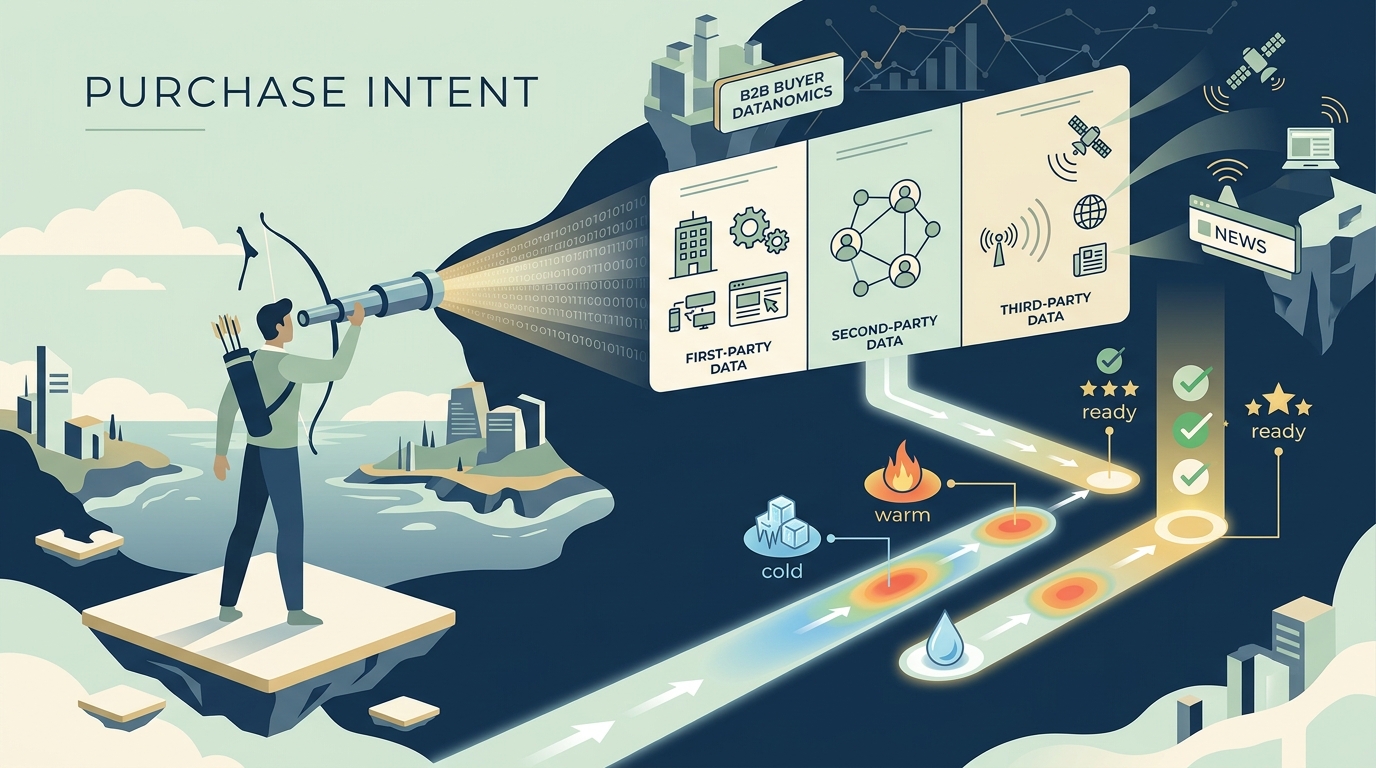
TL;DR: Purchase intent is the measurable likelihood that a person or company is moving toward buying a product like yours right now. In B2B, you measure it with three kinds of intent data—first-party (behavior on your own properties), second-party (a partner's data), and third-party (activity aggregated across the wider web)—and you act on it by timing outreach to the moment intent spikes. This guide explains what purchase intent is, how it is measured, which signals matter, and how to use intent data to reach buyers before a competitor does.
Most pipeline problems are not targeting problems—they are timing problems. You know which accounts fit your ideal customer profile; what you rarely know is when any of them is actually ready to talk. That is the gap purchase intent closes. Instead of ranking accounts only by static traits like industry and size, purchase intent ranks them by what people at those accounts are doing right now—the research, the hiring, the funding —so your team spends its limited hours on the buyers most likely to respond this week.
What Is Purchase Intent?
Purchase intent is the measurable probability that a buyer will purchase a specific type of product within a defined window, inferred from their observable behavior and circumstances. In B2B it is rarely a single action—it is a pattern: repeat visits to a pricing page, a surge in category research, a new leader hired to solve exactly the problem you address. Read together, these behaviors estimate how close an account is to a decision.
Intent versus fit. Fit answers "should this company buy from us?" —it is about firmographics like industry, size, and region, and it barely changes over time. Purchase intent answers a different and more urgent question: "is this company ready to buy now?" A perfect-fit account with zero current intent is a bad use of a rep's morning; a slightly-less-perfect account showing three intent signals this week is a much better one.
Intent versus a lead. Leads are self-declared; intent is inferred. By the time someone becomes a lead, they chose to reveal themselves—and usually revealed themselves to your competitors the same week. Purchase intent surfaces the far larger group that is actively evaluating but has declared nothing, which means acting on it puts you in the deal earlier, often alone, and always with less noise around your message.
Why it matters more now. B2B buyers complete most of their research independently and privately before contacting any vendor—analyst studies of buying groups (Gartner's among them) put the rep's share of the buying cycle in the low double digits. Purchase intent is how you compensate: you cannot join the private research, but you can detect its signature and time your entrance to it.
How Is Purchase Intent Measured in B2B?
Purchase intent is measured in B2B using three complementary types of intent data—first-party, second-party, and third-party—each capturing a different slice of buyer behavior. Combining them gives a fuller, more reliable picture than any one source alone, which is why serious programs treat them as layers rather than alternatives. The umbrella term for all three is buyer intent data.
First-party intent data. This is behavior on properties you own—your website, product, emails, and events. Pricing-page visits, repeat sessions, demo-video completions, and content downloads are all first-party intent. It is the highest-confidence type because you control the collection and can tie it to a known account, but it only sees buyers who have already found you.
Second-party intent data. This is another company's first-party data, shared directly with you—for example, a review site telling you which companies compared you against a competitor, or a partner sharing engagement from a co-marketed event. Second-party data extends your visibility just beyond your own walls, to buyers actively evaluating your category on a trusted third-party property.
Third-party intent data. This is behavioral data aggregated across the wider web—content consumption, research activity, and topic surges observed across many sites and then attributed to a company. Third-party data is the broadest because it catches buyers who have never touched your properties, though it is also the noisiest and needs careful weighting. It is what most people mean when they talk about "intent data" as a category.
The strongest measure of purchase intent stacks all three: first-party for confidence, second-party for evaluation context, and third-party for reach. An account showing intent across more than one layer—researching your category on the open web and revisiting your pricing page—is a far stronger bet than one flickering in a single source.
What Kinds of Intent Signals Should You Track?
You should track two broad families of purchase-intent signal: research signals that show active evaluation, and structural signals that show a buying window opening. Research signals tell you a buyer is looking now; structural signals often fire earlier, before active research even begins—so watching both catches intent at more than one stage of the journey.
Research and engagement signals. These are the classic markers of active purchase intent: repeat pricing-page visits, competitor-comparison reads, review-site activity, category-content consumption, and webinar attendance tied to a specific problem. They are strong because they reflect a buyer choosing to spend time evaluating—but they only appear once the buyer is already in motion.
Structural buying signals. These fire earlier and are harder to fake: funding rounds that free budget, hiring surges in the function you serve, new leadership that re-evaluates the stack, and expansion into new markets. Because they often precede active research, they let you reach a buyer before the pricing-page visit ever happens. For the full taxonomy, see our guide to buying signals.
Recency and stacking do the heavy lifting. Two rules separate real purchase intent from noise. First, recency: a signal from this week is worth far more than the same signal from three months ago. Second, stacking: one signal is a hypothesis, but two or three simultaneous signals at the same account are a genuine buying window. Weight your scoring toward fresh, stacked intent signals and you will cut false positives dramatically.
How Do You Use Purchase Intent to Time Outreach?
You use purchase intent to time outreach by monitoring signals continuously, prioritizing accounts by signal strength and recency, and reaching out the moment a meaningful spike appears—with a message anchored to the specific signal that triggered it. Timing, not message polish alone, is the biggest lever purchase-intent data gives you.
Monitor continuously, not on a schedule. Purchase intent decays fast—the value of a fresh signal drains away with every day it sits unworked. Checking a dashboard once a month means most windows close before you see them, which is why continuous monitoring beats periodic review.
Prioritize, do not just collect. A pile of intent data helps no one if every account gets equal attention. Rank accounts by how strong and current their combined signals are, then work the top of that list first. This is the core of intent-based marketing: letting the data decide who gets contacted and in what order.
Anchor the message to the signal. The whole point of timing to intent is that it makes the first message relevant. An opener that names the trigger—the repeat pricing visits, the new data-team hires, the platform migration—earns a reply that a trigger-free introduction never will. Intent you detect but never reference is intent wasted.
Common Mistakes That Waste Purchase-Intent Data
The most common mistakes with purchase intent are treating every signal as equally urgent, acting on stale data, relying on a single source, and reaching out without referencing the signal at all. Each one quietly turns a genuine advantage into noise, and avoiding them is often the difference between intent data that converts and intent data that just fills a dashboard.
- Ignoring recency. Acting on a six-month-old signal is barely better than cold outreach—the budget it implied has already been spent or reallocated.
- Trusting a single source. Third-party data alone is noisy; first-party alone is narrow. One-source intent produces false positives a stacked view would catch.
- Confusing fit with intent. A great-fit account with no current signal is not a purchase-intent lead. Do not let firmographics masquerade as readiness.
- Generic outreach. Detecting intent and then sending a templated pitch wastes the signal. If you know the trigger, name it.
- No feedback loop. Track which signal types actually convert for your product, then weight future scoring toward those—otherwise you keep chasing signals that never close.
The thread connecting these mistakes is treating purchase intent as a list to download rather than a live system to act on. Intent data only pays off when it is fresh, stacked, and tied to a timely, specific message—the same discipline that separates a hidden buyer in dark social from one you actually reach.
How Lessie Turns Purchase Intent Into Conversations
Lessie is a People Search AI Agent that turns purchase intent into conversations by reading signals across 100+ live sources, ranking accounts by how strong and current their intent is, and pairing each one with a verified contact and a reason to reach out—so the detect, prioritize, and personalize steps happen in a single query instead of across five tools.
A plain-English brief like "payments companies whose product teams started researching fraud tooling" is all the setup required: the agent finds accounts matching that purchase-intent pattern and returns contacts at 95%+ accuracy. And since the underlying buying signals come from a stack of independent sources instead of one vendor's feed, intent that any single provider would miss still surfaces.
The output is not a raw list to triage but a ranked view of who to contact and why now. Each account arrives with the specific signal that surfaced it and outreach drafted around that trigger, so a rep opens their day with genuine purchase intent already translated into a message worth sending. To operationalize the timing side, our guide to how to track social signals covers the monitoring workflow step by step.