




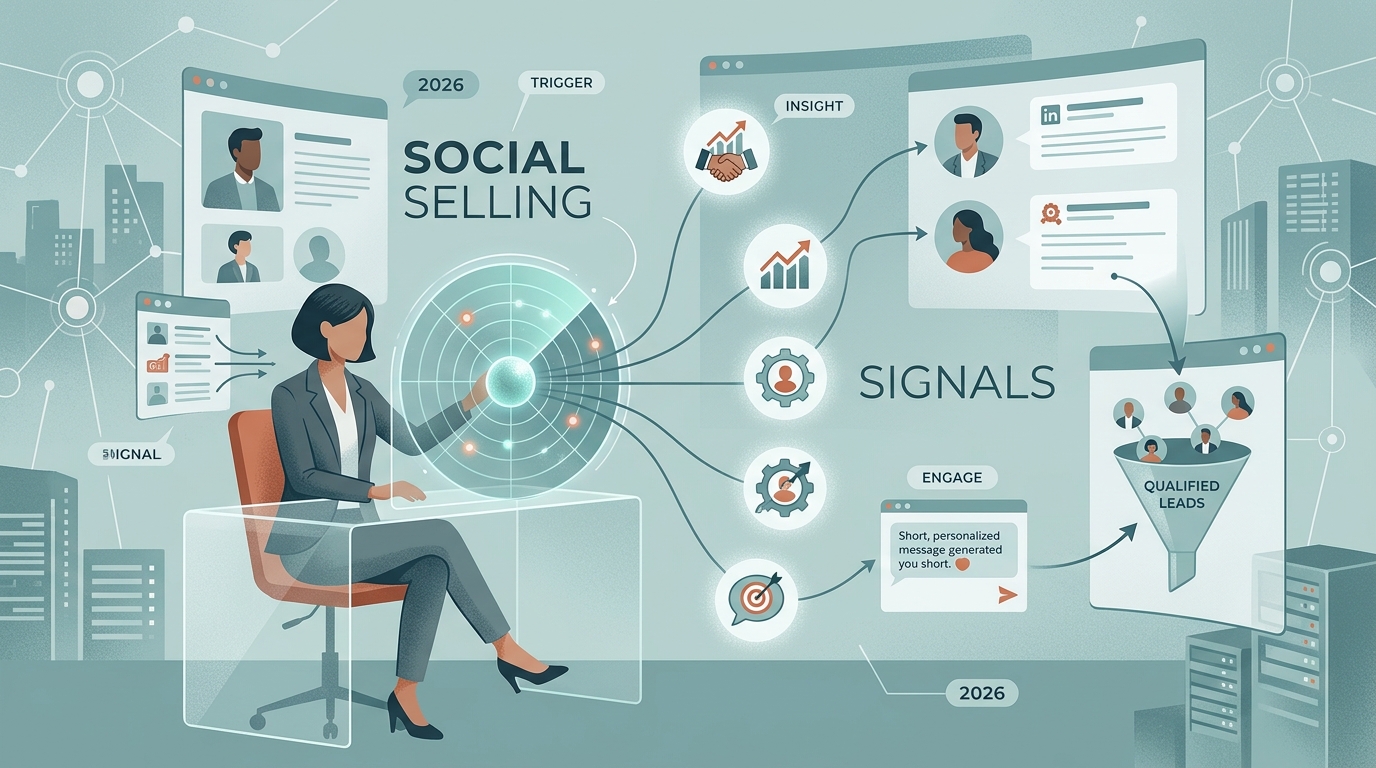
TL;DR: Social selling is the practice of using social platforms—mainly LinkedIn—to research, connect with, and nurture buyers instead of cold-calling them. Most teams still practice it as "post content, comment, and hope," which is why it plateaus. The version that moves pipeline in 2026 pairs that habit with real buyer-intent and social signals: you engage when a specific signal shows someone is in-market, not on a fixed cadence. This guide covers what it is, how to build a social selling strategy in 2026, and how to layer buying signals on top so your outreach converts.
Ask ten sales leaders to define social selling and most will describe the same three habits: build a professional profile, share useful content, and engage with prospects' posts. That is the textbook version, and it is not wrong—but it is incomplete. The missing piece is timing. Reaching out because a quarter has three weeks left is not enough; reaching out because a prospect just changed jobs, a company just raised funding, or a buying committee just started researching your category—that is what actually works, because it is anchored to a real buying signal, not a calendar.
What Is Social Selling?
Social selling is the process of using social networks to find, research, connect with, and build relationships with prospects as a substitute or complement for traditional cold outreach. Instead of a cold call or a blind email, a rep uses a prospect's public activity—posts, comments, job changes, shared connections — to start a relevant conversation and earn attention before ever asking for a meeting.
The term was popularized by LinkedIn as its Sales Navigator product matured, and LinkedIn's own Sales Solutions research has repeatedly found that reps who social sell consistently outperform peers on pipeline generated and quota attainment. The mechanism is simple: buyers now do the majority of their research before ever talking to a vendor—much of it in the private, unattributable channels of dark social—and a visible, credible presence on the same channels they already use to research shortens the distance between "never heard of you" and "willing to take a call."
What it is not. It is not spamming connection requests, not blasting a templated pitch in the first message, and not simply having a LinkedIn account. The Social Selling Index that LinkedIn popularized measures four things—establishing a professional brand, finding the right people, engaging with insights, and building relationships—and none of those four is a synonym for volume. A social seller with a modest network who consistently shows up with relevant, well-timed messages will outperform a rep blasting five hundred connection requests a week.
Where it fits in the funnel. Social selling is primarily a top-of-funnel and mid-funnel discipline. It replaces or supplements cold prospecting, warms up LinkedIn prospecting lists before outreach, and keeps a rep visible to a buying committee across the long, multi-touch B2B sales cycle that Gartner's B2B buying research describes as involving six to ten stakeholders on average. It is rarely, by itself, a closing motion—it is the relationship layer that makes every other motion (cold outreach, demand gen, account-based marketing) convert better.
How Do You Build a Social Selling Strategy in 2026?
You build one in 2026 by creating a credible profile, publishing and engaging with relevant content consistently, identifying the right people with real intent, and reaching out with a message tied to something specific and current about them. The mechanics have not changed much since the discipline was named—what has changed is the volume of noise competing for a buyer's attention, which makes precision and timing far more important than raw activity.
Build a profile buyers trust in seconds. Before anyone reads your message, they check your profile. A professional photo, a headline that describes the outcome you help buyers achieve (not just your job title), and a summary with real social proof (results, testimonials, relevant experience) turn a cold click into a warm impression. This is the "establish your professional brand" pillar of that same LinkedIn framework, and it still matters as much in 2026 as it did a decade ago.
Publish and engage on a real cadence. Share insights relevant to your buyers—not just company announcements—and comment thoughtfully on posts from prospects and industry voices. The goal is to be a recognizable, credible name in your buyers' feed before you ever send a connection request. Research from Forrester and other B2B analyst firms consistently finds that buyers engage more readily with reps who already have a visible, relevant presence rather than reps who appear only when they want something.
Identify the right people, not just any people. A strategy that targets everyone at a target account wastes effort. Map the buying committee — economic buyer, technical evaluator, end user, champion—and prioritize the people whose current activity (a promotion, a new initiative, a relevant post) suggests they are close to a real problem you solve.
Reach out with something specific. The highest-converting outreach messages reference something true and current about the recipient—a post they wrote, a role change, a company event—rather than a generic "I'd love to connect." Specificity is what separates a genuine relationship from a disguised cold blast, and it is the single biggest lever on reply rate.
Nurture before you pitch. A strong strategy treats the first several touches as relationship-building, not pitching. Like and comment thoughtfully, share something genuinely useful, and let the relationship earn the right to a direct ask. Buyers can tell the difference between a rep who wants to help and one who wants a meeting, and the patient approach wins more often over a full sales cycle.
Put together, that is social selling on LinkedIn as most playbooks describe it. It works — but on its own it still has a timing problem: even a perfectly built profile and a thoughtful message land badly if the recipient has zero active interest in your category this quarter. That is the gap the next section closes.
How Do Buying Signals Change Social Selling?
Buying signals change the equation by replacing a fixed outreach cadence with event-triggered outreach—you engage when a specific signal shows real, current intent, instead of engaging on a schedule and hoping the timing happens to line up. This is the single biggest lever available to modern reps, because the same message lands completely differently depending on whether the recipient is actively evaluating a solution or simply scrolling their feed.
A buying signal is any observable behavior or event that indicates a person or company is moving toward a purchase decision. Some signals are explicit—visiting a pricing page, downloading a competitor comparison, or publishing a job posting for a role your product supports. Others are implicit—a leadership change, new funding, a company entering a new market, or a rise in relevant hiring. Both categories fall under what the industry now calls buyer-intent data: structured evidence, pulled from public and behavioral sources, that a specific account or person is actively in-market right now.
Why signals beat cadence. A rep working a fixed sequence—connect, wait three days, comment, wait a week, message—treats every prospect identically regardless of readiness. A signal-based approach instead asks: what changed recently for this person or account that makes today a good day to reach out? A company that just posted five open roles in a function your product serves is a fundamentally better outreach target this week than the same company six months ago with no hiring activity. The underlying research consistently shows that timing relative to a real trigger event, not message polish alone, is what moves reply and meeting-booked rates.
Practical signal categories to watch. A useful signal-based motion tracks several kinds of change:
- Job and role changes. A new VP often re-evaluates existing vendor relationships in their first ninety days—a well-known window for social sellers to reintroduce themselves.
- Company-level events. Funding rounds, executive hires, expansions into new markets, and product launches all correlate with new budget and new initiatives.
- Content and research signals. Someone engaging heavily with content in your category—liking competitor posts, commenting on industry problems —is telling you what is on their mind in public, and learning to track social signals like these turns that scattered activity into a timed outreach list.
- Hiring signals. A surge in job postings for a specific function is one of the most reliable proxies for a company investing in that area—and therefore being open to related tools.
- Technology and intent signals. Visits to review sites, comparison pages, or category research—the kind of behavioral data buyer-intent data platforms aggregate from across the web.
From signal to message. The mechanical shift is small but the impact is large: instead of opening with "I saw we're both connected to Jane," a signal-based opener references the actual trigger—"Congrats on the Series B —curious how the new go-to-market hires are settling in." That single change moves the message from generic outreach to something that reads as genuinely relevant, because it is.
This is also where warm leads come from in a modern pipeline: a warm lead is rarely someone who simply accepted a connection request. It is someone whose recent signal made the outreach land at the right moment, so the first real conversation starts from relevance instead of a cold introduction. Layering signals on top of an outreach strategy is precisely how a rep converts a list of cold connections into a stream of genuinely warm leads.
What Does a Signal-Based Outreach Workflow Look Like?
A signal-based workflow monitors a defined set of trigger events, ranks the resulting accounts and contacts by relevance, and routes the highest-signal people to a rep for a personalized, timely touch—replacing the old model of working a static list in a fixed order. The workflow below is how modern revenue teams operationalize the shift from cadence-based to signal-based selling.
Define the signals that matter for your product. Not every signal is equally predictive for every business. A company selling recruiting software cares more about hiring surges; a company selling finance tools cares more about funding events. Start by mapping two or three signal types that have historically preceded your best-fit customers buying.
Monitor continuously, not on a schedule. Signals lose value quickly —a job change or a funding announcement is most actionable in the days after it happens, not weeks later once every other vendor has already reached out. Manual monitoring (checking LinkedIn feeds, news alerts) does not scale past a handful of accounts, which is why most teams now use software to watch signals continuously across accounts.
Rank, don't just list. Not every signal deserves the same urgency. A workflow that ranks accounts by signal strength and recency lets reps spend their limited outreach time on the handful of people most likely to respond today, instead of working every contact in a territory with equal effort.
Personalize the first message to the specific signal. The message should name the actual trigger—the raise, the hire, the job posting—rather than a vague reference to "your company's growth." Specific beats generic every time, and it is the fastest way to signal that a message is not templated spam.
Engage on the platform before and after the message. Comment on the relevant post, like the announcement, or reference a shared connection before sending a direct message. This sequencing—public engagement, then private outreach —is core relationship-building craft, and pairing it with a real signal makes the sequence far more credible than doing either step in isolation.
Feed outcomes back into targeting. Track which signal types actually convert to meetings and revenue for your specific product, then weight future targeting toward those signals. A signal-based program compounds over time as the team learns which triggers are true predictors versus noise.
What Tools Do You Need for Signal Detection and Outreach?
You need three layers of tooling to run a modern outreach motion: a platform presence (LinkedIn, primarily, plus company channels), a way to detect and rank buying signals across accounts, and a CRM or sequencing tool to route and track outreach. Most teams already have the first and third; the signal layer is the piece that is newest and least standardized —and it is also the piece that determines whether that activity turns into pipeline.
Platform layer. LinkedIn (and Sales Navigator specifically) remains the primary channel for B2B social selling because it is where professional identity, company affiliation, and public activity all live in one place. Twitter/X and industry-specific communities matter for some categories, but LinkedIn is where the majority of LinkedIn prospecting and relationship-building work still happens.
Signal layer. This is where buying-signal detection tools and buyer-intent data platforms sit. Rather than manually scanning news and LinkedIn for job changes or funding events, these tools aggregate the signals automatically and surface which accounts and people are showing real, current intent, so reps stop guessing and start prioritizing.
Routing and execution layer. A CRM or sales engagement platform still matters for tracking outreach, sequencing follow-ups, and reporting on what converts. The signal layer feeds this layer—the highest-signal accounts should route to reps fastest, ideally with the specific trigger event attached so the first message can reference it directly.
Where AI changes the equation. Historically, building the signal layer meant stitching together a news-alert tool, a job-posting tracker, and a funding database —three subscriptions and a lot of manual cross-referencing. An AI-driven approach collapses that into one workflow: describe the account or persona you care about in plain English, and an agent searches live sources, identifies who is showing genuine intent, and returns a ranked, contactable list. That is a meaningfully different starting point for a prospecting program than a rep manually scrolling LinkedIn hoping to spot a relevant post.
How Do You Measure Whether Social Selling Is Working?
You measure whether it is working by tracking connection acceptance rate, reply rate, meetings booked from social touches, and—most importantly—pipeline and revenue sourced or influenced by that activity, not just engagement metrics like likes and profile views. Vanity metrics are easy to game and rarely correlate with revenue, which is why serious programs anchor to funnel outcomes.
Leading indicators. Connection acceptance rate and reply rate tell you whether your profile, targeting, and message quality are working before deals close. A signal-based approach should visibly lift both, because messages tied to a real trigger are inherently more relevant than generic outreach.
Lagging indicators. Meetings booked, opportunities created, and closed revenue attributable to social touches are the metrics that actually justify the time invested. Track these by tagging opportunities with their originating channel so this work gets credit alongside outbound calling and inbound demand gen.
Benchmarking against the market. Research from HubSpot's State of Sales research and Salesforce's State of Sales report both consistently find that top-performing reps spend meaningfully more time on social and relationship-building activity than average performers, and that buyers increasingly expect vendors to already understand their context before the first call. Use those external benchmarks as a sanity check, but weight your own funnel data more heavily—what converts varies by industry and deal size.
How Lessie Approaches Signal-Based Social Selling
Lessie is a People Search AI Agent built around exactly the gap this guide describes: outreach works better when it is triggered by real signals instead of a fixed cadence. Describe the buyer or account profile you care about in plain English—for example, "VPs of Sales at Series B SaaS companies that posted three or more sales-hiring roles in the last month"—and Lessie searches 100+ live sources, identifies the people and accounts actually showing that signal, and returns verified contacts at 95%+ accuracy.
Instead of a rep manually cross-referencing LinkedIn activity, job boards, and funding news —the old way of trying to spot buying signals by hand—Lessie surfaces the signal and the reachable person in the same step. That closes the loop between buying signals and outreach: the rep opens their day with a ranked list of accounts worth a message today, each one attached to the specific trigger that made it worth prioritizing, ready for LinkedIn prospecting or direct outreach.
The result is a signal-driven motion that produces warm leads by construction rather than by luck: every touch is grounded in buyer-intent data rather than a hopeful guess about who might be paying attention this week. For teams that have already built the platform habits of good social selling—a strong profile, consistent content, thoughtful engagement—adding a live signal layer is the single highest-leverage upgrade available in 2026.