




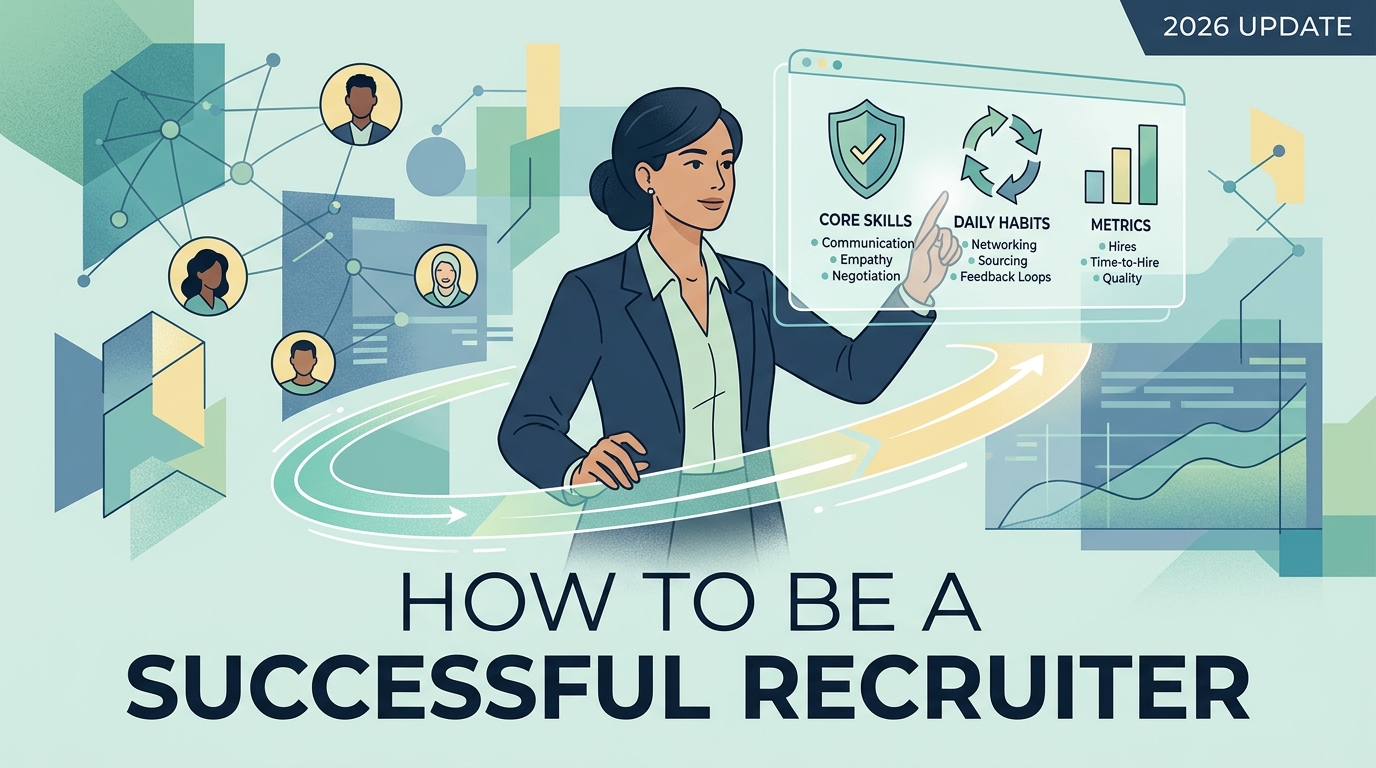
How to be a successful recruiter in one sentence: stop thinking like an order-taker and start operating like a talent advisor. That means seven core skills—deep sourcing, candidate experience, data-driven pipeline management, employer branding, negotiation, relationship building, and command of your AI stack—backed by daily habits and three metrics: time-to-fill, response rate, and quality of hire. This guide breaks down each one with benchmarks you can act on this week.
Ask a hiring manager to describe the difference between an average recruiter and a great one, and you will hear the same story. The average recruiter fills the open req, sends a few resumes, and disappears until the next opening. Anyone researching how to be a successful recruiter should start with the opposite picture: the great recruiter knows the market before the req opens, has warm candidates ready, and keeps relationships alive between searches.
The gap is not talent or luck—it is a system. Speed-to-fill wins this quarter; long-term talent relationships win every quarter after. With U.S. job openings and turnover data showing millions of separations every month, the recruiters who compound relationships outperform the ones who restart from zero on every search.
This guide lays out that system in four parts: the seven core skills every great recruiter trains, the daily habits that keep a pipeline healthy, the three metrics that prove you are improving, and the AI tools that buy back the hours the human work requires. Whether you are six months in or six years in, the gaps it exposes are fixable this quarter.
The 7 Core Skills of a Successful Recruiter
A successful recruiter combines seven skills: sourcing beyond the obvious channels, designing a strong candidate experience, running the pipeline on data, selling the employer brand, negotiating offers that close, building long-term relationships, and mastering the recruiting tech stack. Most recruiters are strong in two or three. The top 10% deliberately train all seven.
1. Deep sourcing beyond LinkedIn
Every recruiter searches LinkedIn, which is exactly why response rates there keep falling. Strong sourcers also work GitHub, niche communities, conference speaker lists, alumni networks, and competitor org charts—places where candidates are not buried under 50 InMails a week. They also map the market before they message it: which companies employ this skill set, who is senior there, and what would make those people move. Build a repeatable process for each channel; our guide to sourcing strategies in recruitment covers the major ones with scripts you can reuse.
2. Candidate experience design
Candidates judge your company by how you recruit. Slow feedback, vague job descriptions, and ghosting after interviews quietly poison your funnel—rejected candidates talk, and referrals dry up. A good recruiter sets expectations at the first call, gives a decision date, and delivers every rejection personally. It costs minutes and compounds for years. The simplest audit: would you be happy going through your own process as a candidate? If the honest answer is no, fix that before buying any tool.
3. Data-driven pipeline management
Gut feel does not scale. Track conversion at every stage—sourced to replied, replied to screened, screened to onsite, onsite to offer, offer to accepted. When you know that one hire takes roughly 100 sourced profiles, you stop panicking mid-search and start diagnosing the exact stage that leaks. The metrics section below gives you benchmarks.
4. Employer branding
You cannot out-message a bad reputation, but you can package a true story well. Successful recruiters collect proof—engineering blog posts, growth numbers, team wins, manager profiles—and weave it into every touchpoint. LinkedIn's talent strategy research consistently finds that candidates research companies before replying; give them something worth finding.
5. Negotiation and closing
Offers fall apart when compensation surprises show up late. Discuss salary expectations in the first screen, pre-close before the offer ("If we came in at X, would you accept?"), and treat counteroffers as predictable, not personal. Ask early what would make a candidate stay where they are—then you know exactly what your offer has to beat. The close starts in the first conversation, not the last one.
6. Relationship building
The silver-medal candidate you treated well becomes next year's hire—or your next hiring manager. Keep a living talent pool, check in quarterly without an ask, and share useful market intel. The math is simple: a warm candidate who already trusts you converts in one conversation, while a cold one takes five touches and still might ghost. Recruiting flips from cold outreach to warm reactivation, and your time-to-fill drops with every cycle.
7. Command of the tech and AI stack
AI will not replace recruiters, but recruiters who use AI are replacing those who do not. Sourcing agents, resume screeners, and outreach personalization reclaim the hours that relationship building requires. Start with our comparison of the best AI recruiting tools to see which category fits your bottleneck.
Sourcing is the skill where tooling moves the needle fastest. Lessie AI turns a plain-English brief into a scored candidate list from 100+ live sources—with 95% accurate, verified emails attached. Free to start.
Daily Habits of Top Recruiters
Top recruiters run a daily rhythm instead of reacting to whichever req is on fire. The pattern across high performers is consistent: protected sourcing time, fast candidate follow-ups, deliberate pipeline reviews, and small daily investments in relationships and market knowledge. Here is the checklist worth copying.
- Block 60-90 minutes for sourcing, every day. Pipeline droughts are caused by the weeks you skipped sourcing, not the week you noticed.
- Reply to every active candidate within 24 hours. Speed signals respect, and the best candidates are off the market in days, not weeks.
- Run a 15-minute pipeline review. One pass over every open role: who is stuck, which stage leaks, what needs a nudge today.
- Send 3-5 personalized outreach messages. Small daily batches with real personalization beat 50 templated blasts. Steal openers from these LinkedIn InMail templates and adapt them to your voice.
- Touch one dormant relationship. A past candidate, a silver medalist, an old hiring manager—one warm message a day keeps the talent pool alive.
- Read 10 minutes of market news. Layoffs, funding rounds, and salary shifts are sourcing triggers. Recruiters who know the market sound like advisors on every call.
- Log everything in your ATS before logging off. Notes you skip today are the context you will not have in the offer negotiation next month.
None of these habits is impressive on its own—that is the point. A recruiter who sources for an hour daily out-pipelines one who binges eight hours when a req goes red. A recruiter who sends five sharp messages daily out-converts the Friday batch of fifty. Consistency is the unfair advantage precisely because most recruiters cannot sustain it past week two.
Recruiter Metrics That Matter
Three metrics tell you whether you are becoming a more successful recruiter: time-to-fill (speed), response rate (sourcing quality), and quality of hire (outcome). Everything else—submittals, calls logged, InMails sent—is activity, not impact. Track these three monthly and let them direct what you fix first.
| Metric | What it measures | Working benchmark |
|---|---|---|
| Time-to-fill | Days from req opening to accepted offer | ~44 days average; top teams run 25-30 |
| Response rate | % of sourced candidates who reply to outreach | 20-30% healthy; under 15% means weak targeting or messaging |
| Quality of hire | Performance + retention of hires at 90 days and 1 year | 90-day retention above 90%; hiring-manager satisfaction trending up |
Time-to-fill benchmarks hover around 44 days according to SHRM's talent acquisition research, but the number matters less than the trend. Break it into stage durations and you will usually find the delay sitting in interview scheduling or offer approval—not in sourcing.
Response rate is the most honest mirror of your sourcing skill. It improves with tighter targeting, personalized first lines, and channels beyond LinkedIn—verified email often doubles the reply rate of InMail for the same list, simply because the message actually lands in front of the person. If you only fix one metric this quarter, fix this one—every downstream number inherits it.
Quality of hire is harder to measure but separates recruiters from resume-forwarders. A simple version works: 90-day retention plus a one-question hiring-manager survey. When quality is visible, you earn the credibility to push back on bad req specs—which is what being a talent advisor actually means.
One framing tip: response rate is a leading indicator you can move this week, while time-to-fill and quality of hire are lagging indicators that confirm the system works. Build a simple weekly scorecard with all three. When a lagging number slips, the leading one usually predicted it a month earlier—that early warning is the entire value of measuring.
Better inputs move every metric. Lessie finds candidates your competitors' Boolean strings miss and attaches verified contact details, so response rates climb and time-to-fill drops without adding headcount.
Level Up With AI Recruiting Tools
The fastest way to free time for the human skills above is to automate the mechanical ones. AI now handles the three most repetitive recruiting tasks—finding people, screening resumes, and drafting outreach—well enough that doing them fully manually is a competitive disadvantage. The recruiters winning in 2026 redirect those hours into relationships and closing.
Lessie AI is a People Search AI Agent built for exactly this division of labor. Instead of stacking Boolean filters, you describe the candidate in plain English—"senior backend engineers in Berlin with Go experience, open to fintech"—and the agent searches 100+ live sources, scores every match, and returns verified emails with 95% accuracy.
- Source in minutes, not afternoons—one natural-language brief replaces hours of manual LinkedIn and Google search across every channel at once.
- Screen before you read—pair it with the free AI resume screener to rank applicants against the job description before your first manual pass.
- Reach out with context—AI-personalized messages drive up to 3x higher reply rates than templates, feeding the response-rate metric directly.
None of this replaces judgment, empathy, or the close. It buys back the time those skills need—which is the whole playbook for how to be a successful recruiter: automate the searching, humanize the relationship.