




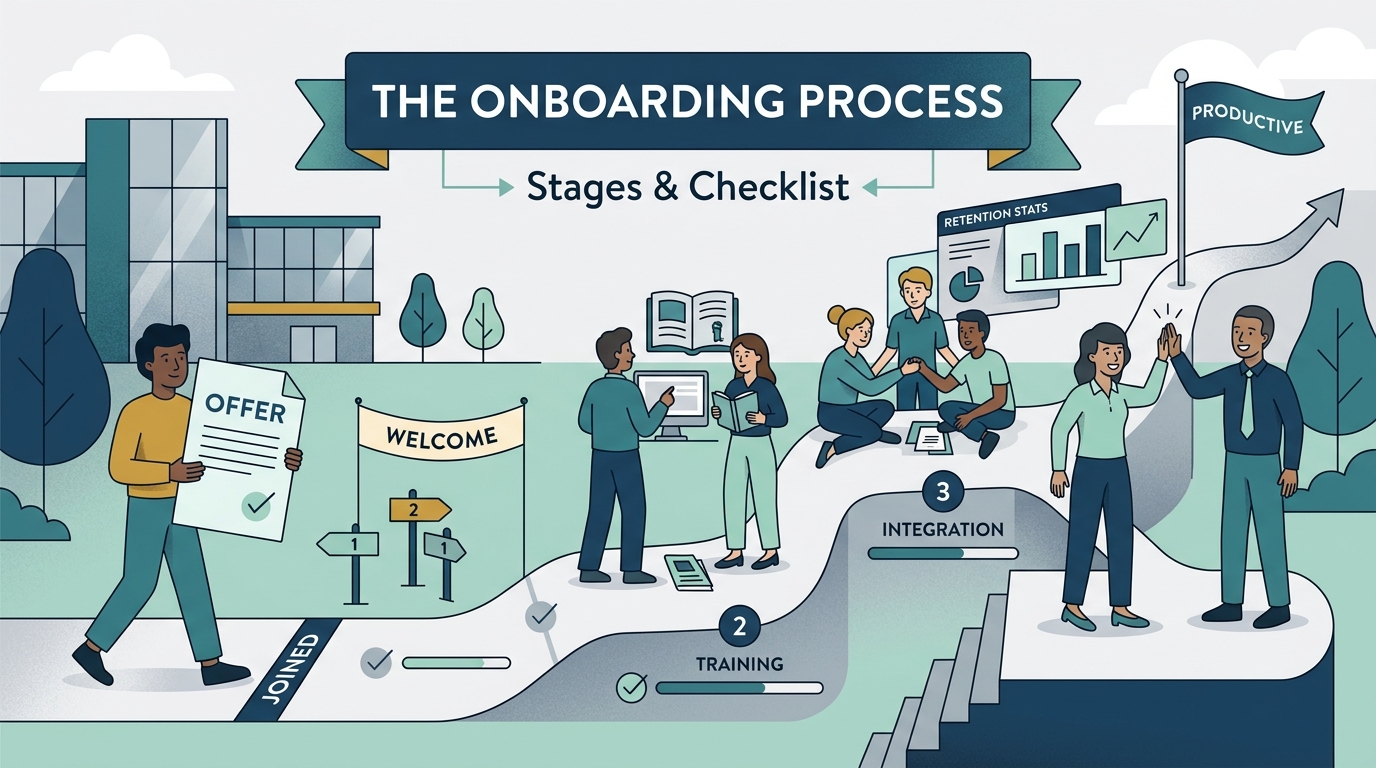
An onboarding process is the structured program a company uses to turn a new hire into a confident, productive team member—covering paperwork, equipment, training, relationships, and goals from offer acceptance through the first 90 days. Done well, it improves new-hire retention by 82%. Yet only 12% of employees say their employer does it well.
An onboarding process is the series of steps a company follows to integrate a new employee into their role, team, and culture. It starts the moment an offer is accepted and typically runs through the first 90 days—covering paperwork, equipment, training, introductions, and early performance goals.
Onboarding is the bridge between hiring and performance. A strong recruitment process gets the right person to sign the offer. The onboarding process determines whether that person ramps up quickly, feels connected, and stays past year one. This guide breaks down the five stages, gives you a checklist you can copy, and explains why it matters with real retention data.
The 5 Stages of an Onboarding Process
A complete employee onboarding process has five stages: preboarding, first day, first week, first 90 days, and ongoing integration. Each stage has a different goal, moving the new hire from "signed an offer" to "fully contributing team member."
- 1Preboarding (offer acceptance to day one)
Handle everything administrative before the start date: signed contract, tax forms, payroll and benefits enrollment, equipment orders, and account provisioning. Send a welcome email with the first-day schedule. The goal is simple—zero paperwork on day one, so the first day is about people, not forms.
- 2First day
Run orientation, hand over a working laptop with all logins ready, introduce the team, and assign an onboarding buddy. The manager walks through role expectations and the 30-60-90 day plan. New hires decide fast whether a company is organized—a broken laptop or missing desk says more than any welcome speech.
- 3First week
Shift from logistics to the role itself: product and tools training, meetings with key stakeholders, and a small starter task the new hire can actually ship. Completing real work in week one builds confidence faster than any slide deck. The manager sets a recurring 1:1 cadence.
- 4First 90 days
Work the 30-60-90 day plan: learn and observe in the first 30 days, contribute with guidance through day 60, own outcomes independently by day 90. Hold structured check-ins at each milestone and close the stage with a formal day-90 review against the written goals.
- 5Ongoing integration
Onboarding does not end at day 90. Best-in-class programs extend to 6–12 months with continued development, a visible career path, engagement surveys, and 6- and 12-month reviews. This is where early momentum turns into long-term retention.
Scale each stage to the role. A junior hire may need more structured training in weeks one and two; a senior leader needs more stakeholder introductions and context, with ownership expected earlier. The five stages stay the same—what changes is how much time you spend in each and who gets involved.
The best onboarding process can't fix a bad hire. Lessie AI searches 100+ live sources to surface candidates who match your role, skills, and culture—with verified contact details, in minutes instead of weeks.
Employee Onboarding Checklist You Can Copy
A practical onboarding checklist covers four areas: paperwork, equipment, people, and goals. Use the list below as a starting template—assign each item an owner and a deadline relative to the start date.
- Paperwork & admin — signed offer letter (draft one in minutes with a free offer letter generator), employment contract, tax and identity forms, payroll setup, benefits enrollment, and policy acknowledgments.
- Equipment & access — laptop ordered and configured, email and chat accounts created, software licenses assigned, security and SSO access granted, badge or office access arranged before day one.
- People & culture — onboarding buddy assigned, manager 1:1s scheduled, intro meetings booked with key stakeholders, new hire added to team channels and recurring meetings, welcome announcement sent.
- Goals & feedback — written 30-60-90 day goals shared in week one, a small starter task assigned, check-ins booked at days 30, 60, and 90, and a formal review at the end of the first quarter.
Keep the checklist in a shared doc or HRIS workflow so HR, IT, and the hiring manager see the same status. Most onboarding failures are coordination failures—three teams each assuming someone else ordered the laptop.
Onboarding vs Orientation: What's the Difference?
Orientation is a one-time event; onboarding is an extended process. Orientation typically fills the first day or two with company overview, policies, and paperwork. The onboarding process wraps around it and continues for 90 days or more, covering training, relationships, and performance goals.
| Dimension | Orientation | Onboarding |
|---|---|---|
| Format | One-time event, often a group session | Ongoing process tailored to the role |
| Duration | A day or two | 90 days to 12 months |
| Content | Company overview, policies, paperwork | Role training, relationships, 30-60-90 goals |
| Owner | HR | HR + hiring manager + buddy |
| Goal | Inform and comply | Retain and make productive |
In short: orientation is one item on the onboarding checklist. Companies that treat a two-day orientation as their entire onboarding process for new employees are usually the ones losing hires in the first six months.
Why the Onboarding Process Matters
Onboarding directly drives retention and productivity. Research summarized by Harvard Business Review found that organizations with a strong onboarding process improve new-hire retention by 82% and productivity by over 70%.
The gap between knowing and doing is enormous. Gallup reports that only 12% of employees strongly agree their organization does a great job of onboarding—while employees who had an exceptional onboarding experience are 2.6x more likely to be extremely satisfied with their workplace.
The stakes are even higher for distributed teams. A remote hire cannot absorb culture from the room, shadow a colleague at the next desk, or grab a manager in the hallway. Without a deliberate program—shipped equipment, scheduled video introductions, written documentation, async-friendly check-ins—remote employees can drift for weeks before anyone notices they are stuck.
The cost of getting it wrong is concrete. Replacing an employee runs one-half to two times their annual salary once you count recruiting, lost productivity, and training. For structured guidance on building a program, SHRM's onboarding toolkit is a solid reference. The math is simple: a few organized weeks up front protect a five-figure hiring investment.
Hire Right Before You Onboard
The best onboarding program starts before day one—with hiring the right person. No buddy program or 30-60-90 plan can compensate for a candidate whose skills or expectations never matched the role. Retention problems blamed on onboarding often trace back to sourcing.
That is where Lessie AI fits. Describe who you need in plain English, and its People Search AI Agent scans 100+ live sources to surface matching candidates with verified contact details and 95% accuracy—cutting manual sourcing time by 80%. Hiring distributed teams? See our guide on how to hire remote employees, where preboarding and async-friendly onboarding matter twice as much.
Get the hire right, then run the five stages above. That combination—precise sourcing plus structured onboarding—is what separates teams that retain talent from teams that recycle it.